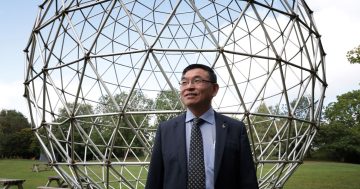
UOW researcher Professor Lezanne Ooi discusses the automated imaging platform being used for Parkinson’s research. Photo: UOW.
A $1.5 million philanthropic donation is removing a major barrier for University of Wollongong researchers working to unlock better ways to diagnose, treat and potentially find a cure for Parkinson’s disease.
Parkinson’s Research Foundation (PRF) has funded a world-class automated imaging platform at UOW’s Molecular Horizons institute, allowing researchers to analyse huge volumes of cell samples faster and dramatically scale up four promising projects already underway.
An Opera Phenix automated cellular imaging system and a JANUS Automated Workstation prepare and load assays for rapid, automated imaging and analysis, enabling UOW researchers to quickly analyse complex biological processes underpinning the disease.
NSW Health Minister and Member for Keira Ryan Park said the scale of Parkinson’s disease in NSW highlighted the urgency of continued investment in research.
“Parkinson’s has a profound impact not only on around 70,000 people living with the condition in NSW, but also on their families, carers and communities,” Mr Park said.
“This world-class technology will allow researchers here at the University of Wollongong to work faster and at a much greater scale, helping to turn scientific discovery into better diagnosis, treatment and, ultimately, hope for a cure.”
The donation was first proposed by former PRF board member Philip Coleman, who is living with Parkinson’s disease and saw it as a way to remove a significant financial barrier to fast-track the university’s research.
Established in 2024 by Michael Katz AM and Dr Richard Balanson, PRF focuses on targeted philanthropic investments that remove bottlenecks in high-potential research, with more than $4.5 million having already been contributed to support four Parkinson’s projects across Australia.
PRF co-founder Michael Katz said UOW’s research strength made it a compelling partner.

A look at the Opera Phenix automated cellular imaging system. Photo: UOW.
“With Parkinson’s being the fastest-growing neurological condition globally, we cannot afford slow science,” Mr Katz said.
“Through this innovative agreement, we are stepping in where traditional funding cannot and removing a financial barrier to this world-class research tool.
“This will ensure discovery isn’t held back by economics.
“Our partnership with UOW will strengthen Australia’s role in the global fight against the disease by accelerating research, treatment and education to slow and stop Parkinson’s.”
UOW vice-chancellor and president Professor Max Lu AO said the UOW investment would substantially strengthen the university’s capacity to deliver impactful health research.
“This gift from the Parkinson’s Research Foundation is an extraordinary investment in our research,” Professor Lu said.
“It also reflects strong confidence in our researchers and the work underway at UOW.
“We are grateful for that confidence and conscious of the responsibility that comes with it.”
UOW researcher Professor Lezanne Ooi said her team had four promising research projects underway and the platform would significantly expand the scale and speed of her team’s work.
“The Opera Phenix enables rapid analysis of large volumes of cell samples, allowing us to interrogate genetic, environmental and cellular pathways with far greater efficiency,” Professor Ooi said.
“This will directly accelerate our work towards improved diagnostics and therapies.”
Parkinson’s disease is Australia’s second most common neurodegenerative disease after dementia, affecting more than 200,000 people nationally and about 10 million globally.
The new imaging platform is expected to support multiple research projects at Molecular Horizons, a specialist research institute that studies disease mechanisms and translates molecular understanding into real-world health applications.
It will strengthen UOW’s contribution to global efforts to slow, treat and ultimately cure Parkinson’s disease.