
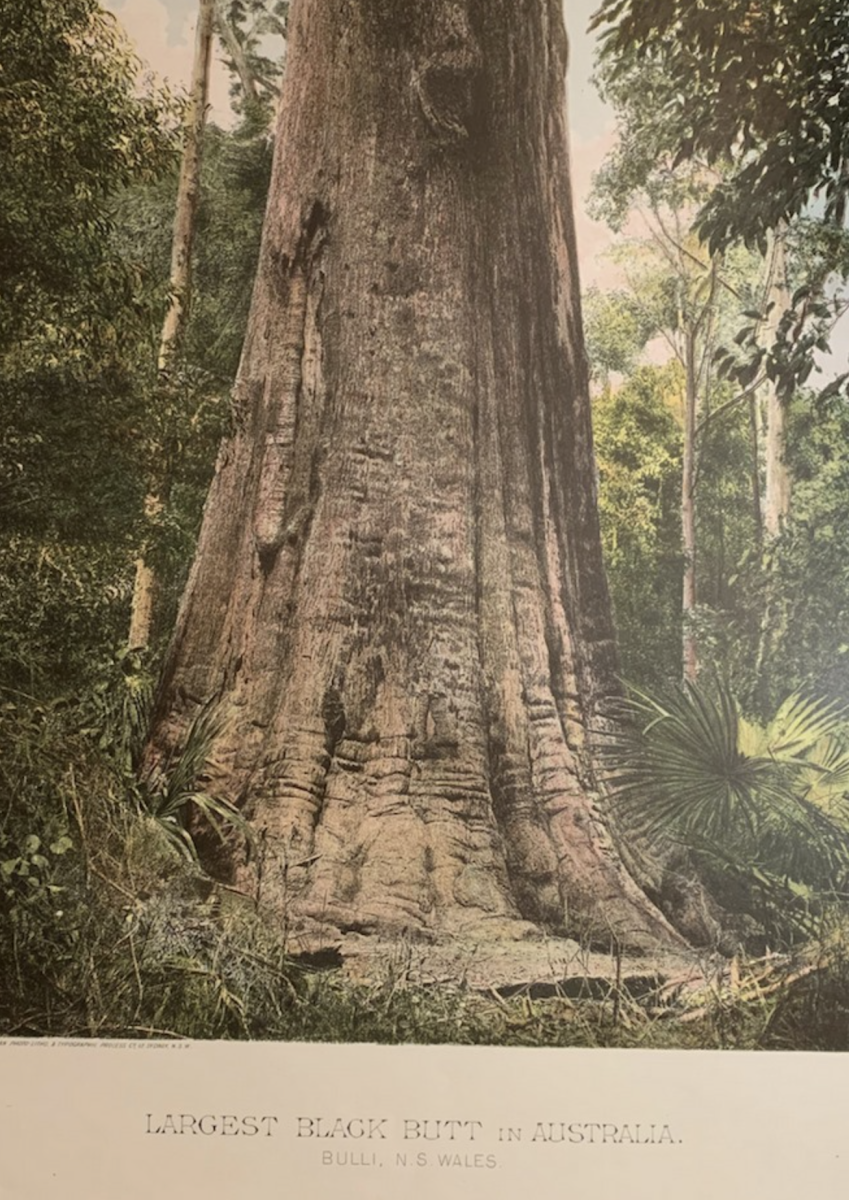
The largest blackbutt in Australia – Bulli, NSW. Photo: Supplied.
The forest giant is a magnificent specimen of Eucalyptus pilularis, which Illawarra residents with a vague interest in trees would probably know more as a Blackbutt.
The “Big Tree” was located amid the remnants of an ancient indigenous escarpment forest that straddled the dividing line between the counties of Camden and Cumberland on what is today known as Bulli Pass.
Trees meant a lot in early Illawarra. Indeed, the major economic benefit the whites first saw in our region was its cedar trees.
Figtree’s once-famous giant Figtree — although thought of as providing little economic potential to the region — nonetheless excited curiosity by its size.
There may well have been larger examples higher up on the escarpment, but Figtree’s fig proved the most highly visible specimen. And, indeed, what is possibly the earliest known photograph of Illawarra depicts that very tree.
Further to the north, there was another giant tree visible to many after Bulli Pass became the major point of entry down the escarpment after 1860. It stood beside Bulli Pass and lots of photos survive.
There had been earlier big specimens near this location. Indeed, when Governor Macquarie visited the area in 1822 he wrote that Illawarra contained the finest and largest trees he had yet seen in the colony — and by then he’d been here some 12 years.
Better still, the earliest dateable surviving image of the Illawarra, painted by Augustus Earle, is The hollow tree on the Illawarra Mountains, executed in 1827. John Dunmore Lang later wrote of the tree that it was so large that it would make an ideal shelter for two travellers and their horses for the night.
But it was another big tree that became one of the region’s early landmarks. It could be found on the property of John McKinnon, a Bulli Pass landholder.
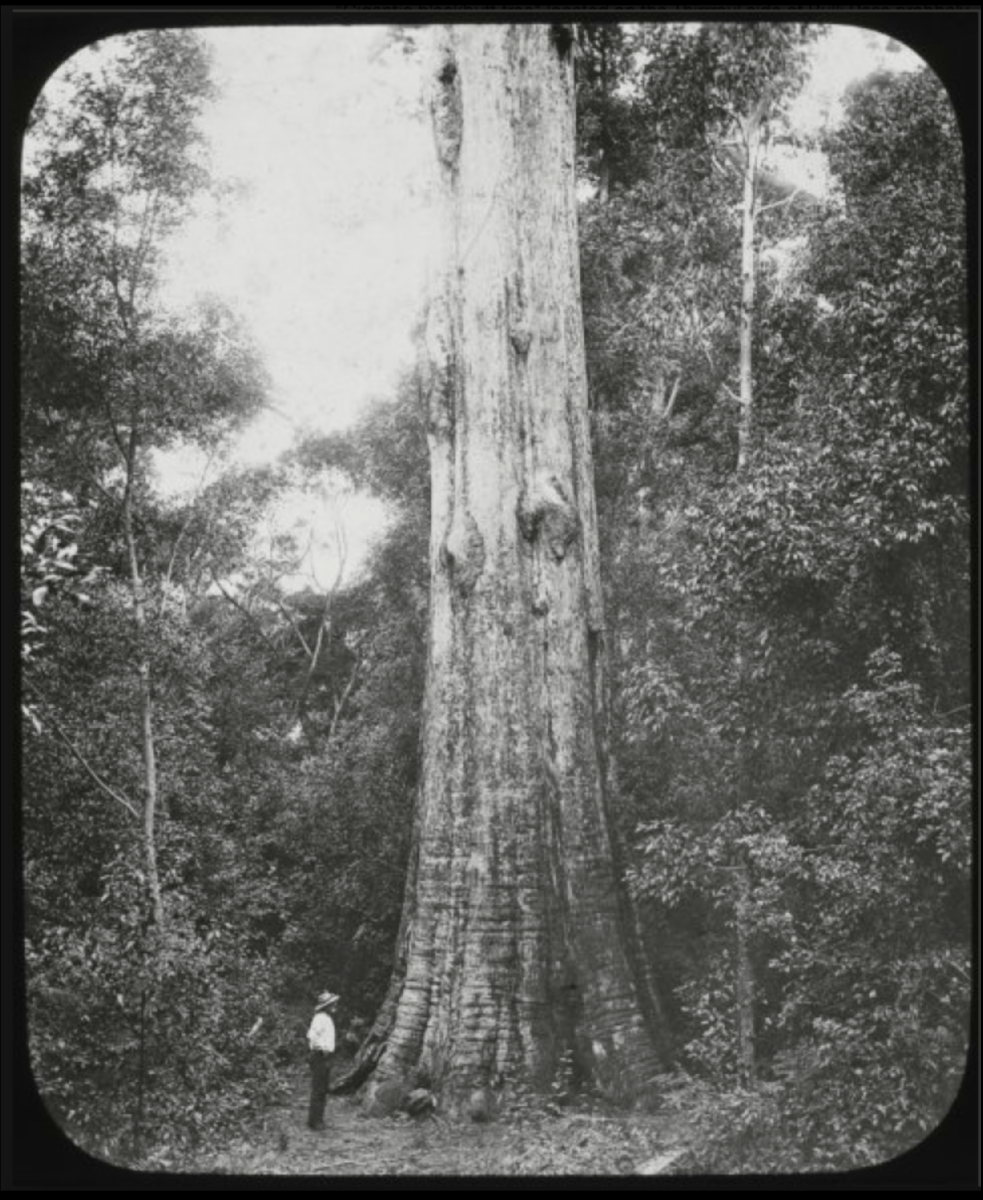
Thirroul’s big tree – a fabulous Fred Hardie lantern slide of a “gigantic blackbutt tree” located on Bulli Pass probably taken about 1891. Photo: Supplied.
This “Big Tree”, also known as “Government House,” became a tourist attraction for many years at holiday time.
“Mr John McKinnon, an old resident of the district, died to-day aged 73 years. The Big Tree, one of the Bulli Pass sights, was in his property. The deceased was well known among tourists,” The Sydney Morning Herald wrote on Monday 4 January, 1904.
Even when the land was later subdivided for a development that did not proceed, the real estate agents felt the Big Tree was a selling point and thus included its location on their map. Postcard manufacturers also thought the immense size of the tree would help boost their profits.
It is always difficult to estimate the height of very large trees without chopping them down. Several attempts were made during the tree’s lifetime.
In 1891 even Joseph Henry Maiden (1859–1925), one of Australia’s botanical superstars, had a go. Yet how precise these figures are is hard to gauge. Maiden, however, did note that “the tree is on the land of a resident which charges a small fee for seeing it”.
But this little earner lasted only slightly more than the first decade of the 20th century.
“A celebrated giant of the forest has been destroyed by fire, it is believed wilfully, by some evil-doing hand: The big Blackbutt on the McKinnon property (on Bulli Pass),” the South Coast Times reported on 23 June 1911. “The tree fell on Sunday. Mr. W. B. Green, who examined the place, found evidence of two fires having been lit under the tree; there had been no bush fire.”
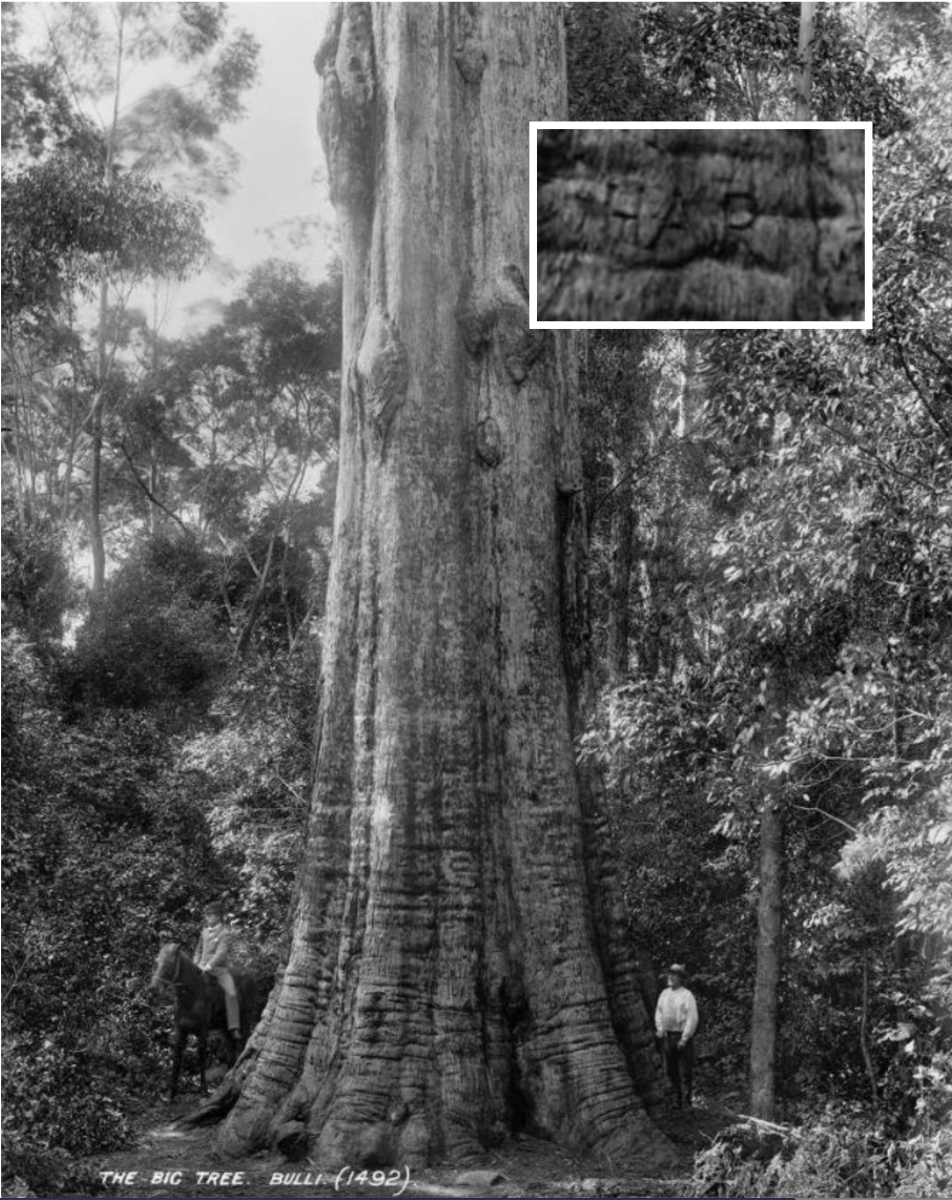
Kerry & Co photographic postcard of the Big Tree with (inset) the initials The initials “H.A.P.” carved into the trunk. Photo: Supplied.
Nonetheless, when I enlarged the Kerry & Co postcard of the giant blackbutt, I made a remarkable discovery: the initials “H.A.P.” had been etched into its bark.
The only local I knew of with those initials resident in the 1890s was Henry Arthur Pringle. I looked through his photograph album, now held by the University of Wollongong and discovered that the horse rider in the Kerry & Co postcard could be seen wearing the same coat Pringle wore in other photographs found within the album.
As “H.A.P.” was how Henry Arthur Pringle is often identified in his fabulous album of photographs and that gentleman only lived in Illawarra for a short period, it’s pretty likely he etched those initials into the giant tree sometime between 1888 and 1894.
So clearly, graffiti rules, OK?