
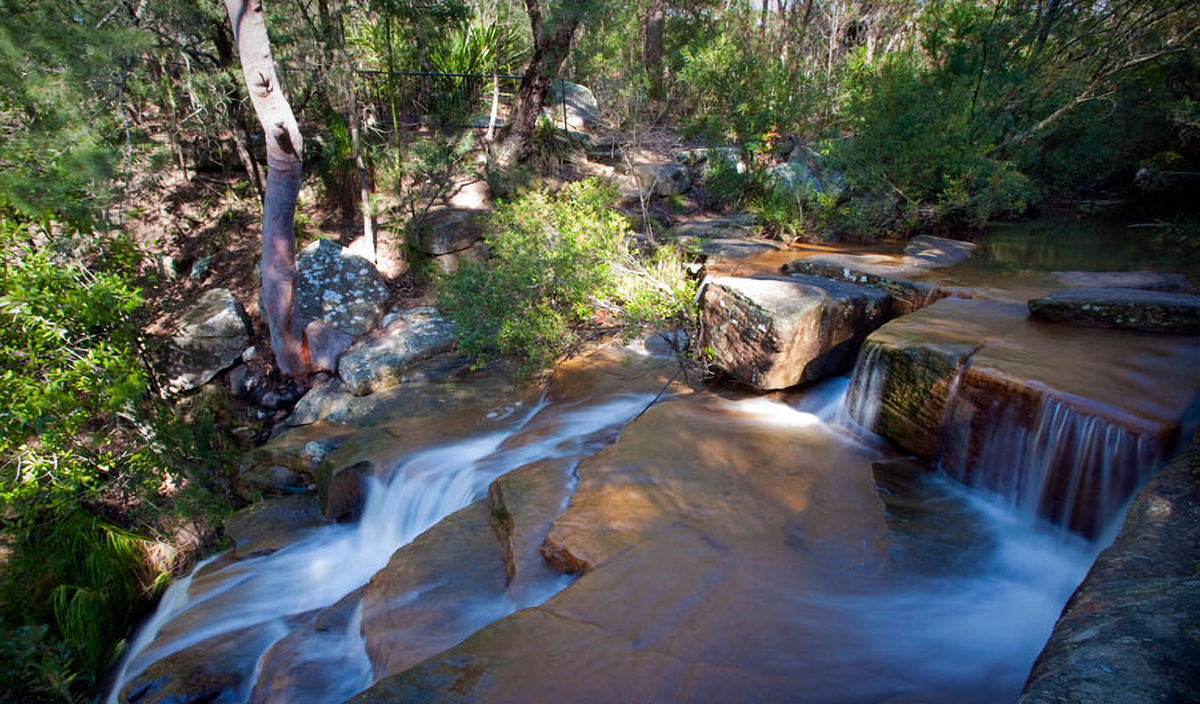
The beautiful Hacking River in the Royal National Park. Its beauty certainly doesn’t reflect its namesake. Photo: Nick Cubbin.
The Hacking River begins in the plateau above the Illawarra escarpment. Its source is formed by the joining of Kellys Creek and Gills Creek, which both feature waterfalls near Stanwell Tops and Helensburgh. The watercourse then flows through the Royal National Park before reaching its estuary at Port Hacking.
Henry Hacking actually got very close to being the first recorded white bloke to get near the Illawarra. Sadly, he was likely totally way bad.
Addicted to alcohol, Hacking was also apparently good with guns – not a good combination.
My first fleet ancestor Peter Hibbs had the bad luck of being a seaman on board the Sirius – the first fleet vessel on which Henry Hacking served as quartermaster.
Both Hibbs and Hacking were stuck for a time on Norfolk Island after the wreck of the Sirius in 1790, but Hacking somehow scampered back to England while Hibbs married a sweet young thing named Mary Pardeaux who had arrived on the second fleet vessel infamously known as The Floating Brothel.
The two men also went on to have a connection with Tasmania for, in 1798, Governor John Hunter appointed Hibbs master of the Norfolk in which Bass and Flinders circumnavigated Tasmania. Flinders even named Tassie’s god-forsaken west coast Hibbs Pyramid after him.
Hacking and Hibbs thus had a hell of a lot of sea-faring experience (having twice circumnavigated the globe in the Sirius) but, while apparently not a crook, Hibbs may have been a bit of no-hoper and, for a time, lived in cave on the Hawkesbury River.
Hacking, however, kept getting into heaps of trouble – but also had an amazing run of luck.
In 1800 and 1801 Hacking piloted the Porpoise into and out of Port Jackson and the following year was appointed first mate of the Lady Nelson, which accompanied Flinders’ Investigator on its journey up the Queensland coast.
In 1803 Hacking was appointed first pilot at Port Jackson. But in November 1803 he and Robert Colpits were found guilty of stealing naval stores from the Investigator and sentenced to death.
Both were reprieved – Hacking on condition he be transported for seven years to Van Diemen’s Land, even though it was just six months since he had also been pardoned after being condemned to death for shooting and wounding his mistress Ann Holmes.
Dopey Governor King, however, claimed Hacking was “still a good man” and writing to Lt Governor Collins in November 1803 reckoned he was “inclined to believe the last Crime was Committed to Obtain Spirits”.
Later, when Hacking was at Hobart serving as Collins’ pilot, King wrote: “I am glad you have kept Hacking, he is a good man but was lost here by the Arts of a Woman.”
In early Van Diemen’s Land, however, drinking and womanising excessively was apparently quite okay and Lt Governor “Mad Tom” Davey was said to often be so inebriated he would, remarkably, stand in the street and pull faces at passers-by.
On 1 June 1804 Hacking was appointed personal coxswain to Collins and in the same year explored the Huon River. In July 1806 he was appointed Hobart’s pilot at £50 a year and had charge of all the government boats and crews.
Hacking then appears to have spent the rest of his life at Hobart except for a short visit to Sydney in 1806. But by 1816 even Governor Davey described Hacking as “useless as a Pilot from Drunkenness and other infirmities”.
Nonetheless Hacking was still granted a pension at half his salary and then, in August 1816, became pound keeper at Hobart by having a pound erected beside his dwelling. In January 1819, then being described as a “Superannuated Harbour Master”, Hacking also received an allowance of £6 and 5 shillings.
In March 1825 Hacking resigned as keeper of the pound, but he still had nearly six years to live.
He died at Hobart on 21 July 1831, aged 81. And yet even four years after his death his pension of £25 per annum was still being paid to someone – presumably his latest woman?
One of Hacking’s earlier “wives” – Ann Holmes – had arrived in Sydney aboard the Royal Admiral in 1792. She had at least two children with Hacking.
But back in 1799 when Ann Holmes attempted to leave the colony aboard the Hunter, Hacking found out and asked the ship’s captain to also take himself and their children. At the subsequent trial Hacking perjured himself, saying that he told Captain Kingston that they were leaving with the Governor’s permission.
Kingston was acquitted and Hacking was sentenced to three years at Norfolk Island but, as usual, was pardoned a few days later.
Hacking’s daughter with Ann Holmes – Maria – eventually turned up in Tasmania with her dad. Now called Maria Uther (1793-1829) she had become the wife of a respectable tradesman but eloped – leaving her husband with three children.
According to her obituary, from 1827 Ann lived in Hobart “pursuing a life of infamy, depravity, and guilt – the dangerous consequences of bad society and drunkenness”.
It was Matthew Flinders who gave the Hacking River its current name. Gweagal elder Beryl Timbery said in 2006 “by the natives, it is called Deeban”.