
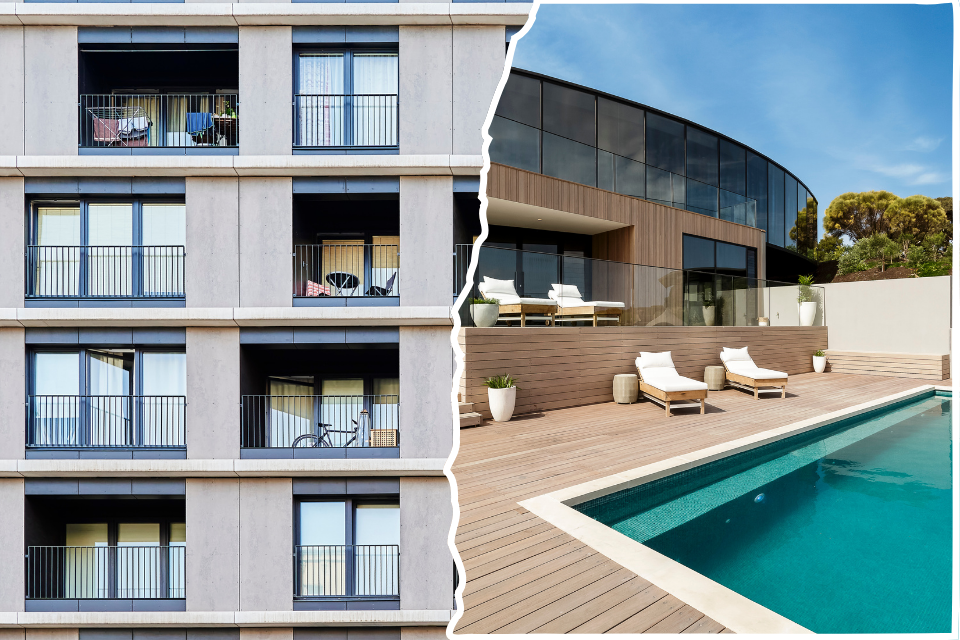
It’s a tale of two markets right now, and experts say only one is driving the current upward momentum. Photos: Lazy_Bear/Picsuite.
It was 2020/21 and a pandemic raged across the world, ravaging the hospitality and tourism industries and forcing businesses and workers to pivot to keep up with ever-shifting rules.
In the One Agency Kane Downie head office in Thirroul, Andrew Hedley and his colleagues braced themselves for what they thought would be a grim knock-on effect on the property market.
“People were talking about another global financial crisis, and there was this feeling we’d have a significant property downturn, because who would buy at a time when people were losing work?” he said.
“Like many people, there was a period when we were not allowed to do our jobs, and there was a sense that the industry was under threat. Then one day, we were allowed to hold open homes again.
“I remember the first was a property in Bulli, and we thought no one would turn up. We had 45 groups through.”
Nationally, the property market surged 24.5 per cent, the highest property value growth in more than 30 years.
To Andrew and property agents across the nation, it was a reminder of the market’s unpredictable nature.
In fact, a 40-year retrospective on growth in home values from Cotality revealed that Australia’s housing market has a long history of defying conventional wisdom, with periods of extraordinary growth occurring under unexpected conditions.
The data underscored that housing performance was shaped by more than monetary policy alone.
“Sometimes home values surge when you least expect it,” Cotality Research Director Tim Lawless said.
“In 1988, with interest rates near 15 per cent and rising, Australian home values skyrocketed by 31 per cent. Fast forward to 2021, amid a global pandemic and closed borders, national values jumped almost 25 per cent.”
In the Illawarra, the inverse was true.
In the past 40 years, 2021 saw the biggest surge (33.1 per cent) — an outcome perhaps driven by a COVID-induced mass exodus from cities, with buyers seeking tree and sea changes – and 1988 the second (29.9 per cent).
The other top three periods of growth over the past four decades in the region were 2002 (22.2 per cent), 2001 (21.3 per cent) and 2003 (18.9 per cent), all of which were followed by two of only seven periods when home values dropped, highlighting the market’s volatility.
In 2025, the region’s home values rose 8.2 per cent, which ranks as the 15th strongest calendar year growth outcome over the past four decades.
So where does all this leave buyers and sellers?
While nobody can make a definitive call on how the market will behave, some factors provide strong clues.
“Fiscal stimulus, credit availability, migration trends and economic shocks all play a role in shaping outcomes,” Tim said. “Periods of extreme growth often coincide with broader economic shifts, not just monetary policy.”
For buyers and sellers alike, it’s worth talking to local experts to gain insights into your market and how it’s impacted by current trends.
For instance, Andrew pointed out the current uptick in buying and selling activity was concentrated on homes at a certain price point.
“Right now there’s a bit of a false economy in that the general media is reporting a hot market. In reality, that’s driven by properties at the lower price point, stimulated artificially by the recent changes to the federal Home Guarantee Scheme,” he said.
“I actually think it will turn out to be a poorly thought-out policy in the long term that will drive entry-level house prices up, inflating them to be as close to the threshold as possible. It’s creating FOMO at that lower price point, and people are paying a lot more for properties that weren’t worth that six months ago. Ultimately, that’s pricing yet another generation of first-home buyers out of the market.
“It has also created two very different dynamics in the market, with relatively flat growth at the upper price points. So people selling homes over $2 million are finding the market to be very different.”