
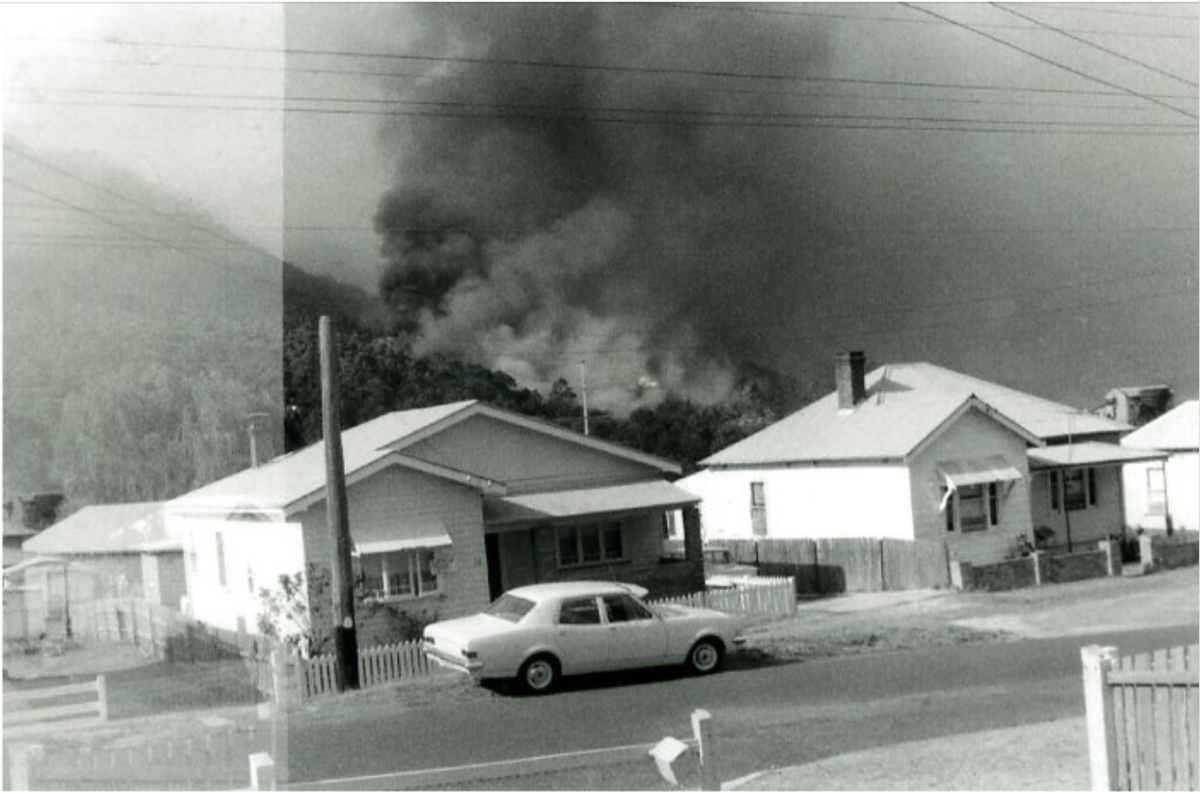
Fire heading for Wave Street in Thirroul in October 1968. Photo: Supplied.
The very recent fire disaster in Victoria again reminds us how fragile rural Australia becomes when dry ground, massive heat and strong winds explode the landscape into flame.
But even beachside urban settlements sometimes come under very serious bushfire attack.
Many still have vivid memories of the 2019 Black Summer fires on the South Coast – of which Wollongong was, mercifully, spared – and coastal areas in Victoria.
Even getting to the beachfront at Mallacoota, close to Victoria’s border with NSW, was not necessarily safe and sea evacuation proved necessary for some.
Another beachside location – Tathra – earlier faced disaster in March 2018 when 65 homes and buildings were destroyed, a further 39 were damaged and 70 caravans/cabins entirely went up in flames.
This surprised me but a quick bit of googling revealed even worse infernos had engulfed the then much smaller town at least three times previously.
Beachside Illawarra – with the escarpment so near to urban habitations in many locations – has meant long-term residents fully know the risk.
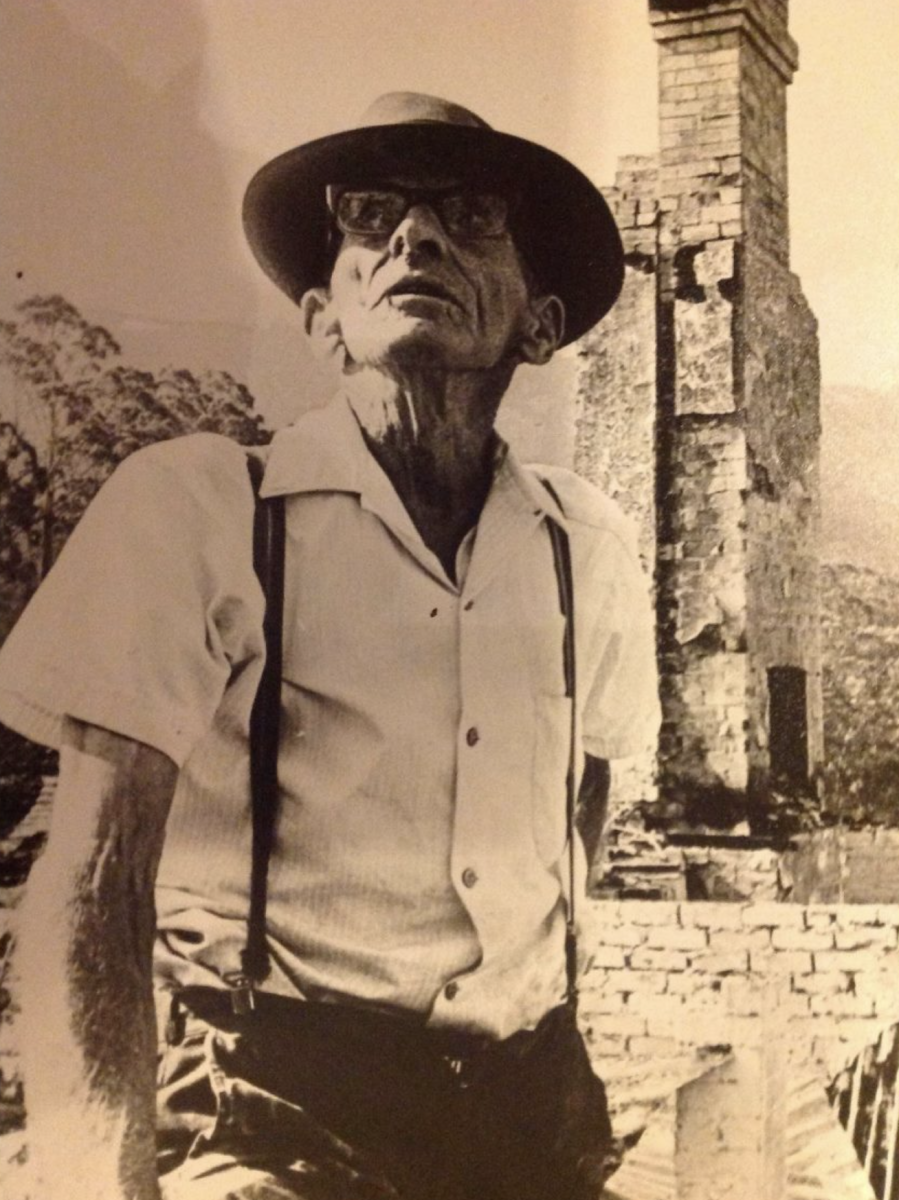
Dianne Guy’s photo of her grandfather, Jack Samways, after his house burnt down in the 1968 bushfires on Bulli Pass. Photo: Supplied.
There is some slight saving grace that even in days of shocking temperatures with howling hot westerly winds, once fire gets to the top of the escarpment it usually moves down relatively slowly, giving residents time to flee.
But exploding eucalypts and embers take a toll on houses and wildlife even if few people actually die. Much of the Illawarra remains undeveloped bushland as it was during the 1968 fires. At that time there were few places where enough water was available to fight the approaching flames and firefighting helicopters were then unknown.
I, unfortunately, am old enough to remember what it was like to live near the foot of Bulli Pass and witness even the wooden fences on the western side of Lawrence Hargrave Drive in flames, with their owners desperately trying to hose them.
I also saw a panic-stricken wallaby hop straight into a passing car near the bottom of Bulli Hill.
Friends of my family moved from Fords Road – then one of the highest streets in Thirroul – to our place as the flames advanced eastwards, pushed by the burning westerly air.
The aftermath on both Fords Road and Bulli Pass was heartbreaking as ember attacks randomly took one house, jumped the next three, then took the next two, leaving home owners to puzzle why their house was saved and their neighbours’ house completely destroyed.
The wind pushed the flames down and more directly north west behind Wave Street at Thirroul.
Remarkably, vintage footage by John Zylstra shows giant flames getting extraordinarily close to even the Thirroul Fire Station in Arthur Street, about 300 metres from the beach.
While I was at home with my mum and joined by our friends from the extreme danger zone on Fords Road, my Dad, as usual, was at Ryans Hotel.
But so grave had the situation become that the drinkers were put on trucks and driven to Buttenshaw Drive in Austinmer to see if the encroaching flames could be stopped from there as it was impossible to fight the fire from any higher up the escarpment.
Had the wind not turned I suspect there would have actually been deaths as the fire ripped through the bush down to Buttenshaw Drive, from where there would be little escape as there was bush on either side of this narrow roadway.
Unless someone has personally experienced a very strong southerly buster hitting the Illawarra coast, it is hard to appreciate what a blessing such a strong cool breeze can be after an oppressively hot day at a time in 1968 when few houses in Illawarra possessed air-conditioning.
It was only the change of wind from hot nor-easter to strong continuous southerly buster that pushed the flames back up the escarpment and saved a very considerable number of houses in Thirroul.
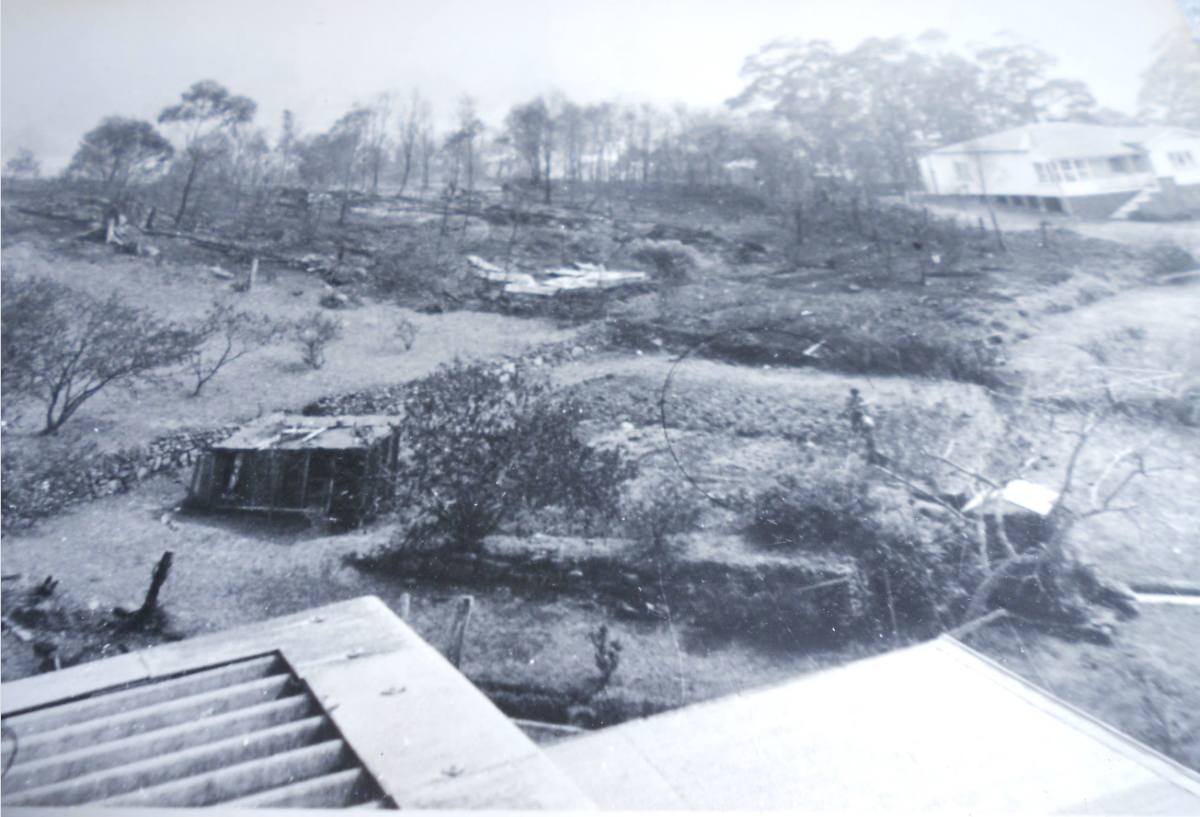
A photo by Sandra Jones … “Taken from the top of our roof in Pass Avenue looking at the mess the [1968] bush fires made.” Photo: Supplied.
Nonetheless, the unlucky ones suffered their residences and belongings completely destroyed. But the randomness of whose house was saved and whose in the same street burnt was most depressing to behold.
Many very sad photos and John Zylstra’s extraordinary video survive to remind Illawarra residents about how what happens elsewhere in Australia also happened here 60 years ago.
We should be very grateful we were spared what happened further down the coast in 2019 but, just like happened in 1968, there is every chance that one day, it may all happen again.
And without a southerly buster miraculously turning up to save us, it would seem that it was the exceptionally erratically variable wind changes that made the bushfires that hit Victoria in January 2026 near impossible to defeat.
Weirdly, it is an ill wind that blows nobody at least a bit of good. Some homeowners whose houses were not lost got sea views they never had previously and some elderly heritage buffs discovered the burnt bushland exposed remnants of some of the earliest roads constructed to get down the escarpment after 1815.