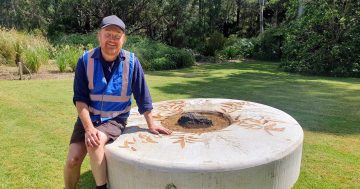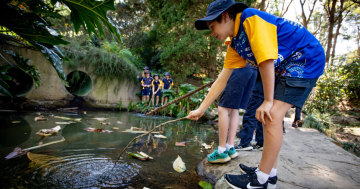

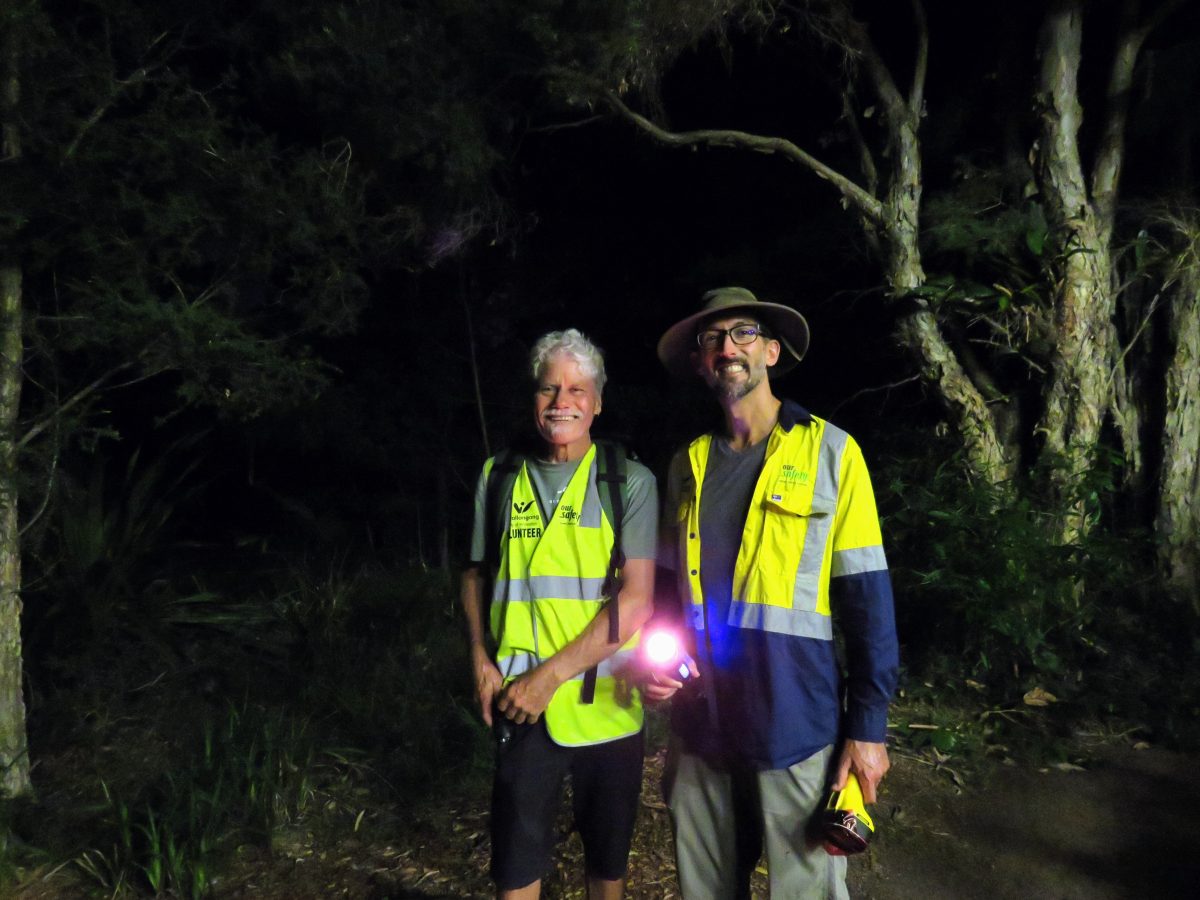
Environment guide Carl Glaister and living collections curator James Beattie are two of the enthusiastic experts guiding the Wollongong Botanic Garden torchlight tours. Photo: Zoe Cartwright.
Do you like moonlit walks, weird creatures and animal facts?
If so, you need to book in for a Wollongong Botanic Garden torchlight tour.
Ater an extended COVID-induced hiatus the walks are back on, offering an opportunity to see the gardens in a whole new light.
When I arrived it was a warm, dusky summer evening. The soft light lent a jungle atmosphere to the familiar ground of the gardens.
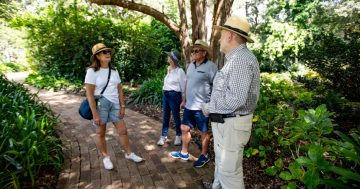
About 30 people, from primary school kids to seniors, gathered around as our guides showed us how to apply red cellophane to our torches so as not to bother the wildlife.
We were also treated to an informative talk from guide Carl Glaister about the different types of birds, bugs and animals that could be found in the gardens after dark, complete with pictures and taxidermied props.
Carl said animals from echidnas to sugar gliders made the gardens their home, alongside reptiles like water dragons and golden crown snakes and stranger creatures like the elusive velvet worm.
First animal fact of the evening – some species of microbat that live in the gardens can eat up to 1200 mosquitoes in a night.
Well-prepared, we split into two groups and headed out into the twilight, with noisy cockatoos and flying foxes overhead.
If you ever went camping and played spotto as a kid, you’ve got a good idea of the vibe. All of us were fizzing with excitement.
Our guides were passionate and knowledgeable and led the group at an easy pace over mostly level terrain, although there were some small stairs and uneven, rocky areas.
Our first spot of the evening was a pair of brush turkeys perched impossibly high up for such big, lumbering birds.
A keen-eyed member of the group spotted a small branch moving just below the turkeys and we observed a tiny ring-tailed possum leap through the canopy.
As it grew darker less-familiar sounds emerged from the night. Our guide explained the lightswitch-click sound coming from the treetops was actually the echolocation of bats.
Another we thought was a frog turned out to be a shy mole cricket.
We found evidence of a powerful owl, which leads us to animal fact number two.
Did you know that powerful owl poo looks like whitewash, because their diet is exclusively made up of meat and bones?
Sadly, we didn’t see the bird responsible for the poo, but shortly afterwards we surprised two tawny frogmouths growling gutturally in a paperbark tree.
As we moved through different sections of the garden the sounds around us changed too, providing an audible sense of the ecosystems each environment supports.
In the rainforest section the microbeasts took centre stage.
We surprised an orb-weaver in the act of spinning her web and another that had just caught a grasshopper about as long as my pen.
A giant water spider gracefully skimmed the surface of a small pond as a long-finned eel wound its way through the depths.
Just before we finished another ring-tailed possum surprised us by running right down to eye-level before it froze and waited for our curious eyes to move on.
Its fluffy rust-coloured fur was a welcome sight to this arachnophobe.
We all went our separate ways into the night, suitably awed and excited by everything we had seen.
Education and outreach specialist at the Botanic Garden Sam Crosby said she was excited to be able to open up at night again.
“People come here by day to see the plants, but at night the wildlife really becomes the superstar,” she said.
“It’s a nice way for families to get together in the evening and do something a bit adventurous.
“It plants the seed to pay attention and connect with what’s going on in your own backyard at night.”
Sam said the team hoped to hold tours every school holidays and add in a regular monthly event.
The best time to book is between September and April, when evenings are a bit warmer and brighter.
Top tip – make sure to wear a long-sleeved shirt and pants to avoid being eaten alive by mozzies.
Keep an eye on the Wollongong Botanic Garden website for more details.