
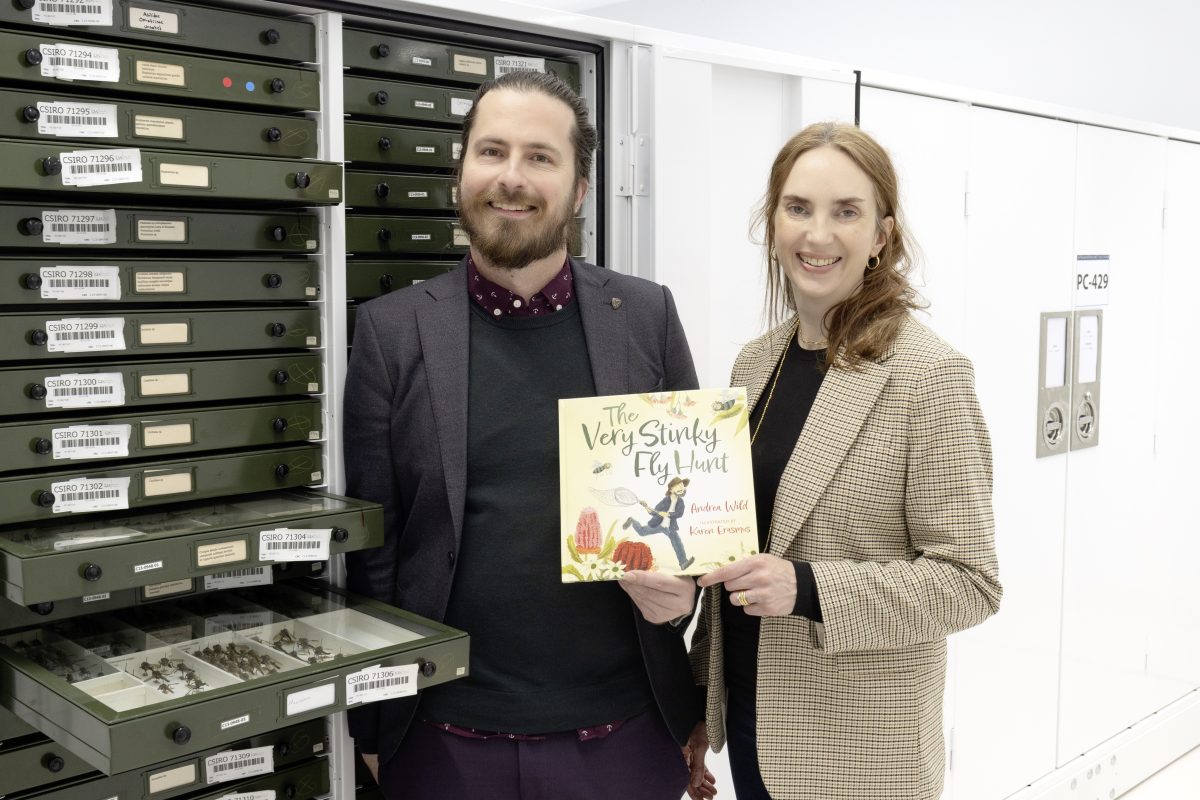
Keith Bayless and Andrea Wild with children’s book The Very Stinky Fly Hunt, inspired by Keith’s discovery of a rare fly near Robertson. Photo: CSIRO.
For the past decade Keith Bayless has poked around public toilets across NSW.
It’s not because he enjoys the ambiance. Keith has been on a quest – and he finally found his holy grail near Robertson: a rare Australian fly, Clisa australis, thought to have vanished in the early 1990s.
Until Keith tracked it down.
“I felt a mixture of relief or elation, and also a bit of surprise and confusion because the fly had previously been known in northern NSW and all the specimens we have now are from the Illawarra and south,” he said.
“As soon as I saw it in the trap at Barren Grounds I realised I had something special.”
Clisa australis was first discovered and described in the 1960s, deep in a bat cave near Kempsey.
Later, it turned up in pit toilets across national parks. Then it seemed to disappear.
Years passed with no sign of the elusive insect, but Keith wasn’t convinced it had disappeared for good.
He travelled to Australia for his PhD research in 2015 and spoke to the entomologist who first described Clisa australis in the 1960s.
“The fly universe in Australia is huge, there are more than 10,000 species and most are undescribed,” he said.
“So I had some hope that people had paused in looking for it, and that’s why it hadn’t been recorded in so long.
“It was still a surprise to me when I found it again.”
Keith said Clisa australis is the only fly in its family found in Australia.
Although it doesn’t eat fruit, it has similar egg-laying structures to fruit flies, and scientists hope better understanding it will help lead to breakthroughs in human health and agriculture.
It will also help develop a deeper understanding of Australia’s complex and mysterious insect ecosystem.
Keith’s quest has been turned into a hilarious and educational children’s book, The Very Stinky Fly Hunt, written by CSIRO science communicator Andrea Wild, in the hopes it will inspire another generation of bug hunters.
Who knows – they could even make a major discovery before they finish school.
“A lot of kids like insects and the fun part of the story is these ones probably like to eat bat poo,” Keith said.
“We really need a lot more interest and help in understanding Australian flies.
“There are thousands of species and certainly some are nuisances or serious pests, but many of the adults are pollinators, so mangoes and chocolate, for instance, are only pollinated by flies.
“You don’t need to go to school and get a PhD to help – go out in your garden, observe what insects are doing, take some photos and upload them to iNaturalist.
“There’s so much left to discover in Australia everyone can do it, and you might see something nobody has ever described before.”