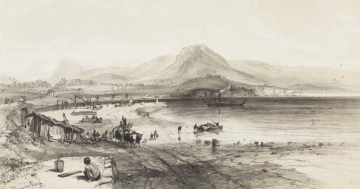

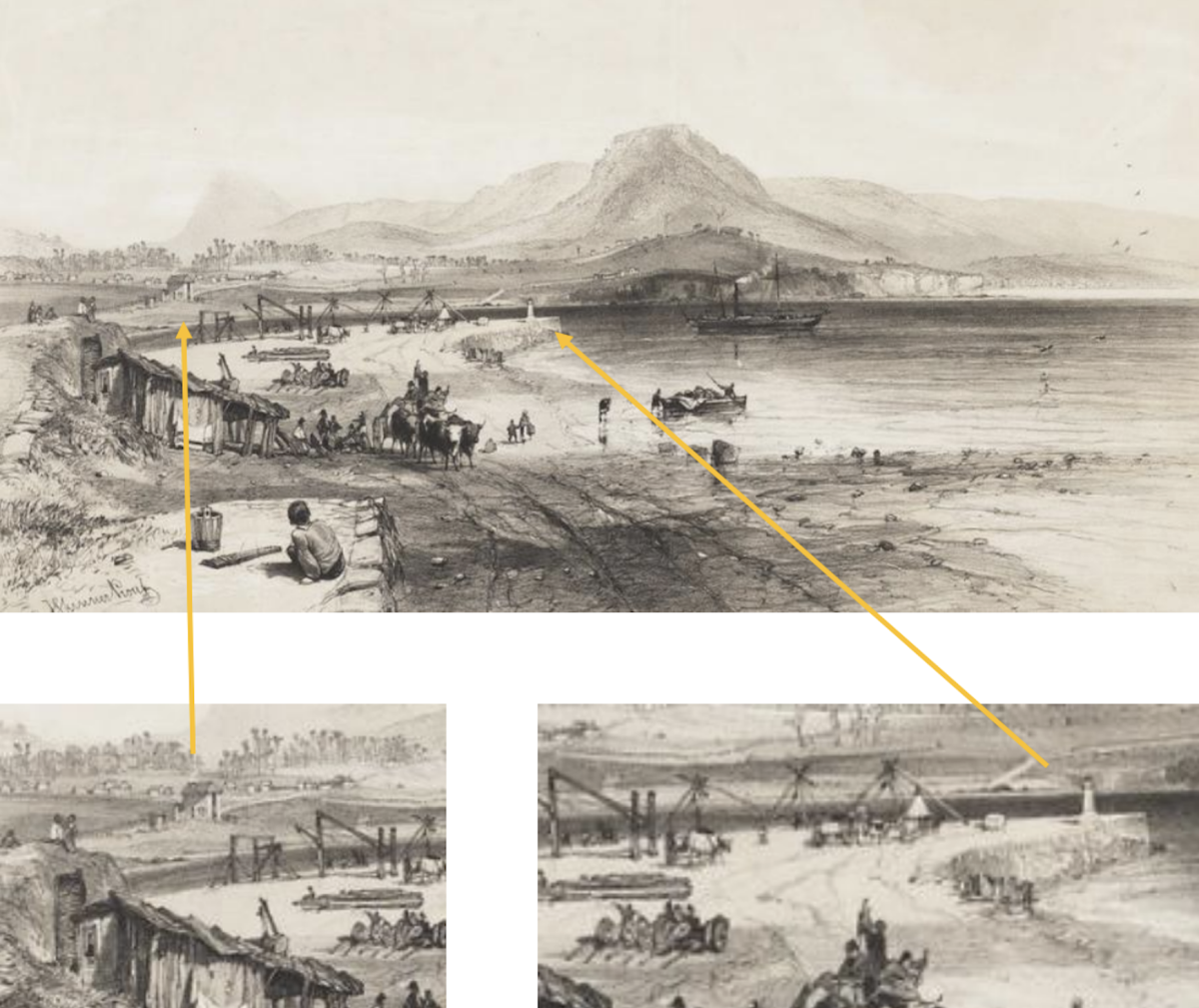
John Skinner Prout’s early lithograph of Wollongong Boat Harbour. The bottom left enlargement shows Custom House, while the right shows the lighthouse. Photo: Mitchell Library, State Library of NSW.
Harry Anneveld, the current manager of the Old Wollongong Court House, has pointed out an anomaly in John Skinner Prout’s image of Wollongong Harbour supposedly produced in the early 1840s.
The puzzle is that although the left-hand side of the image does seem to depict a view of Wollongong in the early 1840s, the right-hand side seems to show Wollongong sometime between 1871 when the lighthouse was built and 1876 when John Skinner Prout died.
Previously I have revealed that the likely reason John Skinner Prout turned up in the Illawarra and produced so many local images in the early 1840s was that Captain Robert Marsh Westmacott (who settled at Sandon Point in 1837) was a distant cousin of Prout’s wife, the former Maria Marsh.
When digitisation made it possible to enlarge what were previously near-microscopic details in Prout’s image, in my excitement I saw on the left what I presumed was the only early image of the original Wollongong Customs House (more correctly titled, as Harry points out, Custom House). However, I failed to see the lighthouse in plain sight on the right.
But, obviously, as Harry revealed, that 1871 Wollongong lighthouse should not be in any image by Prout thought to date from the 1840s.
Harry is finalising a detailed history of the Old Wollongong Court House building, the Government Reserve of which it was part and the original Wollongong town precinct. And his fine research already provides a possible solution to the suggestion raised by Skinner Prout’s biographer, Vernon William Hodgman, that Prout “revisited Australia” after his return to England at least once.
Moreover, Harry’s extensive research about the original Wollongong Custom House makes my assertion in my column from December 2025 that “some surviving original bits of the little wooden custom’s house” now located behind the Old Court House, “may well be Wollongong’s oldest European structure” look, at best, extremely unlikely.
Guided by my favourite historian – Will Durant – I have often engaged in the dangerous art of historical guessing. Indeed, one review of my first book (published in The Australian newspaper in 1990) was given the headline “Conjecture as an artform” by a very witty sub-editor.
Guessing, of course, may simply be a random or quick estimate but conjecture is, hopefully, a slightly more reasoned suggestion based on available data, patterns, or incomplete evidence.
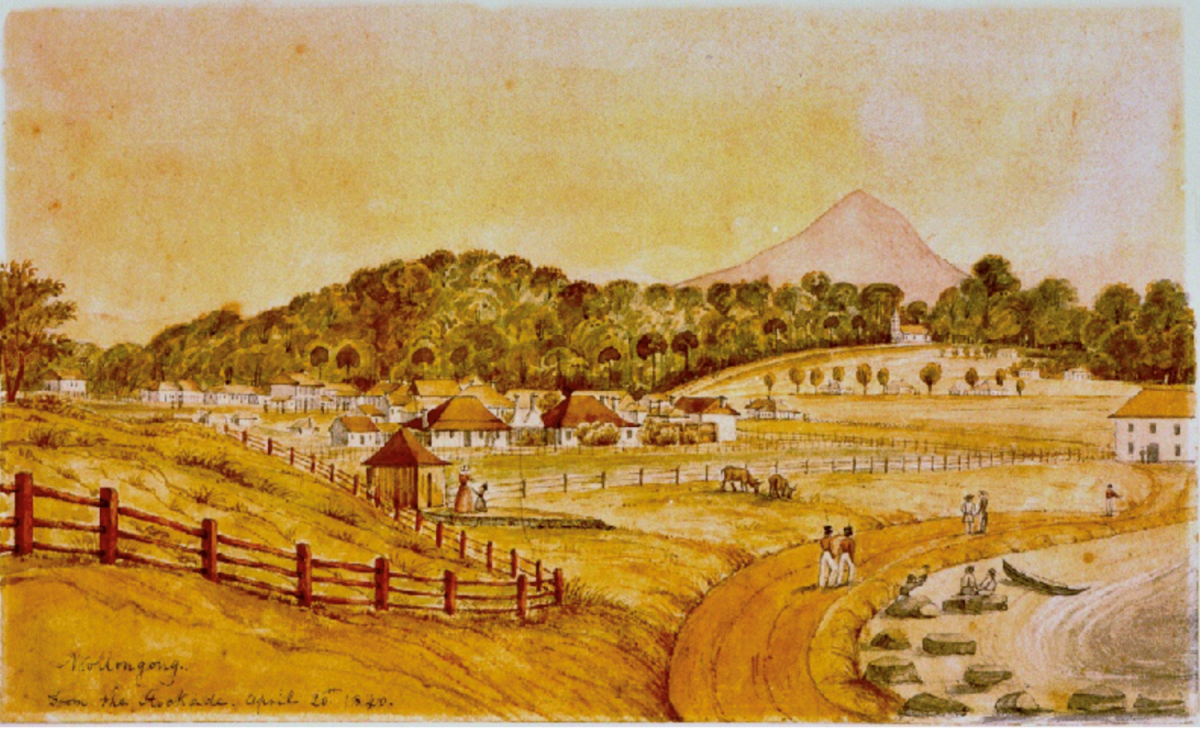
Robert Marsh Westmacott’s Wollongong from the stockade, dated 20 April, 1840 includes a spire on the church to the right. However the spire wasn’t added until 1843. Photo: National Library of Australia.
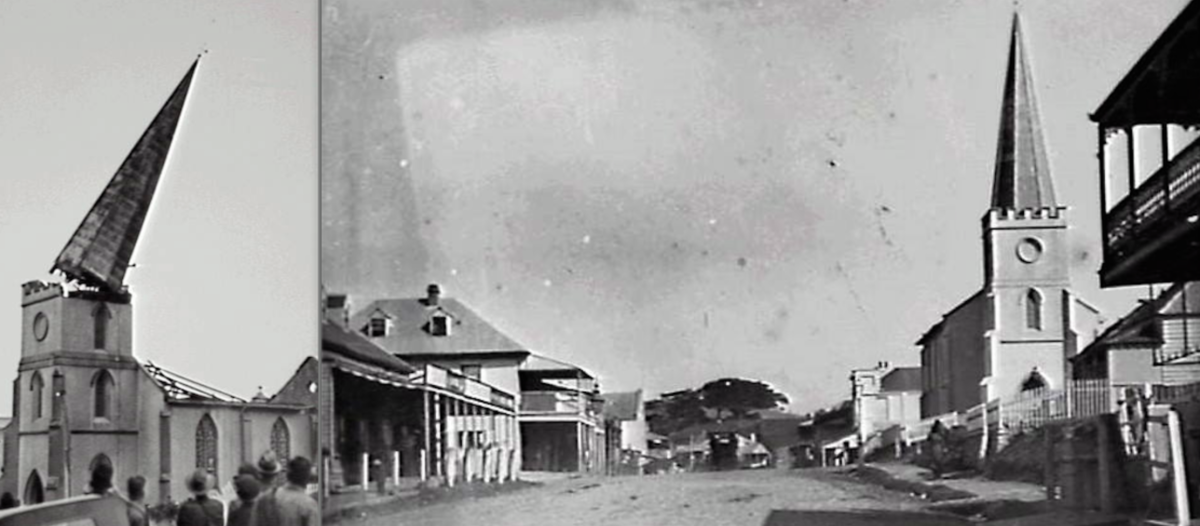
The spire on the Presbyterian Church on the north west intersection of Crown and Church streets. The photos held by Wollongong Library show the church being demolished in February 1936.
I remain fond of both and also of Durant’s massive 11-volume The Story of Civilization (spanning Eastern and Western history) written over four decades and containing close to four million words printed on some 13,000 pages.
After the seventh volume, Durant’s wife, Ariel, was contributing so much she became her husband’s fully acknowledged co-author. And The Story of Civilization is an incredible achievement for a working married couple with children to raise.
In 1968, the Durants were awarded the Pulitzer Prize for Rousseau and Revolution, the 10th volume of their magnum opus. They also wrote a 420-page joint autobiography, published in 1978.
But the one time Will Durant ever went in for brevity was in a cute little volume titled The lessons of history, detailing a long list of his witty aphorisms. The most cynical one – and the one I have most admired over a lifetime – is that “most history is guessing, and the rest is prejudice”.
Harry Anneveld’s eagle-eye and fine research, however, also brings to mind a similar puzzle about another important image from Wollongong’s early history, Robert Marsh Westmacott’s Wollongong from the stockade, dated 20 April, 1840.
At top right the watercolour shows the Presbyterian Church then located on the north western corner of Crown and Church Streets. It was built to architect James Hume’s design in 1839. But the spire (known locally as Atchison’s Folly) was only added in 1843.
My guess (and it’s only a guess) is that Westmacott may have known a spire was planned and so added one to his watercolour to ensure that his distant view of the building did indeed look like a church.
In short, there is much about early Wollongong that the passage of time has made it very difficult to fully know.
Guessing, conjecture and making assumptions can be an entertaining, if dangerous, historical game but it is only the conscientious and continuing detailed research and critique like that of Harry Anneveld that can help Illawarra garner what scant information does survive about early European Illawarra.