
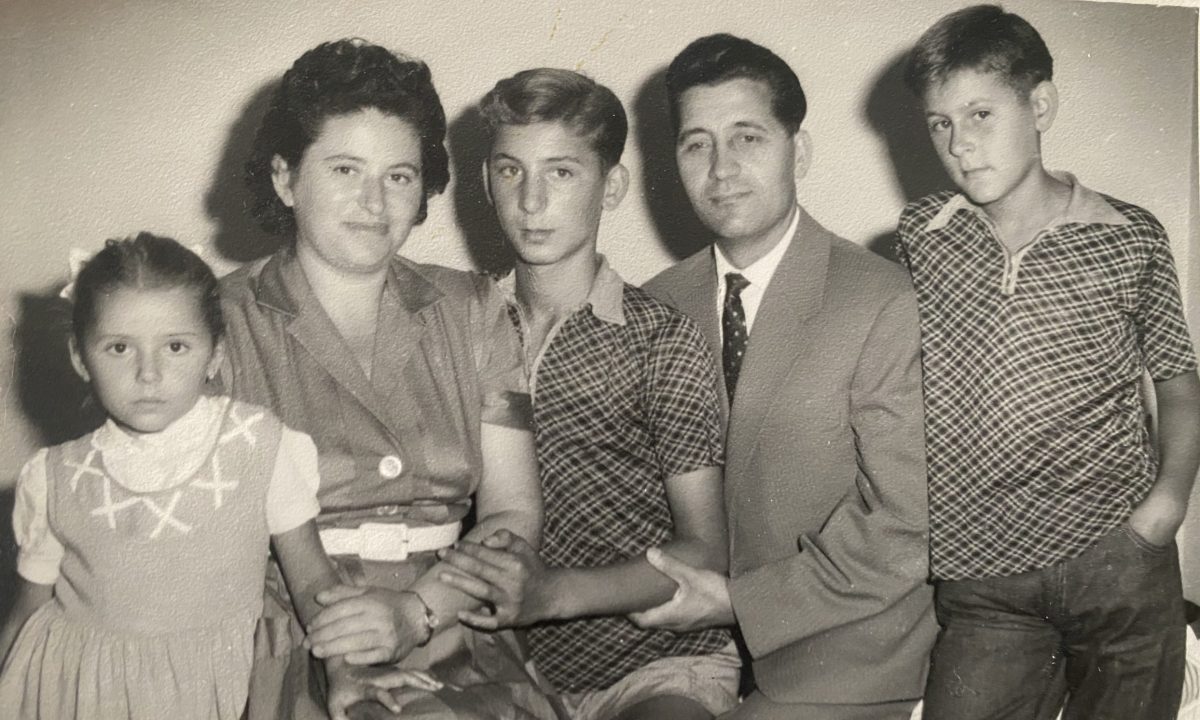
Jasmina (left) with her family, united in Germany after escaping communist Yugoslavia. Photo: Jasmina Pascoe.
When Jasmina Pascoe and her husband walked into the museum that was once the Bonegilla Migrant Camp, a well-meaning woman greeted them with a smile and casually asked if they had ever visited before.
Jasmina burst into tears.
The Wollongong woman was four when the hostel became their first home in Australia. It was 1959 and they had arrived from Germany after escaping from communist Yugoslavia.
“Bonegilla was once an army camp, then converted into a hostel for migrants. Now volunteers had made it into a museum,” she says.
“But the moment I walked in, all I could remember was my mother’s anxiety. Back then, it radiated off her.”
Both of Jasmina’s parents had been prisoners of war in Germany during World War II. Her father’s skills as a tailor offered them some stability, but safety was hard to come by.
“He ran a business in Yugoslavia and said the communists would come in and demand money and if you didn’t pay, there would be nasty repercussions,” she said.
They were tense years, but the family extricated itself and became part of a migrant boom in Australia.
“My father originally wanted to go to America, but they wouldn’t take us because we didn’t speak English,” Jasmina says. “That was fortunate — I love Australia.”
Located in Victoria, Bonegilla could be called the Ellis Island of Australia. It was the country’s largest and longest operating post-WWII facility for housing, processing and training hundreds of thousands of European migrants and refugees.
For many families like Jasmina’s, it was their first Australian home, aiding in language and employment before they integrated into the workforce.
“I don’t remember much about what it was like when we first came, but I can imagine a little of what my parents went through.
“God knows what was going through the minds of migrants like them, as they got onto ships and trains to Bonegilla, not speaking a word of English and carrying deep trauma.”
When Jasmina came across a documentary on a Bonegilla Facebook page that seemed to offer an insight into just that, she had to know more.
Bonegilla – The Migrant’s Journey is a multi-award-winning documentary created by Simon Reich, the child of a German immigrant who arrived in Australia post-war.
In it, nine post-war migrants are interviewed and share insights into their experiences of World War II, migration to Australia, travel on ships, life in migrant camps and assimilation into Australian society.
It has been shown to sold-out audiences far and wide. Now, it’s coming to the Illawarra.
“I sent Simon a message saying we had a lot of migrants in the Illawarra and I was sure they, like me, would love to see this film,” she said.
Tickets are now on sale for a screening of Bonegilla – The Migrant’s Journey at Gala Twin Cinema in March.
“I’m really excited about it, not just for myself but for my children and grandchildren,” Jasmina says.
“I asked Simon if he thought it would be too scary for my 16-year-old daughter and he said, ‘No, this is their heritage’.
“I believe it’s a story that will resonate with migrants regardless of whether Bonegilla was part of their story. I hope we’ll get a full house.
“I hope for all the families, the children and grandchildren, it will have a healing effect and perhaps impart a better understanding of what our parents and grandparents went through. Because truly, it’s extraordinary.”
Bonegilla – The Migrant’s Journey screens at Gala Twin Cinema, Warrawong on Friday 20 March at 7 pm.