
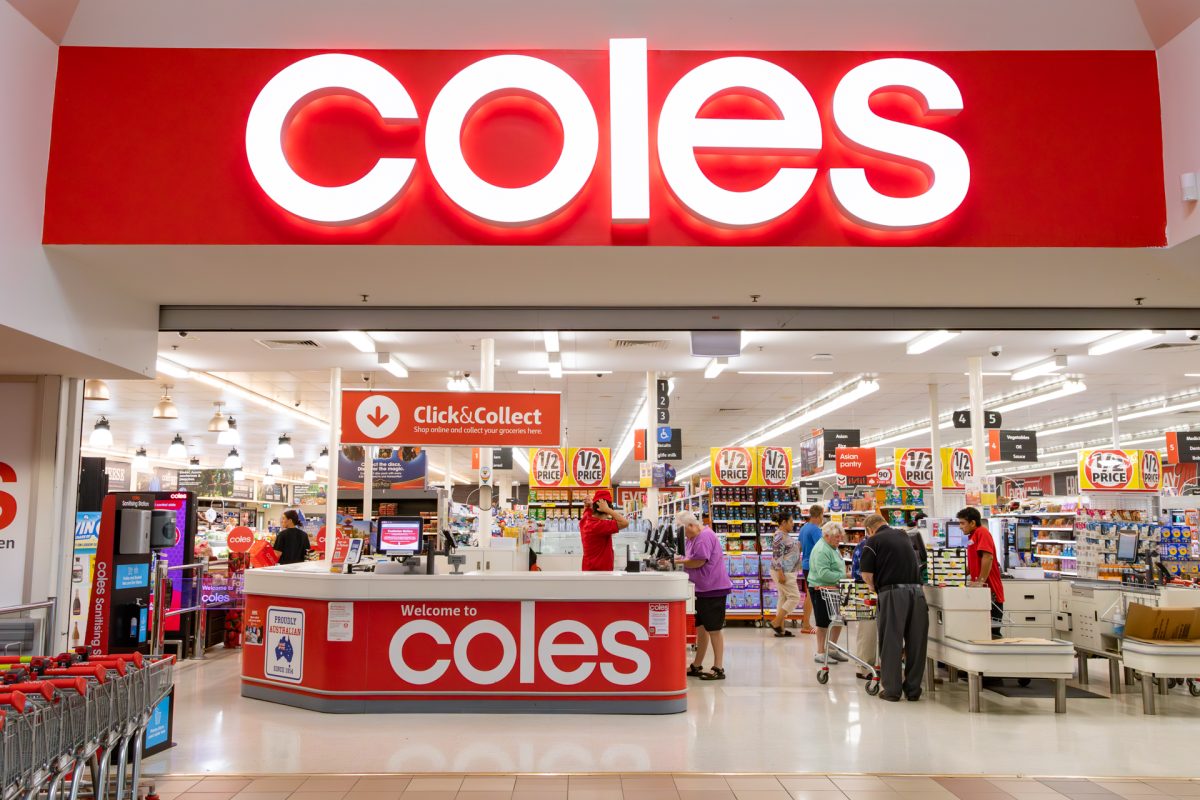
The Australian Competition and Consumer Commission is suing Coles for allegedly misleading customers through its Down Down campaign. Photo: Michelle Kroll.
The consumer watchdog has claimed Coles’ Down Down campaign wasn’t “fair dinkum” and, in fact, misled customers into believing they were saving money.
The ACCC is suing Coles Supermarkets Australia Pty Ltd for allegedly breaching Australian Consumer Law, claiming it misled consumers through discount pricing claims on hundreds of common supermarket products.
Between February 2022 and May 2023, the watchdog examined 245 products, claiming prices on common items were sold at a certain price for a median of 343 days before being jacked up for about 28 days.
The items were then promoted as part of the Down Down campaign, but the reduced prices were either the same as or higher than those previously advertised (ie, before the price increase).
“What’s said on the ticket is a half-truth,” ACCC head counsel Garry Rich SC said in his opening remarks to the Federal Court on Monday (16 February).
“It’s not fair dinkum to tell the customer the price has gone down.”
Mr Rich used the example of a can of Rexona anti-perspirant deodorant.
He stated that from 5 March 2021 to 17 April 2022, it was priced at $5. This increased by 30 per cent to $6.50 for 30 days and was then promoted through the Down Down deals at $6 from 18 May 2022.
He argued that a consumer, when looking at the price ticket to compare what they would have paid before the Down Down promotion, would not realise the full contextual price history of the item.
“What was conveyed to the reasonable consumer?” Mr Rich submitted.
“The message is: the price of this product has gone down.”
Justice Michael O’Brien questioned whether there was merit in looking at the price history of an item before the increase, rather than simply comparing the Down Down price with what someone would have paid before the promotion, given that the cost of items could also change due to factors such as inflation.
Mr Rich countered that that could be a reason for the price increase in the first place.
“It doesn’t matter if there’s a proper, commercial justification for the price spike,” he argued.
“This is planned and the only reason the spike happened is because … [Coles] needs to establish a higher price [before the Down Down discount].
“Coles was deliberately, knowingly increasing the price of these products [to respond to] a rise in retail cost.”
Mr Rich submitted internal emails showing Coles was keen to stay ahead of its main competition, Woolworths, and introducing price increases before a Down Down promotion was a way of increasing prices to account for inflation, while also not causing customers to look elsewhere for a better deal.
“The commercial reasoning … was, if we put our prices up, people might not buy them, so we need a promotion,” he said.
Mr Rich added that internal Coles compliance documents about the Down Down program showed there were key changes to the program’s policy guardrails before the allegedly misleading conduct.
Another argument the ACCC will develop during the course of the case is the concept of a “reasonable period”, asserting that the Down Down promotion was marketed as a “sustained discount”.
Mr Rich stated that this was important given the alleged “temporary nature” of the price of an item before it was included in the promotion.
“The concept of being in place for a reasonable period is part and parcel of this … genuineness of the Down Down,” he submitted.
“[If it was only] in place for a short period … [it] totally undercuts the genuineness of the Down Down [price] to the consumer.”
For Coles, barrister John Sheahan KC appeared briefly, rejecting the ACCC’s allegations.
Part of his argument was that Coles was justified in its pricing movements.
“Obviously, at the end of the day, retail pricing is a matter for Coles,” he said.
Court documents show Coles will also argue that the price drops were genuine.
Mr Sheahan’s argument will be developed more fully when court resumes later this morning (17 February).
The trial is set to be heard in the Federal Court for 10 days.
Original Article published by Claire Fenwicke on Region Canberra.