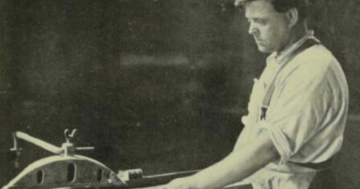
Florence Wallace was the first “lady” to be classed as an Associate of the Sydney Technical College after completing an electrical and mechanical engineering diploma. Photo: Supplied.
Florence Violet Wallace was born to George and Marie Annie (née Giles) Wallace in Melbourne and her family moved to Austinmer.
From Austinmer her father retired in 1922 after 34 years working as as traveller in the Illawarra district and elsewhere for the Vacuum Oil Company.
Although he was likely highly conservative – and had “interests in religion and patriotism” – he doesn’t seem to have stood in his daughter’s way when she used to play about with bells and buzzers and things around the house.
Florence remembered her mother had poor eyesight and couldn’t find things in dark cupboards “so I’d get a battery and I’d hook a switch and when she opened that cupboard door a light would come on … I started sort of playing with those things.”
Although Florence lived in Austinmer she attended Thirroul Public School from which she won a bursary to study at Sydney Girl’s High School.
In 1922 many newspapers reported “that Miss F. V. Wallace … of Austinmer, passed the final examination for the diploma … after a six years’ course covering theory and practice in electrical and mechanical engineering” and became entitled “to be classed as an Associate of the Sydney Technical College … the first lady to have gained the distinction”.
Florence recalled in one 1922 press interview that she “started work with a five pound note”, and when referring to the recent public distinction she had achieved said “today the diploma does not mean much to me, because I have been working steadily … for the last seven years.”
Despite having begun her working life as a maths teacher in Armidale, Florence explained she came back to Sydney and stated that “although I belong to Austinmer I … went to Sydney University and passed Chemistry 1 and Geology 1″.
At the same time Florence bluffed her way into convincing Sydney Technical College into letting her study Electrical Engineering.
Some newspapers had begun by mentioning the “flash” of her “grey eyes” and her “petite and frail appearance” but Florence confidently stated that her “first evening at the Technical College was practical night and the instructor gave me some soldering to do, probably thinking it would finish my enthusiasm. But that was child’s play to me — the sort of thing I’d been doing since I was a kid”.
Florence had got her first electrical job through an advertisement. Someone wanted a house wired and though she had only book knowledge at the time of that sort of work, she wasn’t afraid.
“It was a fearfully hot day,” she recalled, “and the house was about two miles from the tram. I eventually got the job because I was the only contractor to arrive there … and there was no complaint when it was done. Since that day contracting has been so ridiculously easy for me that I have had as many orders as I could keep up with.”
Florence then started out in an office and workshop combined at Rawson Chambers in Sydney and even had “to throw herself on the mercy of the manager to lend her a few chairs, a table, and a strip of oilcloth to make a show for the customers”.
With few tools in the beginning, she gradually bought more with her first lot of earnings.
When Florence transferred her business to the electrical and wireless shop in Sydney’s Royal Arcade, she bought the entire stock of the wireless vendor who preceded her and began to take an interest in wireless telegraphy beyond the mere selling of the apparatus.
Florence also remembered that “the first man who came in for an iron pyrites crystal made me feel ashamed that I couldn’t talk his language – he was a wireless operator from one of the boats – but I set about rectifying that and very soon I was a keen convert to the radiograph. Today I could talk about wireless for hours and never get tired of it”.
Florence travelled to America to further her knowledge in August 1924 and after returning, married Cecil Mackenzie (nine years her junior) to whom she had once sold a radio.
By 1934 Florence was convinced electricity could save women from domestic drudgery and to this end, in 1934 she founded the Electrical Association for Women to spread the adoption of electricity in Australian homes.
Long before current Austinmer resident Saul Griffiths came up with “Electrify 2515”, Florence had already been devoted to electrifying as many appliances in the home as possible.
In the early 1920s Florence had also first experimented with heating water electrically to house tropical fish and eventually her home in Greenwich Point held one of the finest collections of gold-fish in Sydney.
In 1931 Florence even experimented with improving the science of television through the use of chemistry.
Moreover, after 1949, she began corresponding with Albert Einstein and two of her letters are today held in the Einstein Archives in Jerusalem.
During WWII the urgent need for trained telegraphers meant Florence, despite initial government reluctance because of her sex, ended up training about 3000 women, one-third of whom went into the services.
And by 1948 Florence many ex-WWII airmen who wanted to join Qantas needed to learn from Florence’s expertise as by then she held a First Class Flight Radio Telephony Operator’s Licence and was also skilled in morse code.
Two days before she died in 1982 Florence is recorded as having said: “… it is finished and I have proved to them all that women can be as good as, or better than men.”