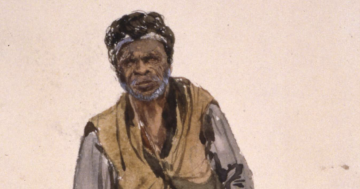
Joseph Selleny’s Thullinbah Wullongong. From the collection of G Valdar in Canada, reproduced in Joe Davis’ book Lake Illawarra: an ongoing history (2005), with the owner’s permission.
There is only one Indigenous person of whom a portrait survives that has a locality in the Illawarra named specifically for him.
Charley Hooka, claimed by John Brown of Brownsville to be “a great chief”, does have his surname today attached to Hooka Island in Lake Illawarra but no image of this man survives.
Our finest full length portrait of any Indigenous 19th century man is undoubtedly that of Joseph Selleny’s Thullinbah.
Today the Illawarra images of the Austrian artist Selleny are scattered all over the world.
Selleny’s ship, the Novara, docked in Sydney Cove between November and December 1858. Its official artist, Joseph Selleny, fortunately turned up in the Gong and, miraculously, some of his treasures have survived.
His image of Thullimbah Wullongong 1858 depicts an elderly man apparently still in extraordinary physical condition despite what would appear to be a disease of eyes – possibly glaucoma.
According to local historian and author Kathleen Hooke, Tullimbar (Selleny spelt it Thullinbah) was born on the banks of Mullet Creek, near present day Dapto or Brownsville, having been first wrapped in a sheet of bark.
Major E H Weston who lived at Albion Park also claims to provide extra details. Weston wrote that Tullimbar was “a strange old character. He used to come across to my place every Saturday for flour, sugar and ‘bacca’; if he didn’t get the latter, his language was, to put it mildly, sulphurous”.
“He had been a great warrior in his day, and his bald black head was covered with scars received in Nulla Nulla fights. He was also a bit of gay Lothario. On one occasion he stole a gin belonging to the Bong Bong tribe and was followed by a former lover of the dark beauty.
“Tullimbar got a glimpse of the Bong Bong back one evening and knew he was out for revenge. When he had camped for the night he rolled a log near his little fire, covered it with his blanket, and hid behind a big tree close by. After a time his enemy sneaked up, and when he got within striking distance, made a bound and drove his spear into the log; before he could withdraw it Tullimbar spring out and drove his spear through him, killing him instantly.
“Being in very thick scrub the body was not found for a long time, so Tullimbar escaped the vengeance of the other tribe.


“He lived to a great age, but went blind in his old age; the other blacks used to drive a stake into the middle of hut and tie him to it at night; to prevent him running away. Sometimes he would get loose and come out, and I have heard him howling like a dingo when he got cold and couldn’t find the camp fire. One night he got loose and rolled into the fire and was so badly burned he died the next day.
“An Aboriginal funeral is a queer affair. They always shift their camp directly someone dies; the body is then rolled in a sheet of bark and carried to the burial place. It takes them hours to go a short distance, as they go forwards, then back, then zig-zag and turn round and round repeatedly. This is said to puzzle the ghost and prevent it coming back to camp.
“Years ago a heavy flood carried away a large portion of the riverbank and disclosed the bones of the departed Tullimbar but I have never heard of this ‘spook’ revisiting any of the old camping grounds.”
Whatever the accuracy of Weston’s reminiscences, Selleny’s image is exceptionally sensitive.
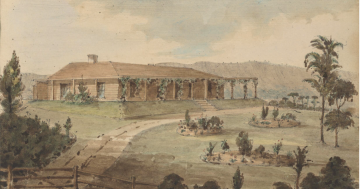
Selleny’s Illawarra landscapes are also priceless and may even provide skilled botanists with some slight insight into local vegetation in the mid 19th century.
The beautiful work (above, left) presumably worked up from one of Selleny’s 1858 sketches, eventually sold at Christies in 2011 for £130,000 plus buyer’s premium – some 214 per cent over its estimate which, of course, put it totally out of the reach of the Wollongong Art Gallery.
I am also particularly fond of Selleny’s depiction of Mt Keira.
We were lucky Joseph Selleny was on board the Novara and that he made it down to Wollongong in late 1858.
Sadly, Selleny was eventually admitted to the Inzersdorf Mental Hospital near Vienna, where he died on 22 May, 1875, at the age of 51.