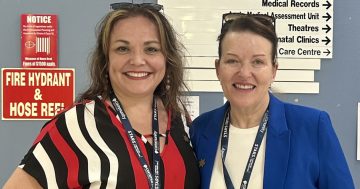
STARS volunteer Catherine Baldachinoff-Miller (left) with STARS volunteer program policy and program coordinator Tanya Southworth. Photo: Supplied.
A flagship program that used volunteers to assist older people bed-blocked in public hospitals across the Illawarra and Shoalhaven has come to an end due to being defunded.
This is despite the STARS program being named 2026 Volunteer Team of the Year at the 2026 Illawarra Volunteer of the Year Awards in its final month of operation in August.
Community Industry Group CEO Nicky Sloan earlier confirmed the STARS program was being defunded, which was followed this week by a final newsletter to the public by STARS volunteer program coordinator Tanya Southworth.
“STARS was funded by the NSW Ministry of Health and it was great that they did,” Ms Sloan said.
“We’ve learnt so much from the older people that we’ve been working with about what supports and helps they really do need.
“The thing is that you can’t continue to run a volunteer group without paid staff.”
She said they had to look after the wellbeing of volunteers, which meant they couldn’t leave them unsupported doing this work.
“I think it’s really proved its value,” she said.
“At the moment it’s only working with people who have to go into residential care but what we’ve said is that we think we could get far more people out of hospital quicker if we’re also working with people who could go home and needed help with their home care packages.
“Unfortunately, it’s the reality of life in the not-for-profit sector. It’s the economic realities and where funders choose to put their money.”
She said they were now keen to explore other avenues of funding, including a benefactor or philanthropist who could see the value in keeping it operating.
Ms Southworth said since September 2024, STARS volunteers had supported more than 110 older people and 76 family members and carers experiencing delayed discharge across Illawarra Shoalhaven hospitals.
“Because our volunteers spend time listening to older people, families and hospital teams, they see barriers that statistics alone cannot reveal,” she said.
“They hear the fears, frustrations and practical challenges people face, and see where gaps between health, aged care and community services can make an already difficult transition even harder.”
She said these frontline insights had helped inform discussions with the NSW Productivity Commission – Inquiry into Stranded Patients, hospital executives and leadership teams, and Community Industry Group’s Strategic Bed Block Taskforce.
“Every hospital visit, conversation and story has contributed to a deeper understanding of what delayed discharge looks like in real life,” she said.
“One of the important legacies of STARS is bringing the experiences of older people and families into broader conversations about how health, aged care and community services can work together to create better pathways out of hospital.”
She said one of the biggest learnings over the past two years was that delayed discharge was rarely a question of whether an aged care bed or service existed.
“Older people and families can find themselves caught in the space between health and aged care — trying to understand unfamiliar systems, make major decisions under pressure, navigate assessments and finances and, sometimes, come to terms with the fact that returning home may no longer be possible,” she said.
“In several cases, people who had spent many months in hospital were able to move forward once they had someone independent who had time to listen, help them understand their options and work alongside the hospital team.”
She said the lesson that stood out was that navigation, relationship-building and supported decision-making were not optional extras.
“While the STARS Volunteer Program is concluding, we are determined that the knowledge generated through the program will not disappear with it,” she said.
“Community Industry Group will continue to share what we have learned and advocate for better navigation, stronger connections between health, aged care and community services, and approaches that keep the older person at the centre of decision-making.
“STARS has shown us that sometimes the gap between having services available and a person actually being able to move forward is a human one.”