An 1840s image of Tom Thumb Lagoon drawn on stone by W L Walton after a sketch by Godfrey Charles Mundy (1804-60) and printed by Charles Joseph Hullmandel (1789–1850) the leading London lithographer of his day. Photo: Supplied.
According to an article titled Recollections of the Aborigines published in the Sydney Mail in 1863, “Tom Thumb’s Lagoon at Illawarra was called Betiria Berrie, which means ‘make
haste’, in reference to the waves tumbling in”.
But back in 1841 The Australian newspaper had claimed its indigenous name was “Tarrawarra”.
Nonetheless, whether or not either is an accurate transliteration of a local indigenous word, it is undeniable that one of the greatest (if not the greatest) acts of environmental destruction ever undertaken in Illawarra was what happened to the remarkable Tom Thumb Lagoon.
Because of the early 20th century popularisation in school text books of the story about Bass and Flinders cutting the beards of indigenous people at Lake Illawarra in 1896, there was even later some confusion about whether this event had happened at Tom Thumb Lagoon or at Lake Illawarra.
The name Tom Thumb was assumed by many to refer to Bass and Flinders’ perilous coastal-hugging 1896 voyage to Illawarra in the tiny boat named Tom Thumb II.
But, actually, early Wollongongers seem to have dubbed its nearest substantial waterway Tom Thumb after the classic European fairy tale about a tiny boy no bigger than a grown man’s thumb.
They presumably did so because this waterway very close to central Wollongong was smaller (although then still quite substantial) than the much bigger Lake Illawarra further south.
And because the first published image of Illawarra was printed in 1838 and titled Illawarra Lake, I myself one made the mistake of assuming it was a depiction of Lake Illawarra when it actually depicted Tom Thumb’s lagoon (photo 1).
But one needs to gaze at a photo taken almost 100 years later to get a good sense of just how big Tom Thumb Lagoon was – even though by then it was the beginning to undergo the very heavy encroachment and infill it would experience throughout the rest of the 20th century (photo 2).
I never got to see the waterway that once extended surprisingly close to the main streets of urban Wollongong in all its grandeur but the work of numerous often obscure artists and writers helped me understand that Tom Thumb Lagoon had long been a significant Aboriginal place.
For example, it was reported as late as February 1857 that “at the Encampment, near Tom Thumb’s Lagoon, the lady of Mr Paddy Burrangalong” gave birth to “a daughter”.
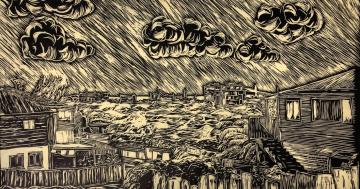
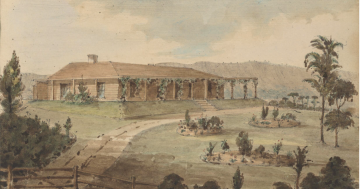
Moreover, we are fortunate in that in 1844 John Skinner Prout produced an image of indigenous people he presumably saw camped beside the waterway (photos 3 and 4).
As late as August 1889, “an aboriginal named Harry Rocking, well known in this district” is recorded as having “died somewhat suddenly at the camp, near the Tom Thumb Lagoon” with his death being ascribed to “consumption”.


What’s more, those indigenous people still camping on Salty Creek on the south side of Tom Thumb Lagoon only had “their humpies removed to Perkins Beach at Port Kembla” as late as 1914, according to a local newspaper.
Obviously at high tide and in heavy weather getting from Wollongong to Port Kembla by the quickest route meant crossing the wide waters of Tom Thumb Lagoon and so construction of the very rudimentary Trimmers Bridge began in 1900 (photo 5).
Eventually improvements were made to both the bridge and its approaches in 1947 and the following photo (photo 6) not only shows this structure but also gives a good indication of how even as late as 1950 the extent of Tom Thumb Lagoon, before massive extra infilling, still covered quite a vast area in wet weather and at high tide was often still open to the sea.
But an extensive watercourse such as Tom Thumb lagoon could only remain in a reasonably healthy condition if the water entering it was not contaminated and extensive natural native vegetation continued to surround it.
A watercolour from the 1850s shows the lagoon still in what looks reasonably good health (photo 7).
Encroaching industry and the creation of Port Kembla ’s inner harbour eventually ensured the former large wetland lagoon would be reduced to minuscule dimensions.
Nonetheless, one photo (photo 8) demonstrates a still substantial lagoon surviving close to both the rail line to Port Kembla and Springhill Road at the bottom – along with the once amazing giant sand dunes in the Port Kembla area seen at top right.
Further infill of the Tom Thumb Lagoon appears to have continued throughout the 1930s and 1940s and as demand for steel picked up after the end of WWII, construction of the Port Kembla Inner Harbour in the 1950s and 1960s got underway.
Plans by property developer Mayor William Wiley to turn the lagoon into a harbour began in the 1880s and ended with his bankruptcy (photo 9).
But the 20th century eventually saw creation of a deep water port (photo 10).
All that could then be done was to salvage remnants of a once a truly grand and remarkable wetland (photo 11).