
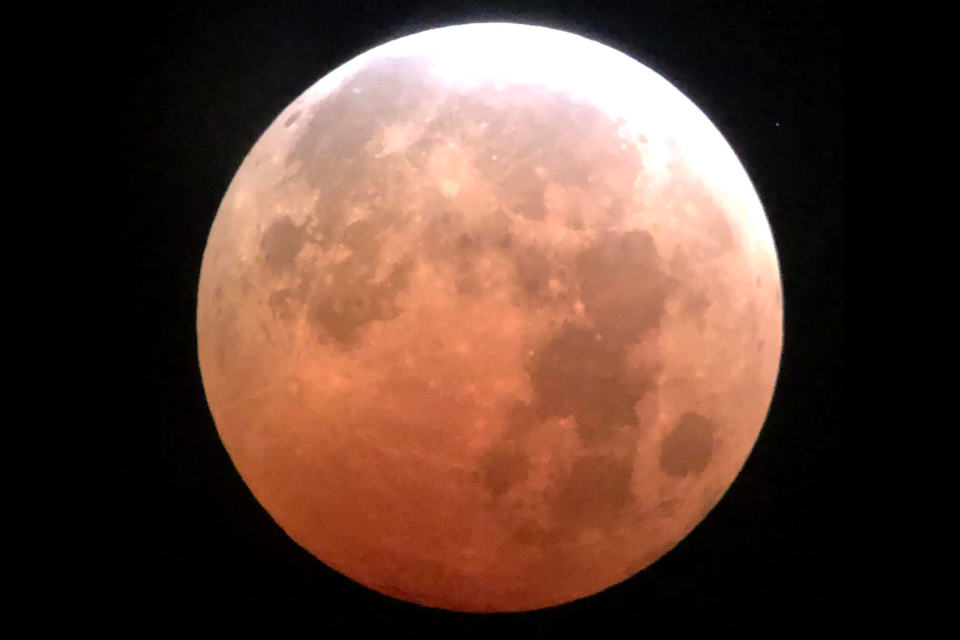
A lunar eclipse in March will double as a blood moon — and for a few reasons will be “the big” celestial event of the year, one expert says. Photo: Dr Brad Tucker.
From dramatic eclipses to rare moons, 2026 is shaping up as a standout year for stargazers.
And whether you have a strict 10 pm bedtime, zero equipment and/or live in a light-polluted city, there’ll be something for you in the night sky this year.
ANU astronomer Dr Brad Tucker says if you’re going to check out one celestial event this year, make it the total lunar eclipse taking place on Tuesday 3 March .
“This is the big one for a couple of reasons,” he says.
“Firstly, it’s a really cool one to look at, and you don’t need any special equipment, unlike a solar eclipse,” he says.
“It’s also at a very human-friendly time — by 8:50 pm, the moon will start passing the Earth’s shadow.”
At around 10:04 pm it will reach its peak, taking on a red hue. This “blood moon” is caused by sunlight still filtering through the moon’s atmosphere, scattering blue light and bending red/orange light onto the lunar surface — the same effect that gives us orange and pink hues at sunset.
From around 11:02 pm, the moon will start to emerge from the shadow.
On Sunday 31 May, we get a blue moon, which is almost your standard full moon. The reason it’s special (and an auspicious moon in many cultures) is its rarity — hence the saying, ‘once in a moon blue’.
Unlike the blood moon, a blue moon is not blue — it’s simply the second full moon in one calendar month. Due to the lunar cycle (about 29.5 days), this only happens every two or three years.
But the moon cannot hog all the celestial glory.
Planetary movements also provide a cool feature in the night sky, with multiple conjunctions, when our solar system’s planets appear to huddle closer together.
One of the most fascinating will be a cluster of Mars, Mercury and Saturn, best observed over multiple days from Sunday 19 to Wednesday 22 April.
Brad says it’s easily observed, and a great catalyst for pondering our place in the universe.
“To start with, planets are easy to find in the sky. They’re usually some of the brighter objects and unlike stars, don’t twinkle,” he says.
“Be up before the sunrise and look east and you’ll see them — Saturn, then a visibly red Mars to the left of it and a slightly fainter Mercury on top. They’ll be closest together on Monday 20 April.
“One of the coolest things when they’re that close is how, in the span of a few days, these objects can shift dramatically, even swapping positions because they move at different speeds across time.”
As Term 2 for NSW public schools starts back on Wednesday 22 April, the timing couldn’t be better, either.
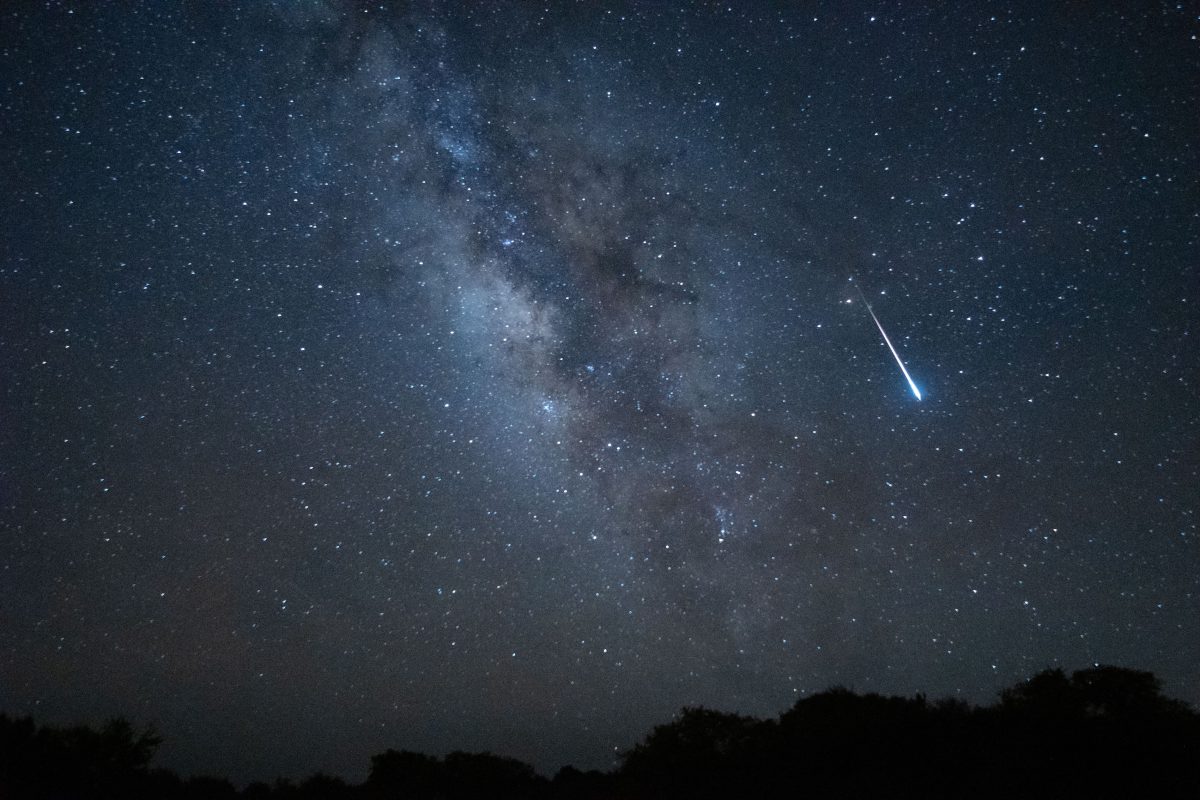
There are a few ways to optimise your meteor shower viewing experience, no matter where you live. Photo: wirestock.
While meteor showers are decidedly “Northern Hemisphere biased”, two reliably cool ones grace Aussie skies quite regularly — the Eta Aquariid in May and the Geminid in December.
Unfortunately, this year a very bright moon is expected to wash out most of Eta Aquariid’s meteors, but the Geminid shower is, fortunately, one of the best a skygazer could ask for.
“We talk about meteor showers like wine — and it’s a good year for the Geminid,” Brad says.
This year, the peak of the shower is predicted for the early morning of Tuesday 15 December, when there won’t be a visible moon.
“It’s a fairly reliable shower in that you’ll get one or two dozen per hour,” he says. “It can be sporadic, though. Sometimes you’ll see a bunch and then nothing for 10 minutes. But there are some things you can do to optimise your experience.”
For both of these meteor showers, look north-east. You needn’t go far — your local park or oval, anywhere with less immediate light, will do. If you live in a city, try to position yourself on the north side of it, with the city lights behind you.
And be patient.
“Give your eyes 10 to 15 minutes time to adjust to the darkness and you’ll notice, as you’re staring out, more and more objects will become visible to you,” Brad says. “And do not look at your phone.”
Capping off the year nicely on Thursday 24 December is a supermoon — a moon that looks significantly bigger and brighter in the sky.
This occurs when the variable orbit of the moon brings it closer to the Earth. They usually happen more than once a year, but rarely do they fall on Christmas Eve.
It’s a great spectacle for the whole family, because it’s best enjoyed at the very family-friendly time of sunset when the moon rises in the east.
Partly because the brain plays tricks on us (when the moon is closer to comparably smaller objects like trees), partly due to atmospheric effects, this moon is most impressive as it appears over the horizon.
“It doesn’t look as gigantic at night,” Brad says. “That means you can take a look and then get the kids off to bed, well before Santa arrives.”
More information on the night sky, star maps and more, can be found in the 2026 Australasian Sky Guide.