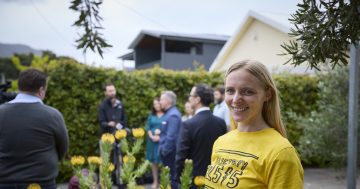
Electrify 2515 backers like Matt McCosker are thrilled with the extension of the electrification pilot to their neighbours in the south. Photo: Rewiring Australia.
Bulli residents could be, on average, thousands of dollars better off each year as the landmark Electrify 2515 community pilot officially expands into 2516, with major subsidies enabling the transition to a fully electric future.
Rewiring Australia is leading the ambitious, community-driven push to study how 500 electrified homes — equipped with solar and smart tech — impact the local power grid.
Until now, the pilot has applied to homes across Clifton, Scarborough, Wombarra, Coledale, Austinmer and Thirroul, removing barriers to electrification by subsidising electric hot water systems, induction cooktops and reverse-cycle air conditioning, and providing free smart energy monitors to track their savings in real-time.
The expansion into Bulli follows a strategic reallocation of resources originally marked for home batteries, following the success of the Federal Government’s separate Cheaper Home Batteries Program.
Subsidies do not apply to electric vehicles, solar, or batteries, as existing federal and state programs already cover these. However, households are still encouraged to integrate them into their home energy plan.
Early data from the first 100 households in the 2515 postcode indicates the average household can save approximately $900 a year by switching from gas to efficient electric appliances. When combined with rooftop solar and batteries, those savings can climb as high as $3100 annually.
Pilot operations manager John Buchelin said data and feedback from participants helped demonstrate that electrification could slash power bills and make homes safer and healthier, with implications for renewables nationwide.
“These are lessons that can be scaled nationally,” he said.

Bulli resident Jennifer Macey (right, pictured with Kate Tracey) has already electrified her household, and hopes to see a surge in uptake in the neighbourhood. Photo: Rewiring Australia.
Bulli’s early adopters have high hopes that the expansion will fuel uptake in the neighbourhood.
Bulli resident Jennifer Macey gradually electrified her household over 15 years, starting with a modest 1.5 kW solar power system and ending with leasing an EV.
She said her family saves thousands each year and hasn’t looked back.
“I know first-hand that the switch to electric can be expensive. Electrify 2515 subsidies will hopefully empower Bulli residents to make these big shifts,” she said.
“It looks like it’s going to be overwhelming, but it’s really not. I would absolutely do it again.
“We have a really good opportunity to do it now, and I hope my fellow Bulli residents will apply. I’m the working model that it works — you can start saving.”
The pilot is being funded by the Australian Renewable Energy Agency (ARENA) and delivered in partnership with Brighte and Endeavour Energy.
Dr James Hazelton of Endeavour Energy said he hoped the experiment would put to bed fears that the existing grid couldn’t cope with broad-scale electrification of homes with EVs, solar and batteries.
“We’re actively transforming today’s network into a dynamic, flexible platform that coordinates consumer energy resources in real time,” he said.
Brighte head of partnerships Nigel Freitas said mounting inflation and energy costs made the financial case for electrification undeniable.
“With incentives on the table and household budgets under pressure, it makes perfect sense for households to make the switch to electric hot water, cooking and heating and reap the benefits which follow,” he said.
Bulli residents are invited to attend a community info event on Sunday, 22 March, from 3 pm at the Bulli Surf Lifesaving Club to learn more and apply to take part in the pilot. For more information or to apply, visit electrify2515.org.