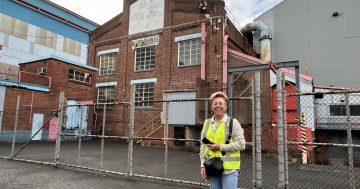
Cement Australia plans to upgrade and expand its Port Kembla Harbour operations. Photo: Cement Australia.
Cement Australia is planning a $250 million upgrade of its Port Kembla operations to replace its Glebe Island facility slated for closure by 2030.
In a scoping report tendered to the NSW Planning, Housing and Infrastructure Department, Cement Australia (CA) said it had operated from Glebe since 1992.
However, in February the NSW Government announced that the Glebe Island facility would close by December 2030.
CA delivers a range of cementitious products and services ranging from bulk and packaged cement products to alternative fuels and waste management.
It operates the largest cementitious manufacturing and distribution network in Australia, servicing customers in every state.
The company has been operating a grinding mill at Port Kembla’s outer harbour since 2014.
It currently produces 1.4 million tonnes per annum (Mtpa) of cementitious material (CM), including cement, slag and flyash, operating 24 hours a day, seven days a week. The mill sits on 2.5 ha of CA’s 4.5 ha lease area on Arawata Drive.
Products are dispatched from the site based on customer demand and according to CA’s scoping report, a busy day may see about 190 trucks each way to and from the site.
In its report, which is required before a formal development application is lodged, CA said it was intending to upgrade the existing Cement Australia Port Kembla Terminal and construct an import facility to enable it to dispatch a further 1.4 Mtpa into the NSW market.
As well, it also plans to construct an export facility to enable export by ship of up to 600 ktpa of cementitious materials into other states. The project will increase the throughput and storage capacity of the Port Kembla facility to 3.4 Mtpa of CM.
“With the announcement of closure of the Glebe Island facility, CA is proposing to replace its Glebe Island facility with a suitable facility at Port Kembla,” the report said.
“The project is necessary to offset the impact of the closure of the Glebe Island facility in December 2030, to ensure no disruption to NSW’s cementitious products supply and to increase the use of supplementary cementitious materials (SCM).
“The project will ensure that CA maintains its capacity to provide a significant portion of the cementitious material required for the Australian market and therefore the project is a major component in guaranteeing this supply to the construction industry.”
The report said CA was strategically located in the heavy industrial heart of Port Kembla, which allowed heavy vehicle access to major arterial roads, access to shipping facilities at the adjacent No 6 Jetty in the Outer Harbour and access to granulated blast furnace slag (GBFS) from the BlueScope Steelworks, as well as limestone and gypsum suppliers in the region.
“Furthermore, the location of the project site allows the impact of heavy vehicle movements to be limited to the major freight road network rather than have transport and traffic impacts on smaller local road networks within the area,” the report said.
“The project is ideally located to take advantage of the stockpiles of GBFS from the BlueScope Steelworks that is in close proximity to the site.
“The project site is also in close proximity to the main freight routes to access the necessary raw materials thus reducing the impacts of freight traffic on the roads.
“The delivery of raw materials (clinker and gypsum) by ship across No 6 Jetty consolidates the function of the port and reduces land based freight traffic.
“Furthermore, the labour force available in Port Kembla allows access to specialist knowledge to assist in operational maintenance of the project.
“The certainty of the supply of cement (and cement substitutes) is fundamental to the construction industry.
“CA provides a significant portion of the cementitious material required for the NSW and national market and the project is critical in guaranteeing this supply to the construction industry.”
The existing Port Kembla facility produces three products – general purpose cement, high early strength cement and ground granulated blast furnace slag.
The production process uses limestone, gypsum, GBFS and clinker, which is the major component by percentage weight in the production of cement. Clinker is mixed with limestone and gypsum to produce GP Cement.
There are three main elements to the upgrade proposal:
- Import and storage: an import and export facility to accommodate the Glebe Island operations as well as expected future growth. This will include either 15 new steel silos or two concrete silos, along with six or eight new weighbridges
- Export: three new steel silos, a conveying system from the silos to No 6 jetty and associated works
- Ship unloader: installation of a ship unloader at No 6 jetty and any required strengthening or structural modifications to the jetty.
Cement Australia said it intended to consult with the community, including holding information sessions, when it submitted a formal application and environmental impact statement to the Planning Department.