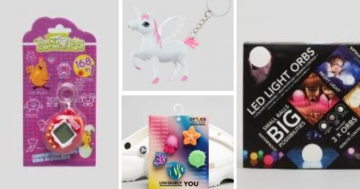
A virtual pet toy and keyring were among toys that allegedly contain dangerous batteries. Photos: ACCC.
A surf and skate retailer has failed to overturn a $14 million fine for an “egregious” failure to know — and follow — button battery safety regulations.
In April 2025, the Australian Competition and Consumer Commission (ACCC) announced it had begun Federal Court proceedings against Fewstone Pty Ltd. The company trades as City Beach, with more than 65 stores Australia-wide, including Wollongong and Shellharbour.
The ACCC action was taken against products containing button batteries, which are small, circular batteries that can cause harm or death if ingested.
Three children have died in button battery incidents in Australia.
Between 22 June, 2022 and 24 October, 2024, the company sold 57,278 non-compliant products that breached safety standards or were improperly labelled with safety messages.
In the Federal Court in December 2025, Judge Elizabeth Downes handed down a $14 million penalty.
The Federal Court of Australia has now dismissed an appeal, which argued that the penalty was manifestly excessive.
In their decision, Judges Joan Collier, Anna Neskovcin and Andrew Moore said the company had committed an “egregious” failure by not following relevant legal and regulatory standards.
The three judges rejected City Beach’s argument that the penalty was manifestly excessive, pointing to the maximum penalty that could be awarded, the company’s size and resources, and the offending itself (including the risk to which customers were exposed).
“The penalty fixed by the primary judge was not excessive at all, let alone so manifestly excessive as to demonstrate a failure in the exercise of discretion,” they said.
The court heard that City Beach had proposed a $3.15 million penalty.
In its appeal, City Beach argued that the relatively low income from the problematic products (a total of $34,368 in the 2022 to 2024 financial years) should be considered when calculating the penalty.
The appeal judges rejected this claim.
“Such an approach erroneously seeks to constrain the appropriate penalty by some mathematical relationship with the direct profit from the contravention,” they said.
“The sale of a very dangerous but very cheap product contravening a safety standard may be a paradigm example of a circumstance where the appropriate penalty may bear no relevant relationship to the profit … because of the heightened need to deter corporations from ever selling such a product, or from failing to have systems and processes in place to protect against such products being supplied to consumers.”
The judges said City Beach had failed to take “necessary steps” to ensure its products were compliant and had been slow to carry out a recall.
The non-compliant products, many of which were marketed to or intended for children, included toys, digital notepads, keyrings, lights and light-up Jibbitz accessories for Crocs shoes.
At least one of the products was labelled as being for children aged “6+”.
While City Beach’s lawyers said the initial proceedings had erred in finding the problematic products were marketed to children, the appeal judges rejected this.
They said that argument was a “misunderstanding” of the judge’s reasoning.
“That does not mean that City Beach engaged in any active promotion of the product,” they said.
“It does not mean that there was an advertising campaign. It simply means that the packaging of the product itself is designed to market the product in that way.”
They also described measures taken by City Beach — such as organising annual education seminars and a new quality assurance process — as being steps that a “responsible retailer” would have taken.
“City Beach’s submissions on its voluntary recall both at trial and on appeal indicate that City Beach has, even to this day, not fully appreciated the serious risk that children were exposed to by its conduct and the resulting urgency in conducting a voluntary recall of the products.”
The decision means the multimillion-dollar penalty, believed to be the first of its kind in Australia, will stand.
City Beach will also have to pay costs.
The appeal judges said the case called for weight to be placed on deterring companies from similar offending (including City Beach in the future).
“It is hardly a surprising proposition that there might be quality or safety standards applying to goods sold in a retail business, and that the retail business may be responsible for ensuring that goods contravening those standards are not sold.
“It is one thing for a person to make a mistake or for a system to fail in some respect.
“It is another thing entirely for there to be no system at all because a business has not taken the requisite steps to understand the regulatory requirements applying to that business.”
More information on Australia’s mandatory button battery standards, which came into effect in June 2022, can be found here.
Original Article published by Claire Sams on Region Canberra.