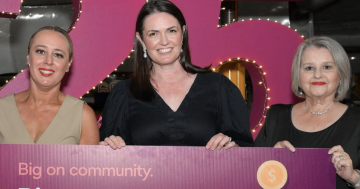
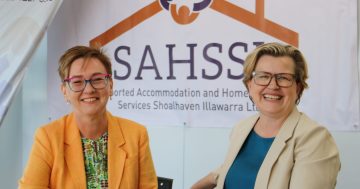
Minister Paul Scully, IWHC interim general manager Tonina Harvey, WHHHS CEO Mandy Booker and Bendigo Bank chairperson Geoff Egan formally launch the partnership. Photo: Keeli Dyson.
Two Illawarra not-for-profit organisations have partnered to better assist women and children experiencing homelessness, with a community-centred initiative providing wraparound support and safe pathway for those in need.
Wollongong Homeless Hub and Housing Services (WHHHS) and Illawarra Women’s Health Centre (IWHC) have responded to the housing and safety crisis impacting the region by combining their areas of expertise to create holistic support, better stability and improve outcomes, particularly for those escaping domestic and family violence.
“At the health centre we have case managers who help women with finding what they need and connecting them into psychosocial supports, advocacy and financial supports,” IWHC interim general manager Tonina Harvey said.
“We deal with a lot of women experiencing domestic and family violence, and often we have women coming to us wanting to leave but having nowhere to go, not sure what to do or how to navigate the whole system.
“The way this partnership works is we have one allocated case worker who will come up and work from the Homeless Hub and work with the staff here and with the women that are coming through and case manage them while they find them some property.”
“Having the housing that we’re able to put up for this partnership and having the women’s health centre coming on board to do that longer term wraparound support really will give women and children of the Illawarra some stability,” WHHHS CEO Mandy Booker said.
“I think that is how we break that cycle, not about just that short term crisis work with people, it’s about that long-term recovery and really allowing people to work at their own journey, at their own time rather than being in that crisis in-and-out space.”
The integrated service model allows women to have access to transitional housing as well as individualised case planning, advocacy, referrals, health and wellbeing services, counselling, workshops and practical supports designed to help sustain tenancies and build long-term stability.
Each approach is personalised to best meet the needs of the individual.
“People often need a foundation of a lot of different supports depending on their level of resilience and what they’ve been through,” Tonina said.
“It varies from person to person and whether there’s children involved or not children involved is another issue, so really we’re just asking the woman what she needs and work with her around that.
“We make it client centred because there’s no point us trying to achieve goals for somebody who hasn’t got those goals or vision for themselves.”
“I think what it does is make generational change,” Mandy said.
“We see the children that don’t get the same opportunities that other children get from having stable housing and being able to have school attendance and all of the social activities that come with having a stable family home – it’s absolutely critical for the next generation.”
The initiative has already made a difference in the lives of local women, with one participant able to regain stability and rebuild her life after a house fire in January left her homeless and facing trauma, financial hardship, post-separation violence, complex mental health concerns and physical injuries.
“Through case management, advocacy and our Wollongong Homeless Hub partnership, we successfully nominated her for transitional accommodation giving her a safe and stable place to live,” Tonina said.
“Our caseworker also connected her with mental health support, financial counselling, welfare rights advocacy, emergency relief, legal services and community programs.
“She has been supported to join social connection and psychoeducation groups through IWHC and the Women’s Trauma Recovery Centre, reducing isolation and building confidence.”
Wollongong MP and Planning Minister Paul Scully said the partnership showed potential to be upscaled and replicated in other areas, with housing and homelessness a statewide concern.
“If this demonstrates that it can happen and it can work, which I’m confident that it can given the people involved, then we’ve got to take that experience, take that learning and understanding of how it could be done and see where we could apply it to other regions,” he said.
“It may end up that this is a good approach to do in outer metropolitan and larger regional centres where there is a concentration of service providers that can work together and if that’s something that comes out of the work here then that’s a good outcome.”
But despite several construction projects underway with support from the state and federal governments, transitional housing supply is still below the need and the organisations are stretching every dollar to meet the needs of the people who use their services.
This initiative was made possible through the support of Bendigo Bank Oak Flats and Gerringong which donated a $50,000 boost for the project after having already supported the not-for-profit organisations in the past.
“Having that investment and having that enduring connection in the funding is important,” Tonina said.
“In this sector even though we have government funding it’s not even covering all the basics at the moment.”
“This is really truly a community initiative that’s coming together so having Bendigo Bank on board to put money back into the community that supports their banking is a really important aspect for people to understand that by supporting places like Bendigo Bank they’re supporting their communities as well,” Mandy said.
More information about services and supports available through the WHHHS and IWHC are available on their websites.