The Maltese community in 1953 were visited by Archbishop Michael Gonzi, but they still didn’t have a centre to congregate in. Photos: Supplied.
A Cringila community centre founded on the need for connection within the newly migrated Maltese residents who called the Illawarra home in the 1950s is celebrating 75 years since its committee was first formed, creating the foundations for the vital hub it is today.
In 1951, in the outskirts of the employment hub that was Port Kembla Steelworks, migrants from Malta were making Cringila their home after coming from across the seas to start their lives in the Illawarra.
“They all lived here and built their own houses, they were allowed to build extensions in those days much easier and they would host two or three families until they got on their feet where they would then purchase land and then build a house,” George Cross Falcons Community Centre president Louis Parnis said.
“A lot of people would’ve felt that they were uncomfortable, leaving their mum and dad, sisters – they were getting a bit homesick.
“But where do you go? You can’t fly 24 hours and there would be no ships going, so you only come, you don’t go. They had to make the most of it.”
With no communal place to call their own, a small group set out to create a hub for the Maltese community, officially forming a committee on 10 June 1951, setting in motion steps for fundraising and logistics to buy a block of land and create the space they needed using their very own hands.
Peter Micallef came to Australia at 18 in 1958 and by 1959 he was part of the movement.
“I was told by the others that we intend to build this club, we used to call it a club then, and I said, ‘Well, I want to be a part of it,'” Peter said.
“Those days to get a dollar for these sort of things was hard, even if you go and ask people to make an effort it was like squeezing blood out of a stone.”
Not long after he joined, they broke ground on the site, building the centre brick by brick without machinery or professional help.
“It was all volunteer, nobody ever got a cent for it; we did it from our own heart,” Peter said.
“I used to go to work … when we finished work – those days used to be from seven o’clock to half past three – come here, put a brick or do a bit of concrete or this or that and come seven o’clock you go home.

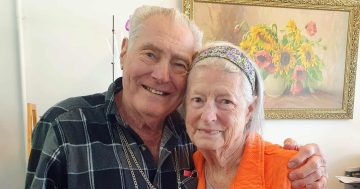
Peter Micallef, pictured with his family, has been a part of the centre for more than seven decades.
“Unless we dirty our hands it wasn’t going to happen because there was no money.”
They soon had a bunker-like structure where they could gather, but a bigger vision saw the centre take shape.
“Next minute you’ve got a little room where they can have coffee, and that’s actually how the club originated,” Louis said.
“And then as time evolved, they started to build what the club looks like today, but the club was built in about five sections because there was no commodity of two or three million dollars; it was like, ‘How much money have we got? Thirty pounds – let’s buy a door.”
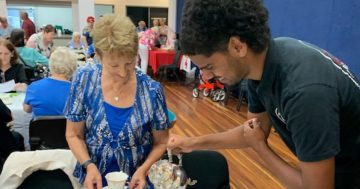
Those hard-earned foundations now form much of the George Cross Falcons Community Centre today, hosting hundreds of people for lunch every Monday as well as events and community groups who need the space.
“It’s still a part of my heart,” Peter said.
“I’ve been here 70 years; there’s hardly ever been a week that I’m not here.
“I reckon it’s beautiful; I go to a lot of other clubs but when I come here it’s different, it’s a family.
“You appreciate it because you did it with your own hands, that’s what I’m proud of.”

More than 100 people gather at the centre every week, with inclusivity at the core of its culture.
Maltese presidents, prime ministers, archbishops, clergymen and other dignitaries have walked through the doors of the hub which has continued to thrive and play an important role for not only the Maltese community but other cultures who share the space.
A large part of its ongoing success in the modern day has been due to the centre’s president Louis Parnis, who has been at the helm for more than two decades.
But his involvement actually came by accident, when he was nominated to join the committee after merely coming along to a meeting to help transport his father-in-law.
“I did not know that the club was on its way down to be sold if no-one took it over,” Louis said.
“I went to the first meeting and I could tell they weren’t going anywhere and they were in big trouble.
“They thought in their heads because all the Maltese had left Cringila by now, they’re all in Dapto or Shellharbour and Kiama, they thought because they left the club’s not needed – but it was needed more.”
He helped bring it into the modern age while still honouring its purpose and origins with two men’s sheds, a community garden, a memorial for the Maltese soldiers who fought in World War I, murals and a museum with artifacts and items connecting Cringila back to Malta.
“A lot of the elderly are never going to be able to go back, so what we try to do is we bring back what they can’t visit and see,” Louis said.
Importantly, he helped improve the financial sustainability and longevity to ensure it can continue to be used for years to come, and although the centre benefits from grants from all levels, it’s not out to make money.
“That gives us incentive to work harder, not less – so the more we get the harder we work,” Louis said.
“Why be greedy? Why do you want $1.20 when $1 is enough? And that’s a policy I work on.
“What’s important is that we are giving more than we take.”
To find out more or to contact the centre visit the George Cross Falcons Community Centre website.