David Finlay’s spectacular shot of the Aurora Australis at Gerroa on 1 June 2025. Photo: David Finlay.
By day David Finlay has his feet firmly on the ground, but by night you’ll find him with his head in the clouds.
In the dead of winter, when the sun has set, and the chill is rising up from the earth, most people retreat indoors to curl up in front of the heater. Not David. The Transport NSW manager shrugs off his work high-vis, grabs his camera gear and boots and heads outside to join the creatures of the night.
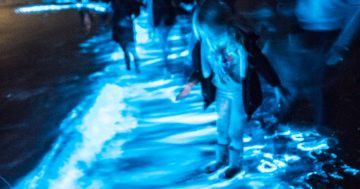
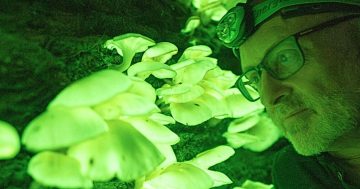
Whether he is ankle-deep in mud searching for glow worms in Helensburgh’s old railway tunnel, getting his feet wet looking for bioluminescence in the region’s waterways, hunting fireflies and glow-in-the-dark mushrooms in national parks or capturing spectacular lightshows like the Aurora Australis on film, the Kiama citizen scientist has made a habit of “going dark” to catch Mother Nature’s light.
“I would love to be able to glow in the dark myself; I think that would be a really cool superpower,” says David. “But I can’t, so I spend my nights searching for things that do.”
The 53 year-old, who grew up in Orange, credits his parents for encouraging his curiosity as a child and giving him time and freedom to explore the world beneath his feet and above his head.
“They knew I wasn’t a normal kid,” he laughs. “I was always outside lying on a blanket looking at stars. Then in 2017 I went to America with my Dad to watch a total solar eclipse and while we were there I discovered fireflies.
“It was literally a lightbulb moment, experiencing something so wondrous for the first time in my life, with fireflies landing on my shoulder and these silent lights dancing around me; it was unforgettable.”
The encounter sparked a passion for all that glows in the dark, with David’s spectacular photographs and vast knowledge making him a popular community speaker and one of the region’s most well-known citizen scientists.

David watching an eclipse. Photo: David Finlay.
Saturday 15 August marks the start of National Science Week and this year volunteers like David are being celebrated for the work they do behind the scenes to support scientific research and data collection.
David is among hundreds of volunteers hosting talks in libraries across the nation as part of Citizen Science Corners, a Science Week partnership between the Australian Citizen Science Association and Australian Library and Information Association.
Australian Citizen Science Association chair Stephanie von Gavel says the initiative is an opportunity to showcase the often “invisible” work of citizen science volunteers and highlight the “social cohesion” created when communities come together across age groups and backgrounds to work towards a common goal.
“Citizen science delivers enormous value to Australian science, conservation and public health,” she says.
As part of the Science Week series, David will host a nature talk on skywatching, auroras, meteorites and eclipses at Shellharbour Library on Thursday 20 August. He will share his knowledge on astronomical events that you can see with the naked eye and photograph with basic camera equipment.
David will also host a talk at Jervis Bay Museum and Maritime Gallery on Saturday 22 August on sea sparkles (bioluminescence), fireflies, glow worms and ghost fungi.
“Whether you are 70 or seven like me when I first discovered the wonder of the universe, science connects us all to the Earth and to each other,” he explains.

Capturing the Flaming Dragon comet from the Kiama hills. Photo: David Finlay.
An industrial chemist by trade, David has been a citizen scientist for more than four decades – educating people about the environment through data and information sharing – but until the early 1990s there wasn’t a name for it.
Then in 1995 British sociologist Alan Irwin and American ornithologist Rick Bonney coined the expression “citizen scientist” to describe public involvement in research. Citizen science is now a well-known, if not well funded, cornerstone of scientific data collection and analysis.
Estimates suggest there are more than 100,000 citizen scientists across the nation doing their bit to help tackle climate change, biodiversity and ocean health by supporting scientific analysis and research through activities such as annual bird, whale, dolphin and bogong moth counts, to name just a few.
However, James Cook University Professor Adam Smith believes this figure is a “major underestimate”, with his research suggesting there are closer to a million citizen scientists across Australia working alongside professionals.
David is proud to be among a national cohort of volunteers doing their bit to educate others about the wonders of the natural world.
“It really is the greatest show on earth and I don’t have to spend $300 on a ticket like I would for a concert; I just have to be curious,” he says, explaining that his transition from stargazer to star speaker was a “happy accident”.

A total lunar eclipse in 2022. Photo: David Finlay.
In 2024 David decided to share his magical night-time discoveries with the wider public, offering free, guided firefly tours at Macquarie Pass. His social media post went viral, with thousands expressing an interest in the experience.
His idea for a free walk and talk snowballed and sessions booked out in minutes. David was not interested in the business of running guided talks but realised people had a real thirst for knowledge and a passion for getting out in nature.
So he scaled back the firefly walks to protect the fragile ecosystem and began sharing information and spectacular images of his firefly encounters, bioluminescence flares and sightings of comets, meteors, eclipses and auroras on his Instagram page.
His goal is to educate the wider community on the science behind the magic of things that glow in the night.
“Many of nature’s most spectacular shows happen after the sun goes down,” says David. “If people are inside nesting, with their eyes on screens, they’re going to miss it. I want to teach them about what’s out there and how to preserve it.”