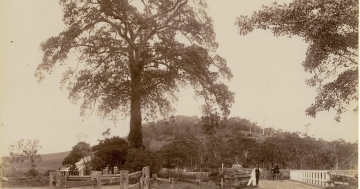
Lake Illawarra from Dunster’s Hill. An anonymous watercolour from 1871. Photo: Supplied.
Not too many white people in Illawarra get the honour (dubious or otherwise) of having their surname attached to an identifiable local place.
Charlie Throsby Smith (1798-1876) seems to have done OK with Smith’s Hill and his surname likely will hang on for maybe another century or more.
And without needing the help of a high school to enshrine their name long after they have gone the way of all things, the indigenous men Tullimbar and Charlie Hooka (as I revealed in last week’s article) have somehow managed to cement their monikers on the lips of Wollongongers more than a century later.
But Edward Geard hasn’t fared as well as Charlie Smith (even with the help of St Therese’s Church and the Illawarra Grammar school nearby) and only a few ageing Illawarrans would probably ever have heard of either him or his eponymous West Wollongong hill.
However the bloke who later bought Geard’s house, William Robson who came to Wollongong to open the Osborne-Wallsend colliery, has done slightly better and at least has a street in Keiraville today named after him.
Reidtown was named after Robert Sparkes Reid. He was a Scottish-born convict who once owned 240 acres (97 ha) encompassing some of the area stretching down Fairy Meadow and Towradgi way. But the suburb once dubbed Reidtown is likely today mostly unknown.
Yet Gwynneville – named after the brothers John and William Gwynne – has somehow done better and their surname has hung on tight.
James Cram, whose surname once graced Cramsville at Balgownie, however, has lucked out and his surname has also gone the way of many Wollongong things.
Smedley’s Hill at Old Bulli has also faded into the mists of historical time but Dr Cox’s property at Corrimal – called Summer Hill – was (despite its sunshiny moniker) for a very long time also called Cox’s Hill by the locals and there may even be a handful still alive who call it that to this day.
Dunster’s Hill – the rare 1871 watercolour view from which graces this current article – is yet another Illawarra eponymous eminence. It was named after a Joseph Dunster (1788-1861) and his wife Mary who died in the year the painting was executed.
Some then thought the pleasing vistas to be seen from Dunster’s Hill were among nature’s finer panoramic gifts to Illawarra.
In December 1871 Dunster’s Hill became the site of a special Christmassy “Sabbath School Picnic” on Dunster’s land, about two and a half miles (4 km) west of the Shellharbour township. And the event caused one local journo to wax exceedingly lyrical: “A more delightful spot than that chosen for the day’s pleasure it is impossible to conceive of, a charming prospect indeed is presented from Mr Dunster’s hill. This hill is some 400 feet above the level of the sea, and is the crowning height of many others which spread in beautiful undulations at N.,S.,E., and W., presenting a delightful view of hill and dale.
“A commanding view of the district is obtained from this hill: on the south the Minnamurra is seen flowing oceanward, beyond it the heights south of Kiama; on the north is a splendid view of Lake Illawarra, its blue waters the very picture of calm repos; beyond it is seen Dapto and Wollongong, backed by the Illawarra range, Keira and Kembla being prominent objects in the scene.
“Looking eastward most of the buildings in Shellharbour township are in view, and stretching into the broad Pacific, Point Bass is seen on the S.E., and on the N.E. the Five Islands are full in view. The lovers of beautiful scenery would indeed have to travel far to find scenery of greater beauty. The hill top is crowned by the neat residence of Mr. J. Dunster, whose charming family and well-regulated household harmonize well with nature’s surroundings.
“Westward of Mr. Dunster’s is a fine view of the Illawarra Range, which forms the back ground of a succession of heights which own their origin to that Plutonic agency which upheaved the range, and caused it no longer to be the sea margin. When this range was upheaved, the molten trap pierced the ocean’s floor and raised the whole of the district coast, draining the waters therefrom, and leaving those numerous trap hills which diversify the prospect and give fertility to the soil.”
Remarkably the 1871 watercolour which graces this story – although by an anonymous artist – was advertised as being on exhibition in a Wollongong printery office (there then being no art gallery in The Gong) in the very year of its creation: “There are now on view at our office four watercolour sketches by a gentleman residing in this district … They reflect considerable credit, as works of arts, on the gentleman who produced them: View from Westmacott’s Pass, The Illawarra Fig Tree, on the Dapto road with Mount Kembla and scenery in the background, View of the Illawarra Lake from Dunster’s Hill, Shellharbour and sketch of the Macquarie River, near its source.”
Now how totally way nectar is that?