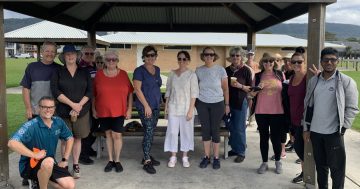
Trudie Campbell and Alanna Hoye from the ISLHD Community Asthma Service together with Healthy Cities Australia’s Alexander Brown demonstrate a puffer and spacer at a recent workshop. Photo: Alexander Brown.
The Illawarra might be known for its fresh sea breezes, but this Tuesday (5 May) brings a reminder that for more than 18,000 Wollongong residents, each breath can still be a struggle.
This World Asthma Day brings to light a sad reality: while most people with asthma can live full and healthy lives with the right treatment and support, many Aussies are missing out due to cost, access, lack of information or other barriers.
This year Breathe Better Illawarra (BBI), a Healthy Cities Australia asthma education and advocacy initiative funded by Asthma Australia, partners with the National Asthma Council Australia, Illawarra Shoalhaven Local Health District Community Asthma Service and COORDINARE: South Eastern NSW Primary Health Network to deliver the 2026 Asthma Update.
The free training opportunity for registered healthcare professionals will feature local experts in respiratory and emergency medicine and keynote speaker, National Asthma Council Clinical Executive Lead Professor Debbie Rigby.
They will spread the word about the major changes to asthma treatment recommended in the latest edition of the National Asthma Council Australia’s Australian Asthma Handbook.
Healthy Cities Australia Asthma Program Coordinator Alexander Brown said asthma was an often underestimated illness.
“It’s such a common condition but, perhaps because of that, it’s often not taken seriously enough,” he said.
“A lot of people just live with mild symptoms and treat it as if that’s normal.
“It’s often treated as an acute disease and it’s not — it’s chronic, it has to be managed all the time, and properly.”
National guidelines have changed to warn against an overreliance on over-the-counter medications.
“A lot of asthma sufferers when they get breathless or wheezy will rely solely on those blue puffers you can get over-the-counter,” Alexander said. “If you’re relying solely on that, you’re at higher risk of having more severe flare-up.”
While most asthma deaths are preventable, effective treatment requires combined therapies.
In fact, if you’re using more than three of the ubiquitous blue puffers a year, you’re at risk of a dangerous exacerbation. More than 12 a year is associated with increased risk of death.
“The key message for the public is, it might be time to check with your doctor to see if there is a more appropriate approach to your asthma management,” Alexander said.
Another warning comes with flu season.
At least 80 per cent of asthma flare-ups are caused by viral infection.
“People with asthma have a particular need to ensure they get their vaccination,” Alexander said.
Members of the public living with asthma have resources available to them to help manage the disease.
Asthma Australia is the national consumer organisation for people with asthma and can be contacted for free advice on 1800 278 462, or you can book an appointment online.
Locally, you can call ISLHD Community Asthma Service on 1300 792 755 to make an appointment for clinical review with a nurse specialist.
Registered healthcare professionals who wish to attend the 2026 Asthma Update can register via COORDINARE.