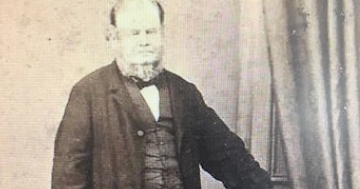
Legendary rugby league player Ken Irvine, who was known for his scorching speed. Photo: Supplied.
In the 1960s the legendary rugby league winger Ken Irvine had tremendous speed.
No-one could catch him if he got in front of them and he was once put to the test at Kembla Grange.
You can see Irvine in footy action at this video link.
But back in the 1820s, John Dunlop Wylie (also spelt Wyllie) should have also been a winner.
Arriving as a free settler aboard the Greenock in November 1823, by January 1824 Wylie already had four convicts assigned to him. More on those hapless convicts later.
Wylie decided to become a farmer and grazier and called his promised Illawarra land grant Dunlop Vale, but by 1830 his debts were big and his mortgagees closed in.
His Illawarra lands – 809 ha (2000 acres) in his own name at Kembla Grange – were pretty soon in the Presbyterian clutches of others, one being the troublesome Reverend John Dunmore Lang, who had come to Australia on the Greenock with Wylie and the other being the Carruth brothers.
Reverend Lang claimed that the Carruths “came from same part of Scotland as Wylie and professed to be his friends, if not his relatives”.
By 1833 Lang declared he had “no confidence at all in Mr Wyllie’s ability to manage his own affairs” and that “the two Carruths, who professed to take a deep interest in his welfare, and were thorough farmers, got two-thirds” of half of Wylie’s land. The Reverend Lang took control of the remaining 404 ha (1000 acres).
Lang also claimed that “how Messrs. Garruth paid Mr Wyllie for their portions of the land, or whether they ever paid him at all, and how the partnership was conducted”, he couldn’t tell.
Having later gone to England during 1833, on his return Lang found that ”Wylie had fallen into bad health, that the Carruths had got tired of keeping him at the Illawarra farm and had brought him up to Sydney and, instead of supplying the necessary funds from the partnership for his decent maintenance in some respectable boarding-house, they had simply got him into the general hospital as a pauper, where he died shortly”.
The Carruths then sold 404 ha (1000 acres) of Wylie’s former land to a Dr Gerard Gerard and went to New Zealand. And it was Dr Gerard who seems to have given Wylie’s former acres the name Kembla Grange. This property would later be acquired by a former Illawarra convict named Robert Haworth who remarkably went on to become Mayor of Wollongong.
The four convicts originally assigned to Wylie also had very mixed fortunes.
William Rochford (also spelt Ratsford) was a cotton spinner. He arrived on the Agamemnon with a seven-year sentence for robbing a pub in 1820 and was assigned to Wylie in 1824. By 1827 he had obtained his Certificate of Freedom. Yet by 1828, charged with robbery he absconded and had a £5 reward on his head.
Spelling, however, seems to have saved him for in 1828 under the name of Ratsford (rather than Rochford) he was again accused of robbery but was miraculously acquitted.
The other convict assigned to Wylie in 1824 – Joseph Lenny (also spelt Linney) – had been convicted for having forged banknotes. He got a sentence of 14 years and arrived aboard the Prince of Orange in 1821. He seems to have served out his sentence and then also disappeared into historical obscurity.
Another of Wylie’s 1824 convicts – Isaac Radford – had also robbed a pub but got a life sentence for his trouble. He had arrived in NSW on the Batavia in 1819 but was apparently troublesome and was sent to Newcastle as a secondary place of punishment. He finally obtained a Ticket of Leave but it was cancelled in 1832 because he was accused of “selling property presumed to have been stolen”.
In 1991 the well-known Australian singer-songwriter John Williamson came up with his Beachcomber From Wollongong lyric using Kembla Grange as rhyming slang: “The old codger sure looks strange/ Hoping to find some Kembla Grange/ Around Wollongong.”
But, apart from some big losses by mug punters at the Kembla Grange racetrack over the years, the course had one of its biggest operational losses in October 2025 when a sprinkler malfunction overnight soaked a 200 m section of the home straight and the entire race meeting was abandoned despite perfect weather.

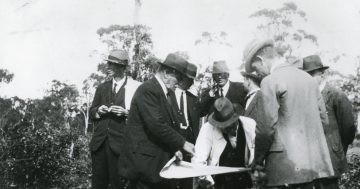
Ken Irvine takes on Gili at Kembla Grange in 1963. Photo: Supplied.
One of the biggest 20th century Kembla Grange winners (or losers, as records vary) was in 1963 when the celebrated rugby league player Ken Irvine attempted to outrun a seven-year-old horse named Gili that had won 11 Metropolitan races over 60 yards (55 m).
Irvine was blessed with scorching speed and had run 100 yards (91 m) in 9.3 seconds – setting a world professional sprint record.
Irvine ran on a specially prepared strip alongside the outside rail and managed to grab an early lead, but the horse ran him down and won in a fraction over five seconds.
Local memories of the event suggest that Irvine had actually won the contest against Gili at Kembla Grange racecourse in August 1963 but the surviving photos suggest otherwise.