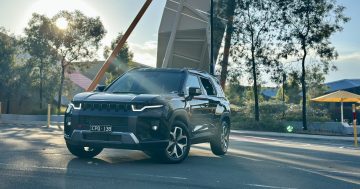
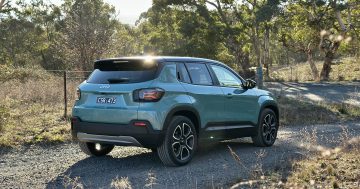
The 2026 KGM Musso EV. Photo: James Coleman.
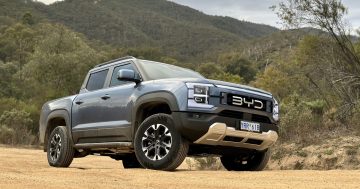
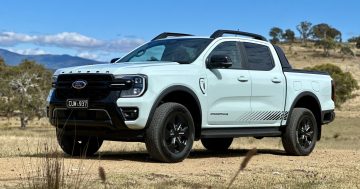
The king of utes has gone electric. Yep, a fully EV-ified version of the venerable Toyota HiLux is about to go on sale in Australia in the coming weeks, starting from $74,000 for the base SR metal-tray variety and $82,990 for the body-tubbed SR5.
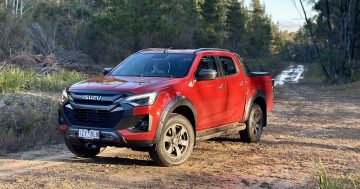
At some point soon, maybe by the end of the year, we’ll also get an electric Isuzu D-Max – even if rumours of a price-tag over $100,000 sounds like it’s over before it’s begun.
So, is there any point me talking about today’s test car? It’s an electric ute, but chances are, you’ve never heard of the brand. Certainly most passers-by on the road gave it the second take you’d give a barber if you caught him trimming a customer’s underarm hair.


Except it’s better than the HiLux in one key area – driving range.
Toyota claims its EV ute can do up to 315 km, while the more basic model is down to around 245 km. And that’s without hitching up to 2000 kg of braked trailer or caravan to the back. As for the D-Max, that will barely crack 325 km. Both utes would struggle to get from Canberra to Sydney on a charge.
My KGM Musso EV, however? Up to 420 km for my two-wheel drive spec, and 380 km for the heavier all-wheel drive. Positively benevolent in comparison.
But. What about everything else?
What is it?
Put simply, KGM is what SsangYong used to be. There was a brief period when it flirted with KGM SsangYong as the name, but this obviously got too complicated, so KGM it is.
It stands for KG Mobility and despite what you might think, it’s not Chinese, it’s South Korean. But while fellow South Koreans Hyundai and Kia were good little students in school and have gone on to achieve great things for their country, KGM has only just picked itself up and dusted itself off from a life of drugs. How else do you explain the design of the SsangYong Stavic?
Its ute, the Musso (South Korean for rhino, hence the side badge), also exists as a conventional 2.2-litre turbo-diesel, but for the Musso EV, it’s a whole new design as well as drivetrain. Some said Jeep. I say funky. And really quite handsome.

Not as big as other ute trays, but it’s still got all the tie-down hooks. Photo: James Coleman.
The actual tray bit is stubbier than most utes, but the overall proportions work well. You just have to deal with the odd bit of superfluous plastic, like the small plastic rails on the top of the bonnet – like anyone’s actually going to airlift it by helicopter into the DMZ.
Underneath, there’s the option for one electric motor over the front axle, for $60,000 driveaway, or a motor over each axle, for $64,000. Power ranges from 152 kW to 266 kW accordingly.
What’s it like to live with?
Having recently sampled the KGM Torres SUV, I was fearful of my week with the Musso EV. Would the main screen decide to randomly turn off? Would the steering wheel be awkwardly large? And would it drive like one of those shopping-centre kiddie rides?
No, actually. None of the above.


It’s true the Bluetooth blacked out occasionally. And I had to remember to plug my phone in to use Apple CarPlay – which is getting annoying in 2026.
The screen is also painful to find your way around – it took me a day of poking and prodding through menus to find out how to change the drive mode. And every physical button that was needed was plastered on the steering wheel, so the result looks like a Scrabble board.
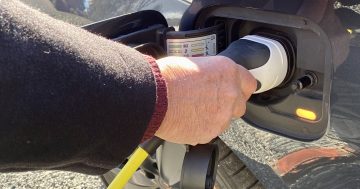
I also don’t like cars that sing or talk to me. And boy, does this one do both. It feels like there’s a different jingle for every operation – locking it, unlocking it, getting too close to the car in front, you name it. And when you plug it into charge, the voice of a South Korean woman emanates from somewhere onboard to announce “charging started”.

Where all the buttons went. Photo: James Coleman.
But you do get heated leather seats front and rear and once you find the button, a heated steering wheel. The sound system also far exceeds last week’s Lexus. Apparently even the suspension can “self level” when you pile the tray with heavy stuff. So it’s very well-equipped.
The body does shudder and bang over small bumps, like it’s very tightly sprung. Pull up to an intersection and it continues rocking slightly like a spring door stopper you’ve just twanged. But it’s comfortable enough and easy to steer.
Being smaller than most utes, it’s nimble too – even if you have to work around an initial delay when putting your foot down.
The verdict
Time has yet to tell how useful electric utes will really prove themselves – even with a range of 420 km. As my family’s recent trip to South Australia in China’s plug-in hybrid GWM ute proved, diesel is still king for long and rough stuff.
But KGM surely knows this. It’s why the Musso EV is shaped more like a toy ute. And – when I eventually found them – has only two drive modes of Eco and Sport (there’s nothing for off-road). Towing capacity? 1800 kg, if you must. And in the real world, where I tested it, your range is closer to 380 km.
But for now – and especially considering the price – it’s the best one out there.

The rear suspension “self levels” depending on how much weight is in the back. Photo: James Coleman.
2026 KGM Musso EV 2WD
- $60,000 driveaway
- Electric motor, 80.6 kWh battery, 152 kW / 339 Nm
- Automatic, front-wheel drive (FWD)
- 420 km claimed range
- 1800 kg braked towing capacity
- 2165 kg
- Not yet rated for safety
- 7-year, unlimited-kilometre warranty
Thanks to KGM Australia for providing this car for testing. Region has no commercial arrangement with KGM Australia.
Original Article published by James Coleman on Region Canberra.