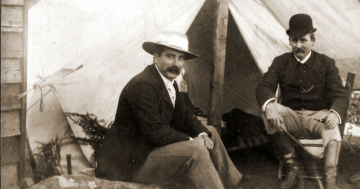
The 19th century Summerhill residence in Corrimal, showing members of the Midgley and Cox families relaxing following the marriage of Arthur Midgely and Mary Doncaster Cox in 1876. Photo: National Library of Australia.
I was born to completely non-religious parents and so never darkened the door of even a local Sunday School.
Yet my parents were married by a grandson of the Chief Rabbi of all Vienna who just so happened to have turned up in Thirroul as the ordained Presbyterian Minister from 1949 until 1966.
My mum and the Reverend only became acquainted while walking their dogs around Thirroul and when she told him she was getting married she felt she couldn’t say no when he asked to perform the ceremony.
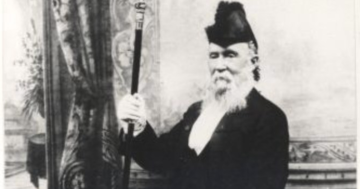
Thirroul’s Reverend William Pollak was a highly cultured former resident of the “Asparagus Castle” in Vienna who not only knew the famed playwright Bertolt Brecht but also, surprisingly, once worked as Marlene Dietrich’s private secretary.
Exotic Illawarra religious figures have thus become a source of some fascination.
For example, John Stephen Hales (born in Thirroul in 1920) went on to become the world leader of the Exclusive Brethren – currently known as the Plymouth Brethren Christian Church.
This sect had been meeting in Thirroul since 1893 and were known locally as The Saints.
By 1987 John Hales had become the sect’s Elect Vessel – someone believed to be uniquely guided by the Holy Spirit.
And it was Hales who began to steer the controversial sect away from strict isolationism towards sophisticated groundwork for the massive corporate assets held by the Brethren group today amid allegations of strict social shunning of former members and even covert political lobbying.
Quakerism – although having few obvious Illawarra adherents – nonetheless once had a significant devotee living in Corrimal from 1840 to 1880.
Officially known as the Religious Society of Friends, Quakers are followers of a Protestant Christian movement founded in England in the 1650s by George Fox. They are known for practising silent worship, rejecting formal clergy and working for peace.

The Reverend William Pollak in theatrical pose. Photo: Supplied.
Quaker fellow-traveller Dr George Cox lived at Summerhill in Corrimal in an area that also became known locally as “Coxton”.
Born to a very wealthy family of corn merchants, Cox spent two years in Russia before gaining his medical degree in Edinburgh in 1830.
He then travelled the continent occasionally serving as a private physician to the likes of the Duke of Rutland.
But with no pressing need to earn a living, he eventually settled down to what should have been a very quiet life on a land-holding on the rising ground of Corrimal.
Puzzlingly, although it turns out Cox does not seem to have been a formal member of the Society of Friends, he definitely held their views and soon found himself involved in clashes between Friends’ principles and the pragmatic necessities of dealing with local matters.
Cox, like many Quakers, seems to have considered involvement with the law as inherently encouraging conflict and thus contrary to Quaker beliefs.
This Quaker attitude was rooted in suspicion of the legal system’s corruption, a refusal to take oaths based on biblical injunction and a preference for direct, mediated resolution over adversarial litigation.
And so when Cox ended up in a court – which he did on several occasions – he proved very reluctant and usually gave either little or completely useless statements that could not be considered as evidence.
One of the first upsets to Cox’s peace and quiet was when he found that the Bulli Coal Company wanted to encroach on his land but was somehow able to cause a satisfactory boundary re-survey to be undertaken without formal litigation.

The second subdivision of Dr George Cox’s Summerhill Corrimal Estate in 1904. Image: Supplied.
In addition, Cox’s quiet intransigence appears to have also caused the main road from Wollongong to Bulli to traverse what became known known as Cox’s Hill, Corrimal, because he wanted it to run directly past his property.
Remarkably, it does seem that primarily because of Dr Cox, the Princes Highway does not more sensibly traverse the flat ground somewhere about where Corrimal and Bellambi railway stations now stand.
Hilariously, Dr Cox was actually a Trustee of the Old Bulli Road but demurred to say he was and no evidence during the dispute emerged that it was so – even though in 1870 he had also been elected as auditor to the North Illawarra Municipal Council.
Moreover, even though Cox married an Irish Catholic woman, his daughter, Christina, was married in 1869 at the Society of Friends Meeting House in Sydney to Walter Robson, of Saffron Walden in England – a most important town in Quaker history to which the couple then removed.
In 1880, at his own request, Cox (aged 75) was buried in a strictly private funeral service on his property at Summer Hill in Corrimal conducted by Mr Joseph Neave, then the leading representative of the Friends Society in NSW.
Cox’s gravesite long remained in a reserve after subdivision but was eventually resumed for unpaid rates – yet the street names associated with the Cox family survive.
Curiously, until relatively recently The Exclusive Brethren still worshipped in Thirroul in an un-church-like building on the corner of High Street. Also a group that is still today a part of Religious Society of Friends reputedly continues to meet monthly in the same town.
Although any kind of Christian belief remains pretty much a mystery to me, I very much regret not having been able to talk in detail with Thirroul’s very curious Reverend Pollak about his encounters with both Bertolt Brecht and Marlene Dietrich.