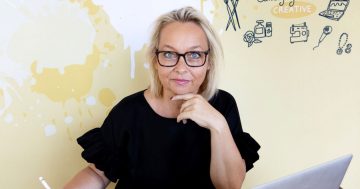
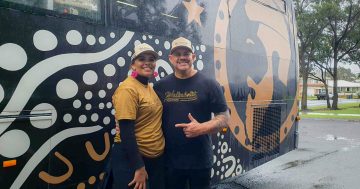
Nicole Smede is a multimodal artist. Photo: Supplied.
For Nicole Smede, reconnecting with her Aboriginal language and culture unlocked an entirely new creative path.
Now, the Mangerton-based artist has been recognised as a finalist in the prestigious Indigenous Storytellers Scholarship, celebrating a creative practice that weaves together language, music, poetry, film and community to bring First Nations stories to life.
“I wasn’t quite sure what it was all about,” she said.
“Then I jumped on the website and thought, ‘Oh, hold on, this is quite prestigious’. Some big names have come through it.”
Smede didn’t take out the top prize, but simply making the finalist list knowing who had gone before was enough, particularly after also receiving the Local Artist Award during the Wollongong Art Prize last year.
She said the scholarship targeted emerging artists ready to step up to the next stage in their careers, whether they were just starting out or shifting into a new form of practice.
Smede has “always been musical”, though her path to a practice that now blends field recordings, voice, instrumental composition and spoken word to create atmospheric works hasn’t been linear.
“I studied a degree in music at the Sydney Conservatorium many years ago. I’m a trained vocalist,” she said.
“But I didn’t feel like that was the pathway for me, entering into the classical vocal world.
“It wasn’t until I started reconnecting with my Aboriginal culture and learning language, that I started exploring that and reflecting on those learnings through the creative arts.”
Smede said she started writing poetry in language, which became songs and the extension of that was making soundscapes and films, developing a multimodal arts practice.
“The creative arts are just a web of threads for us to tell our stories,” she said.
“Using multiple modes just makes a lot of sense. You can explore a theme through art and poetry and music, and they’re all entwined together. I don’t see them as separate things.
“But I think learning language, and that connection between language and Country and identity was really what unlocked it for me.”
She said at the time, she was working at Nowra arts organisation Bundanon, driving 20 minutes through bushland every day.
“On those drives, things would come to me,” she said.
“I’d often have to pull over, get my phone out and sing little melodies or write down little poems or whatever was coming to me on my way to work.”
She said her practice was grounded in community, working with elders, custodians, young people, and artists across disciplines to co-create works that reflected lived experience, intergenerational knowledge, and the stories embedded in place.
“When you are an Aboriginal person or Aboriginal-identifying person, community is everything,” she said.
“The community that I was living in when I started exploring all of that language learning was the Yuin community.”
With her ancestry in Warrimay further up the NSW coast and being born on Dharawal Country in Wollongong, she spent many years living off her ancestral lands where the Yuin community “took me under their wing”.
“Part of my gratitude and love for the community is to collaborate with them and to always make sure I’m giving back in some way,” she said.
For Smede, that means community consultation, permissions and ongoing collaboration are non‑negotiable parts of how she works.
That commitment was put to the test last year, when she premiered Nyiirun Yiiga (We Are Here), a large-scale choral work for more than 200 voices, yidaki and percussion, in her ancestral Gathang language.
“I got this beautiful invitation to write a choral piece for the finale of the Canberra International Music Festival,” she said.
“I really wanted to write in Gathang … so that was a big process of really collaborating with community.”
She said before a note could be performed, she sought permission from the Gathang language community, her Warrimay community, and the traditional owners of Ngunnawal and Ngambri Country, where the work would be performed for the Canberra-based festival.
“We were going to teach it to some non‑Aboriginal people as well, so I had to make sure I had permission for that and that it was done in the correct way,” she said.
Smede said she also ensured First Nations voices were central on stage.
She said it was really important to have “mob there on stage participating”, along with non-Aboriginal people singing a song that was about Aboriginal pride in language.
She said the project was the most challenging work she had undertaken.
These days, she sings as part of a 10-piece women’s choir in Dhurga, Dharawal and Gathang languages at community events and occasionally adds to TV and film soundtracks, having previously contributed to Goldstone, Black Cockatoo Crisis, and 1919.
This year she is also composing four works for the Australian Music Examinations Board (AMEB) syllabus that will eventually be learned and performed by students across the country.