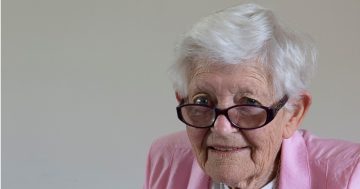
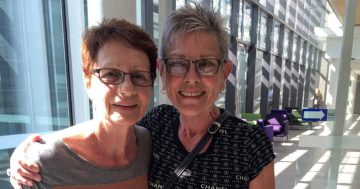
Young minds are uniquely primed to understand aging and memory loss — if given the right tools. Photo: Image-Source.
While society still often treats dementia as a condition calling for isolation rather than open conversation, children don’t carry the preconceived notions that adults do, according to one dementia advocate.
Member of the Association of Intergenerational Practice Val Fell says that, free from stigma, young minds are uniquely primed to understand aging and memory loss, if given the right tools.
She uses a clever, visual metaphor to explain dementia to young children.
“Imagine you’ve got a train set on the floor and it’s gliding smoothly along the track. When it comes to an intersection, see what happens if something stops the train going through — like a LEGO on the track. When you’re playing, you can take that block off and start the train again,” she says.
“Now, think of your brain. There are hundreds of tracks that take your thoughts through your brain. Sometimes, when a thought gets to an intersection with another track, something stops the thought from going through. You can’t put your hand into your head to put the thought back on the track. That’s when things go wrong.
“You need medication to try to get rid of that blockage, which is called a plaque, like the plaque you get on your teeth. The kind of dementia you get depends on where those track intersections are.”
From simple metaphors like blocked train tracks to shared storytelling sessions, talking to kids about dementia isn’t just possible — it’s essential for building an empathetic future.
Through intergenerational initiatives that bring school students and aged-care residents together, educators and advocates are demonstrating a powerful truth: building a dementia-friendly society begins in childhood.
But there’s a disconnect, Val says.
“A lot of young children these days do not have any contact with older people,” Val says. “In many cases, their grandparents live overseas, so they don’t live near people that are related to them. They have no way of getting to know them.”
That’s where the Association of Intergenerational Practice comes in.

For her dementia advocacy work, Val Fell received a Social Justice Champion award from Cunningham MP Alison Byrnes earlier this year. Photo: Community Industry Group.
The association promotes intergenerational connection.
One way is by running classes in schools, libraries and other places to form three-way links between children, an associated residential aged care facility and community members.
Children take a lesson chosen from the curriculum, on any subject from sport to geography, and a group of nursing home residents share their knowledge on the subject.
“The older people love getting together to talk to the children, and the children get to learn that people who are older and in nursing homes are still people. They’ve lived a long life and had different experiences,” Val says.
“For example, on the topic of sport, a child might ask, ‘What sport did you play when you were at school?’, and an older person might reply, ‘I was at school during the Second World War, so we didn’t have much time to play. But when we did, we played things like Vigoro or hopscotch’. Chances are, kids have never heard of Vigoro.”
“It’s time to talk about dementia” was the theme of this year’s Dementia Action Week, during which Dementia Australia asked everyone to join a national conversation to increase understanding and reduce stigma that surrounds Australia’s leading cause of death.
But a conversation with children about dementia need not — should not — wait on intervention from advocacy groups.
Families can sit down at any time and, whether it’s through a relatable metaphor or simply by ditching the medical jargon in favour of age-appropriate language, talk openly about how the brain changes with age.
Val says normalising these conversations early prevents fear from taking root and helps children stay comfortably connected to the older people in their lives.
“Social isolation is a dreadful thing. We don’t need to isolate people with dementia. They are still people, and children have to be helped to realise that,” Val says.
“We need a whole-community approach, and it begins with younger children — helping them form friendships with older people and learn about aging right through school. Educating them to try to imagine themselves in the shoes of a person who has dementia.”