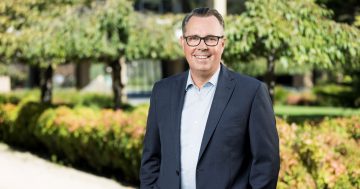
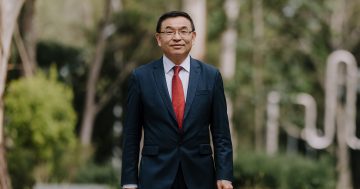
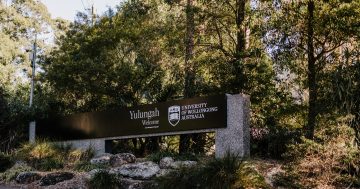
Former University of Wollongong interim vice-chancellor John Dewar (left) and chancellor Michael Still are under the spotlight at the ICAC inquiry. Photos: UOW.
The University of Wollongong’s former chancellor and interim vice-chancellor are facing allegations of corrupt conduct and breaches of public trust and university policies, according to opening statements to the ICAC inquiry.
While former chancellor Michael Still stood down from his position on 5 June ahead of the inquiry, he potentially could still face dismissal.
Day one of the hearing on Monday (22 June) heard allegations that UOW former chief governance officer Alyssa White created new job positions and, on at least 10 occasions, filled them with friends and former colleagues.
Counsel assisting the inquiry Emma Bathurst outlined evidence that the inquiry would canvass in relation to allegations concerning UOW staff, including Ms White, Mr Still and former interim vice-chancellor John Dewar.
The inquiry will investigate whether Ms White or any other UOW staff partially exercised their official functions by intentionally subverting recruitment processes for governance roles, to benefit persons associated with Ms White.
It will also investigate the circumstances around the selection and payment of private firm Aspirall Consultancy and the role of Mr Still, Ms White and other employees in approving that work.
And third, it will look at whether Mr Still or any other staff or contractor partially exercised their functions by failing to manage any conflict of interest relating to the employment of Professor Dewar as interim vice-chancellor and the university’s concurrent engagement of consultant KordaMentha.
While day one of the inquiry focused on the recruitment practices, Ms Bathurst also addressed the second and third allegations.
She told the inquiry Aspirall Consultancy was founded by Tanya Diesel, its current CEO, who had met Mr Still in 2004 and remained a friend.
“The commission will inquire into how Aspirall came to be engaged, first, in respect of some work associated with the recruitment of the new vice-chancellor in mid-2024, and, second, in relation to a university executive and council workshop and chancellor Still’s and other university employees’ role in approving those engagements,” Ms Bathurst said.
“The evidence is expected to show that Aspirall was not selected for these engagements using the university’s prescribed procurement policies and procedures. Rather, the evidence will show that these projects were funded using the [university] council’s discretionary fund, which comprised $2 million allowed to the council in 2024 to spend at its discretion.”
Ms Bathurst said the university’s purchasing and procurement policy provided that consultancies that would cost the university more than $20,000 were required to undergo a tendering process.
After vice-chancellor Patricia Davidson resigned on 19 April, 2024, Mr Still proposed a working group be established to drive recruitment and that Ms White would chair the group.
It is claimed Ms Diesel sent a proposal to Ms White outlining how Aspirall could conduct focus groups — at a cost of $49,600 — to help inform the search for a new vice-chancellor.
“The evidence will show that the proposal was forwarded to chancellor Still, whose response was, ‘Sorry. Thought I had agreed with this one’,” Ms Bathurst said.
“That was taken to be approval, after which Ms White emailed the proposal to the chair of the finance and infrastructure committee Merran Dawson, indicating it had been approved by the chancellor and was proposed to be funded from the council’s discretionary fund, as funds were not available within the governance budget.
“The evidence is expected to show that at no time did chancellor Still formally declare his existing friendship or association with Ms Diesel in respect of this engagement.”
The second proposal from Aspirall was for a “Rising to a Different Platform Council workshop”, with a quoted cost of $50,800 (plus GST).
When Professor Dewar questioned the context of the proposal, Mr Still and Ms White decided to defer it until early 2025.
However, Ms Diesel and Mr Still continued to text about it and Ms Diesel sent a revised proposal to Ms White, with a quote of $55,500.
Ms Bathurst claimed Mr Still gave his consent to the proposal after Ms White messaged him, asking if “he was okay for her to sign the contract with Aspirall for the engagement”.
A further revised proposal was sent through, which quoted the work at $56,600 (plus GST). It was sent to Warwick Shanks, then the university’s pro chancellor, seeking that the council discretionary fund be utilised to pay for the engagement. That approval was also granted.
“Following that approval being granted, Ms Diesel discussed expanding the scope of the work with the chancellor, which included interviewing more senior personnel within the university. That expanded scope meant that the cost of the work increased by $23,200 to a total of $79,800,” Ms Bathurst said.
A third proposed engagement — to interview leadership staff at a cost of $176,500 — was put on hold indefinitely.
While the search was ongoing for a new vice-chancellor, Professor John Dewar was appointed as interim vice-chancellor.
“The evidence is expected to show that in negotiations with chancellor Still leading up to his appointment, Professor Dewar proposed that he be seconded from KordaMentha to the university as interim vice-chancellor,” Ms Bathurst said.
Ultimately, Professor Dewar took a leave of absence from KordaMentha.
Mr Still and Professor Dewar negotiated and eventually finalised a secondary employment letter, which:
- Permitted Professor Dewar to provide leadership to a team of consultants in KordaMentha’s higher education practice;
- Prohibited Professor Dewar from being involved in any NSW regional universities;
- Confirmed that Professor Dewar would not play a role in seeking to have the university engage KordaMentha to provide any services to the university and, if KordaMentha was so engaged, he would not be involved in the management of those services.
“The secondary employment letter is evidence of the recognition from the outset, on the university’s part, of at least a potential conflict of interest between Professor Dewar’s role as interim vice-chancellor and his continuing role as a partner of KordaMentha, particularly to the extent the university engaged KordaMentha as a consultant during his tenure,” Ms Bathurst said.
“The evidence will show that at the very time of Professor Dewar’s commencement as interim vice-chancellor, KordaMentha and two other consultancies participated in a tender for an enterprise-wide review of the university’s operations.
“The evidence is expected to show that despite the terms of the secondary employment letter, Professor Dewar and members of the KordaMentha team had a role in preparing the request for proposal itself, as well as KordaMentha’s proposal in response to the request for a proposal.”
Initially, KordaMentha’s work was costed at about $300,000. However, its mandate expanded and KordaMentha became a key participant in what was known as the Future University of Wollongong Transformation Program.
“The total amount the university spent on KordaMentha during this time exceeded $3.7 million, including $835,090 from the council discretionary fund. These were lucrative arrangements,” Ms Bathurst told the inquiry.
The inquiry continues and is expected to run for three weeks.