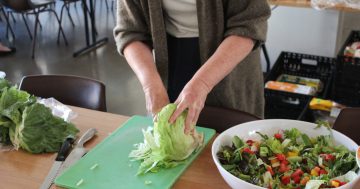
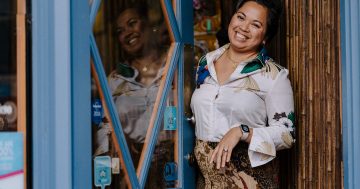
Every week, Meadow Street Meats and local volunteers turn snags into community connection. Photos: WRF.
Every week, locals gather at the Warrawong Residents Forum (WRF) to connect with service agencies offering everything from legal aid to mental health support. Often, they do so with a sausage sandwich in hand, featuring a bona fide butcher’s snag from Meadow Street Meats.
“The community love it,” WRF’s Ash Castro says.
“There’s a big difference between a supermarket sausage and a real butcher’s snag, and the dignity that comes with it is unmatchable. We’re a tiny agency, and there’s no way we’d be able to achieve something like that with our resources alone.”
Every week, WRF makes light meals and grocery bags and more, to supply directly to community members doing it tough, community groups and schools.
They’re able to, thanks only to upwards of 600 kg of food donated to them by businesses in the area. Some of it — like the weekly contribution from Meadow Street Meats — is reliably donated regularly. Much of it is surplus food that might otherwise be bound for the bin.
And now there’s a way to divert even more food from waste — and it’s fiendishly simple.
Food insecurity is an urgent and escalating issue in the Illawarra, with tens of thousands of homes across the region lacking access to sufficient healthy food to lead healthy lives. At the same time, 7.6 million tonnes of food is wasted each year in Australia, 70 per cent of which is perfectly edible.
When Healthy Cities Australia was awarded an Environment Protection Authority NSW grant to increase collaboration and capacity of the food rescue and relief in the Illawarra, Illawarra Food Rescue & Relief was born.
The program, which works to rescue more food and get it to the schools, community centres and other organisations that provide food relief, now hosts a WhatsApp group that allows Illawarra businesses to redirect surplus food to relief agencies in real time.
Fair Food Coordinator for Healthy Cities Australia Grace Potter, who heads up the Food Fairness Illawarra program says it lowers one barrier for local businesses looking to play their part in tackling the problems of food insecurity and waste.
“Donating food can sometimes be logistically difficult,” she says.
“Established organisations like Oz Harvest and SecondBite have refrigerated vehicles but a lot of the smaller food relief agencies are low on resources. Some may not even have fridges, freezers or pantry space let alone refrigerated vehicles, so logistically it’s hard to collect food donations.
“It’s also a matter of food relief agencies knowing when businesses have food, and for businesses that can’t guarantee what they’ll have to donate when, how to organise ad hoc donations.”
The WhatsApp group has about 50 members, including staff of businesses with food to donate and the food relief agencies that need it.
Businesses simply post who and where they are and what they’ve got, and food agencies can respond directly.
“It really streamlines those ad hoc donations,” Grace says.
“For some businesses that can’t commit to regular donations but are still concerned with food waste and have something to give from time to time, it’s that soft entry point they need.”
So far bakers, butchers, grocers, cafes and restaurants have all brokered surplus food donations this way.
“One agency got 15 kg of bacon, and that helped them with a community breakfast.”
Join the Illawarra Food Donations WhatsApp group.