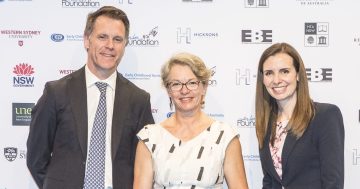
Thirty-four principals and leaders toured Google HQ in Sydney. Photos: Department of Education.
Illawarra principals will bring new approaches, advancements and ways of thinking into schools across the region after receiving a crash course from a company at the forefront of technology and innovation.
Thirty-four principals and education leaders from Illawarra schools have toured Google’s headquarters in Sydney to receive insights into the programs, techniques and practices that could improve opportunities for students, teachers and the broader school community.
“It was just looking at a way of people working together as a team and collaborating because Google do it better than most and are leading the way in so many things,” Balarang Public School principal Tina Duffield said.
Oak Flats Public School principal Jodi Niedermayer said: “Technology is so crucial to what we’re doing and it can go by so quickly, so if we’re not keeping on top of these new technologies we’ll be left behind and our students will outdo our knowledge.
“It’s just about working smart, but also a way to really be collaborative and creative.”
The representatives from primary and high schools were exposed to the programs and technologies that could make their lives easier and improve the learning experience.
“They began with all of the platforms on Google and all of the different tools that they thought would be relevant for educators and for leaders in the work,” Ms Duffield said.
“With the Department of Education talking about workload reduction and making teachers’ jobs and leaders’ jobs and people right across the department’s jobs easier, the AI platforms that they were talking about and all the different iterations of those were exceptional.
“They were really, really helpful and some of the features we had never, ever seen before.”

The Illawarra principals engaged with new programs to help improve educational experiences and opportunities.
A focus of the experience was the approach to problem-solving and being comfortable with the uncomfortable while working with ”design thinking” — a non-linear technique to approaching complex issues through the stages of empathise, define, ideate, prototype and test.
“The thing about it is it’s a really individual thing that you can do, but it also really lends itself to a collaborative approach as well,” Ms Duffield said.
“It allows you to go back and ideate and iterate and trial prototypes and test them until you get something that’s working for you.”
Ms Niedermayer said: “Design thinking also allows you to not go straight to the solution, and I think often we do that, particularly because time-wise we go straight to what could be a possible solution rather that really trying to identify and work out what is the problem that we’re trying to work with and what are the possible ideas first and foremost.”
It’s hoped the experience, and even just seeing how the company approaches wellbeing with layouts, breaks and access to food, will help the educators to broaden their horizons and inspire them to look outside the box.
“When I think about education and I think about me in particular, I went to school myself, I then went to university and then I went back to schools and because the Department of Education is such a huge organisaiton, we have so many people with different expertise within it and so many systems that support us, it means that we can become a little insular,” Ms Niedermayer said.
“So, looking outside of the Department of Education and looking at businesses and what they can offer and how their way or their thinking can support us to do our job better or more effectively, I think, is really exciting and is something that is a little bit untapped.”
While approval to use the programs, particularly AI, in the classrooms may still be in the works, this eye-opening experience is already motivating the school leaders to learn more about the technology and how it can address problems such as teacher burnout.
“For me, it’s about taking one or two things right now and how can I utilise it and how can I share that with my staff one step at a time, not trying to do anything too big,” Ms Niedermayer said.
“I think the design thinking process is a great place to start, and just some of the smaller tools like Vids or Readalong are things that we can introduce to our staff.”