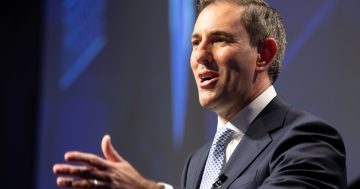
Treasurer Jim Chalmers says no-one is getting carried away by February’s slight inflation ease. Photo: Michelle Kroll.
Inflation has eased to 3.7 per cent in the year to February, which is down slightly from 3.8 per cent the month before, according to the latest data from the Australian Bureau of Statistics.
However, the new figures pre-date the war against Iran and Treasure Jim Chalmers said the next data set release was likely to show a spike.
“It’s pleasing to see inflation come off a bit in February, but we don’t get carried away by that, because we understand that the inflationary pressures from the war in the Middle East are very substantial,” he said on Wednesday (25 March).
“And we expect to see the consequences of that war push up inflation higher for longer in our economy.”
The largest contributor to annual inflation in February was housing, which rose by 7.2 per cent.
This was followed by a 3.1 per cent rise in food and non-alcoholic beverages and a 4.1 per cent rise in recreation and culture.
When prices for some items change significantly, such as automotive fuel, measures of underlying inflation like the “trimmed mean” can give more insights into how inflation is trending.
Trimmed mean inflation is a core inflation measure that calculates the weighted average of price changes after excluding the most extreme top and bottom price movements.
ABS head of prices statistics Sue-Ellen Luke said the trimmed mean inflation was 3.3 per cent in the 12 months to February 2026, unchanged from the 12 months to January 2026.
Dr Chalmers said inflation was too high before and the war in the Middle East and the ongoing conflict would make it worse.
“Headline inflation was flat in the month to be 3.7 per cent through the year, down from 0.4 per cent in the month and 3.8 per cent through the year in January,” the Treasurer said.
“Underlying inflation was 0.2 per cent in the month to be 3.3 per cent through the year.
“Compared to January, the monthly number moderated from 0.3 per cent while the annual number was unchanged.
“Our inflation challenge reflects a mix of both temporary and persistent factors, including the end of energy rebates.”
Treasury estimates that around three quarters of the increase in inflation since the middle of last year to the beginning of this year reflects temporary factors.
“We recognise people are still under pressure, which is why we’re rolling out responsible cost of living relief and taking action to shore up fuel supply and ensure Australians are getting a fair go at the bowser,” Dr Chalmers said.
“The Australian economy is not immune from global uncertainty and volatility, but we’re well placed and well prepared with faster growth than any major advanced economy, low unemployment and solid wages growth.”
Shadow Treasurer Tim Wilson said the latest CPI data confirmed inflation remained a persistent challenge that Labor was grappling to control.
“New inflation data shows Australia has been left vulnerable and exposed because the Treasurer’s active inflation agenda has been left to persist even before the inflation consequences of the global crisis,” he said.
“Australians are being hit from both sides. Their confidence is falling while their cost of living keeps rising.
“Under Labor, we are heading for a lost decade of productivity, leaving every Australian around $35,000 worse off.
“This reflects what families already know – their pay packets are not going as far and the pressure is not easing.
“Instead of easing pressure, government spending is adding to inflation risks at a time when Australians need relief.”
Mr Wilson said at 3.7 per cent, inflation in Australia was currently greater than in France at 0.9 per cent, Japan 1.3 per cent, Italy 1.5 per cent, Canada 1.8 per cent, Germany 1.9 per cent, United States 2.4 per cent and the United Kingdom 3.0 per cent.
“Australians have lost confidence in Labor’s management of the economy and the Treasurer’s excuses as his active inflation agenda squeezes household budgets and new data confirms plummeting consumer confidence and skyrocketing inflation expectations,” he said.
“The most persistent inflation is homegrown – risen from 4.9 to 5.0 per cent – and fuelled by the Treasurer’s active inflation agenda that is pouring debt petrol on the inflation fire.”
Original Article published by Chris Johnson on Region Canberra.