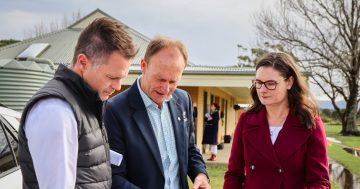
Nursery co-ordinator Daniel Dorin, Mayor Chris Homer and council’s open spaces manager Geoff Arthur among the trees being grown for the Tripoli Way project. Photo: Kellie O’Brien.
When you walk through the rows of native plants at the Oak Flats nursery, what you might not realise is that among them more than 600 trees and 75,000 tube stock plants are quietly growing in preparation for one of Shellharbour’s biggest road projects.
As early works continue on the Tripoli Way Extension Project in Albion Park, the Shellharbour City Council Nursery team in Oak Flats is banking on “born and bred” local stock to cool streets, protect waterways and transform the landscape long after construction ends in 2028.
Mayor Chris Homer said the benefits of the plants being grown in Shellharbour were they had “a better chance of take-up when it’s born and bred in our climate”.
Council’s open spaces manager Geoff Arthur said that all started with seed collection coming from native species.
“You’re keeping the same genetics that’s within the area where possible and also, as part of that, the guys are growing that seed into the tube stocks you see now,” Mr Arthur said pointing to trays of plants within the nursery’s hothouse.
“Then it’s hardened outside, which means the chance of survival when it goes out into our elements is greater.
“We’re not transporting something down from Queensland that’s growing in these beautiful, lush conditions and then it comes here and we get a frost and it doesn’t survive.”
Mr Arthur said while some losses were the norm, by having the entire process happening in Shellharbour it reduced losses significantly.
He said growing trees that were endemic to the local area for the project was being done in stages based on growth rates.
“Some of that is your standard street trees that complement the shared footpaths,” he said.
“They’re species that don’t have heavy roots to damage infrastructure.
“Then we have got some for riparian zones, so some natural creek lines at the western end of Tripoli Way.”
He said while seed collection began when the project was given the green light, they were also able to access reserves from their own stocks from the past three years.
“The larger eucalypts we obviously got in quite early,” he said.
“Some of them are already planted now and a metre and a half tall, and others are still in seed over here in the trays.”
The biggest benefit for the roads project was council having its own nursery.
Nursery co-ordinator Daniel Dorin said it had a long history in Shellharbour, having been at Industrial Road for more than 30 years, but having been in the area for much longer.
Mr Dorin said in the beginning it was purely wholesale, with its customers primarily builders, developers and internal sales, but was changed to include retail about 15 years ago.
It also now hosts a disability group weekly, school groups and provides programs and talks in Shellharbour libraries.


He said the stock often changed with trends, but it was always rooted in what aligned with Shellharbour conditions.
“We’re not going to pull things down from Tropical North Queensland, because that type of stuff just won’t grow here,” he said.
“We don’t grow roses, because of our irrigation here in summertime – you just find infested disease on them.
“It’s why we don’t just stock everything.”
Mr Arthur said purchasing through a nursery like theirs meant customers were supporting trees that didn’t have the potential to be weed invasive.
“A lot of stuff sold, in two to three years’ time it becomes problematic because it’s growing all through the city,” he said.
“We’re on the front foot with that. Anything we put out here generally will be fine, acceptable and grow within the conditions we have.”
Outside of providing customers with more localised knowledge, he said another benefit was internal sales to support regeneration projects in natural parks and reserves, and a greening the city project to provide canopy cover in the city, all of which reduced council costs.
“Council’s about to undertake a greening strategy which looks at canopy cover and urban heating,” he said.
“You go through some of the older streetscapes where there’s quite large trees that are damaging infrastructure, whereas we’re a bit more selective about how we do that now.
“We’re trying to plant trees in the right places … but we do need cooling of our roads and cooling of our shared footpaths.”
Cr Homer said the nursery’s trees also played a part when renewing recreational grounds and playgrounds.
“There is commentary sometimes when we renew a playground about ‘where’s the shading?’ but if we put shading in, there wouldn’t be a playground, because the budget just gets out of control,” he said.
“I think strategically using the natural environment that’s growing here can provide shading.”
Mr Arthur said the other benefit was developing better skilled staff, with its apprentices and trainees gaining the fundamentals of propagation and growing plants.
“Some of these apprentices will have collected this seed, propagated, potted these plants up, and then they’ll be at the end of the project, putting them in the ground,” he said.
“Like me, I live in the local area and have been here 40 years, and I drive past stuff I’ve planted years ago and it’s amazing.”
Shellharbour City Council Nursery is located at 132 Industrial Road, Oak Flats with on-street parking on River Oak Place. It is open to the public Monday to Friday from 7:30 am to 3:45 pm.