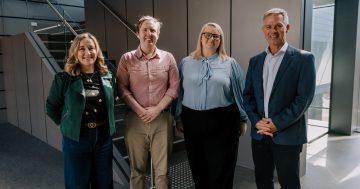
UOW MND researcher Christen Chisholm has been named MND Australia’s Early Career Researcher of the Year. Photo: Michael Gray.
Christen Chisholm credits her mentor and long-time friend Justin Yerbury for giving her the courage to leave a satisfying teaching career and “start over” in research.
“It was a lot. I had three young children and had been at the top of the ladder as a teacher. That was the world I knew. I was starting over and starting at the bottom as a PhD candidate, earning very little money. It was a huge change for me,” the University of Wollongong researcher said in an interview in 2025.
But Professor Yerbury’s encouragement for Dr Chisholm to start a PhD in his UOW lab in 2019 and ultimately build on his legacy in motor neurone disease (MND) research changed her life.
She’s now been named MND Australia’s Early Career Researcher of the Year.
Dr Chisholm, a Research Fellow at UOW’s Molecular Horizons and recipient of the 2026 MND Australia Bill Gole Research Fellowship, is working on developing new therapies targeting one of the key drivers of MND: the build-up of toxic misfolded proteins within motor neurons.
“I am incredibly honoured to receive this award and deeply grateful to MND Australia and FightMND for their commitment to supporting MND research,” she said.
“I am so proud to be part of the passionate research team at UOW, who are united by the goal of continuing Justin’s legacy and creating a future where an MND diagnosis is not met with devastation but with effective treatments and hope for the future.”
During her PhD, Dr Chisholm led development of a new treatment approach that harnesses cells’ own waste-disposal systems to seek out and clear away one particular toxic protein known to cause an inherited form of MND.
The work showed reduced protein aggregation, protection of motor neurons and delayed disease progression in cellular and preclinical models.
After undertaking a Bachelor of Biotechnology at UOW, Dr Chisholm spent two decades working as a science teacher in Illawarra high schools.
Dr Chisholm had been friends with Justin Yerbury and his wife Rachel for many years.

Professor Justin Yerbury passed away from MND at 49 years old. Photo: UOW.
“I had no intention of leaving teaching until I realised Justin would need support in the lab,” Dr Chisholm said in an interview with UOW’s The Stand.
“He had just had the life-saving mechanical ventilation surgery and was determined to continue his research. I wanted to help him.
“I was friends with Justin and Rachel for many years and saw what he went through when his mum, sister and aunt passed away from MND, all within a short period of time.
“Justin encouraged me to come and start a PhD in his lab. He knew I had the science background and believed that I could do it.
“Justin chose to continue his life even though he would be completely paralysed and unable to speak because he believed he could still contribute to finding a cure for this disease. That courage was what inspired me to start again.”
Through her Bill Gole Fellowship, Dr Chisholm is now tackling one of the biggest challenges in neurological medicine: safely delivering treatments to the brain and spinal cord.
Her research combines gene therapy, lipid nanoparticle technology and focused ultrasound to carry therapeutic molecules across the blood-brain and blood-spinal cord barriers directly to affected motor neurons.
Soon after completing her PhD, Dr Chisholm was invited to present her work at the 2025 Neuro4D Conference in Mainz, Germany, an international meeting on neurodegenerative diseases.
At UOW, she works alongside Dr Luke McAlary, Dr Jeremy Lum and Professor Heath Ecroyd as part of the MND research program founded by Professor Yerbury, and teaches undergraduate and postgraduate students across immunology, pharmacology and biomedical research.
Dr Chisholm credits Dr McAlary and Dr Lum for supporting her research after Professor Yerbury died in 2023.
“When we lost Justin, it was incredibly hard for so many reasons. I lost a friend and a supervisor, so I felt quite lost in many ways,” she told The Stand.
“Luke and Jeremy both stepped up enormously. They stepped into his role as a supervisor and helped me to finish my PhD. I don’t think I would have been able to do so without their support.
“They are both incredibly humble researchers, but what they have achieved in pushing the lab’s research forward and supporting everyone around them is a huge achievement.
Dr Chisholm is passionate about raising awareness of the world-leading MND research being conducted at UOW and is working to establish research programs that will enable people with lived experience of MND to participate in and contribute to research.
She established the UOW MND research advisory panel, attends the Illawarra MND carers support group and hosts lab tours for patients and families.