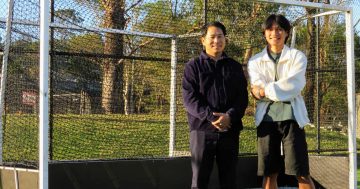
Moya Dodd at The Illawarra Connection dinner. She spoke about the importance of integrity in sport and life, among stories of her incredible life. Photo: Brad Chilby.
For one hour every Monday night, 10-year-old Moya Dodd was mesmerised by English football matches shown on her family’s newly purchased colour TV.
It was in 1976 in her Adelaide home – above a suburban fire station where her father worked – that Moya discovered a whole new world that eventually became her world.
She went on to represent her country with the Matildas, becoming vice-captain, played in FIFA’s first ever women’s tournament in 1988 and 25 years later, joined the governing body of FIFA as one of the first women in its 108-year history. She’s also a lawyer, author, consultant and fierce advocate for equality and inclusion.
Moya told the latest The Illawarra Connection dinner on Tuesday (14 April) about her football journey, her fight for women’s equality in the sport and how, upon becoming part of FIFA’s “elite”, her integrity and resilience came to the fore.
She described how, when she first saw those professional football games on TV, she became obsessed.
“I became a Liverpool fan; I would check the newspaper every day for news and my favourite team,” she said.
“I was just transfixed by this pattern of movement and passing and I just couldn’t get enough of it.”
One day when scouring the sports pages for news of her beloved Liverpool team, she read the soccer news and discovered in very small print – “I think under the greyhound results” – the results of the Women’s Soccer League.
“It was like I’d struck gold,” she said.
“There was actually a Women’s Soccer League in Adelaide. There were six teams in all of Adelaide, but one of them was just down the road from where I lived.”
So at age 13, Moya got on her bike, pedalled off and went to join the local team.
While later playing for her Port Adelaide football team she came up against an Australian team player.
“I was like, oh wow. It was the first time it had even occurred to me, the first time I’d heard that we even had a national team. I was so excited to play against her.
(For the record, Moya’s team was “completely whooped, I think it was double figures”.)
“I really wanted to become as good as she was. [It] taught me the importance of having benchmarks that you can set yourself against.”
By age 19 Moya had made the South Australian state team and the following year was picked for the Matildas.
In 1988 FIFA held its first women’s football tournament, played in China.
“It became known as the pilot World Cup and our first match was against Brazil. And yes, they were as dazzling as you thought they might be, but somehow we scored a goal against them.
“I came on as a substitute a few minutes from the end with us leading one-nil. So you can imagine how terrifying that is. I was playing at left back, a position I had not played before and I have never played since.
“When the final whistle went, we were still leading one-nil. So that was a truly joyous moment. It kicked off a fantastic rivalry between Australia and Brazil that lives on to this day.”


Moya went on to play for her country 24 times, including 12 in full international matches.
She missed the 1995 World Cup with a torn ACL. It was the end of her international career but far from the end of her association with the world game.
In 2007 she joined the board of Football Australia and later served as vice president of the Asian Football Confederation.
Not long afterwards, the male-only FIFA board created quota roles for women and Moya was one of the first three females appointed to the board in its 108-year history.
She discovered “a world of exceptional luxury”.
Among the trips on Lear jets, the best seats at World Cup matches and “endless buffets and dinners that were always laid out with whiskey and cigars”, there were also the gifts.
It was one of those gifts that would eventually expose FIFA’s culture of secrecy and privilege and result in a number of criminal convictions.
A gift bag from Brazil’s Football Association at the 2014 World Cup contained, among other items, a luxury Parmigiani watch.
Not realising its significance, Moya decided to check the value of the watch, following FIFA’s ethics code of not accepting gifts unless they were of trivial or symbolic value.
She says she almost “swallowed her toothbrush” when her Google search showed the value – US$29,000.
Moya knew she couldn’t accept the watch so she contacted a FIFA lawyer asking for advice, which was “thanks for reporting this, please bring the watch to us and we’ll advise you what to do”.
“And I thought, great, this is good. It’s out of my safe, it’s in someone else’s safe. And I stopped worrying about it.”
But a few months later the UK Sunday Times reported that, with the exception of Moya and two others, FIFA executives had accepted these luxury gifts, despite the ethics code.
“You might think, well, you come out of it looking fine – what’s the problem with that?
“Well, that’s not really how things work in these rooms.
“In terms of disaster, politically, on a scale of one to 10, this was an 11, because we were the people who had, you know, dobbed them in, spoiled the party. We were party poopers.”
Moya had to defend herself and her integrity as fellow executives blamed her for being a whistleblower.
“I really have never been given such a hard time for doing the right thing, actually, but within about six or eight months, I think they would have gladly exchanged places with me.
“I was in the hotel in Zurich, a very nice hotel, that was raided by the authorities at 6 am and they arrested and took away quite a number of my colleagues from the FIFA board.
“There were simultaneous raids around the world and they took in dozens of football officials. In essence, the investigation had shown that there was a whole racket going on of kickbacks being paid on sports rights agreements in the Americas.”
But FIFA also gave Moya a platform to advocate for equality, human rights and integrity reforms, leading to governance reforms that compelled the inclusion of women and greater priority and resourcing for women’s football.
“If we want to collectively be able to act with integrity, we have to be providing safe spaces for us to admit our weaknesses, explore our doubts, talk through our issues with honesty in a safe space,” she told the gathering of Illawarra business and community leaders.
“In a team, this is what it is. This is the difference between winning and losing and I think in a society, it’s also the difference between being able to create a culture of integrity and not.”