
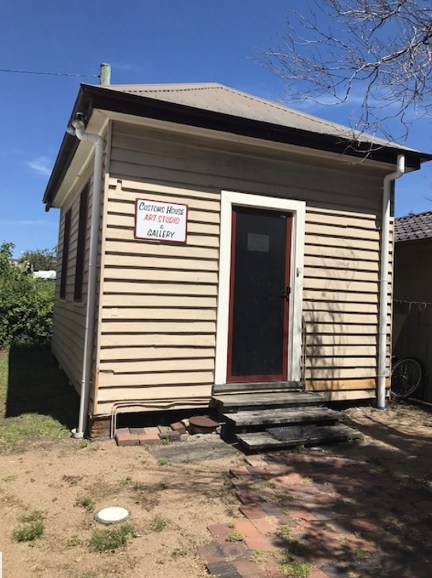
The former Wollongong Harbour Customs House behind Wollongong Harbour’s Old Courthouse which fronts Belmore Basin. Photo: Supplied.
If you actually live in a building in Wollongong that you know to be built a century ago you are doing well, as they are now increasingly uncommon.
Even extant European structures constructed as late as the 1890s are today not just uncommon but few and far between.
Way back in 2011, I published a response to a Wollongong Council planner who tried to argue that that my friend and fellow historical researcher Michael Organ was wrong in that Judge Roger Therry’s residence in Bukari St – known as Keera Vale – was not Wollongong’s oldest house.
Unfortunately for the planner he did not know that the construction of Keera Vale could be remarkably precisely dated because The Sydney Morning Herald (26 October, 1844, page 3) contained an advertisement for the lease of the Farm of Keera Vale, Illawarra which stated there was a “commodious two-storied house, advancing rapidly towards completion, and will be fit for the reception of a family about the 1st of January’’.
The hapless planner was unable to provide examples of any surviving older structure.
Today, because of digitisation allowing close examination of a highly enlarged version of British painter and writer John Skinner Prout’s lithograph, I now consider there well may be substantial bits of a structure still standing near Wollongong Harbour that very likely pre-dates Keera Vale.
Towards the top left of the lithograph, with Mt Kembla dimly behind in the distance, is a strange little structure with a man apparently standing guard beside it. It is Illawarra’s original Customs House.
The person who manned the little Customs House was employed to count the lengths of cedar being shipped from the then tiny port and keep a record and, fortunately, Prout’s lithograph is not the only image of the Customs House positioned in its original location.

A highly enlarged detail from a coloured version of an old postcard. Wollongong Customs House is the brown building. Photo: Supplied.
Keeping record of the lengths of cedar about to be shipped was needed because in 1827, a half-penny-a-foot cedar tax had been levied.
Embryonic European Wollongong was then only just becoming the port at which nearly “all the cedar of the Five Islands, and the wheat maize and potatoes grown there” were shipped to Sydney.
The “little boat port” soon proved too small and in 1837, Governor Bourke instructed the Colonial Engineer Captain George Barney to design and oversee the construction of a harbour at Wollongong.
Barney’s design was for a basin 100 foot long, 35 feet wide and eight feet deep (30 m x 10 m x 2.4 m) at low tide with a stone pier that incorporated a slipway for the Pilot Boat.
The size of the basin in 1841 began to be further extended to 300 feet long and 150 feet wide (91 m x 45 m) with the some of the heavy work being carried out by convicts.
Construction of this slightly better basin was completed on 25 November 1844 at a cost of £3465 and it could accommodate coasting vessels from 5 to 20 tons.
By then the “red cedar” laws had shifted from unregulated logging to a system of government control and licensing for timber extraction, particularly on Crown land.
Legislation required permission to cut specified quantities of cedar by the 1820s and this evolved into specific licensing by the 1830s and then more comprehensive timber cutting control by 1839.
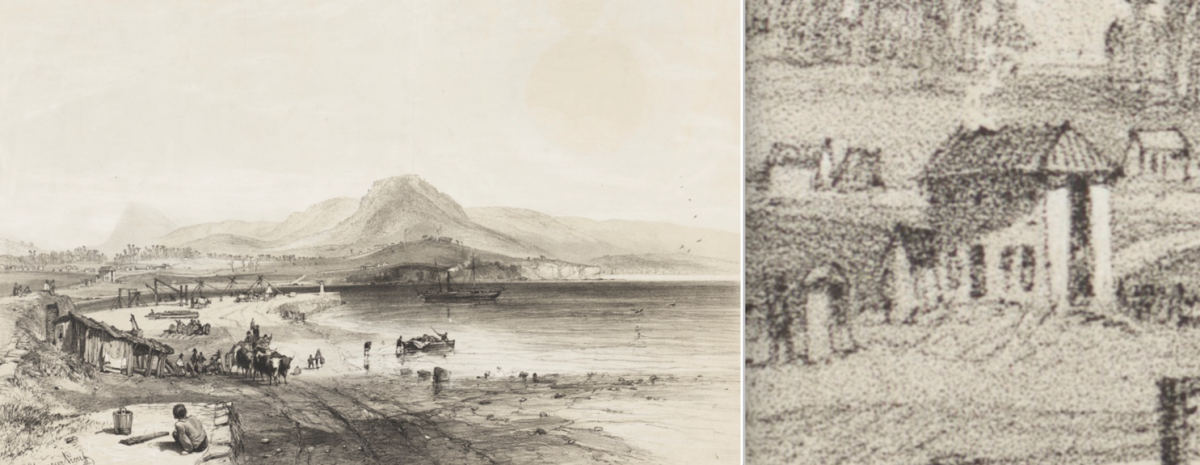
Left: John Skinner Prout produced the finest early lithograph of Wollongong Boat Harbour as seen in either 1841 or 1842. Right: An enlarged detail from the lithograph of Customs House. Photo: Mitchell Library/State Library of NSW.
This made a lot of timber getters and their bosses unhappy. As early as 1827, one disgruntled Illawarra dealer in red cedar, calling himself “A Sufferer From The Cedar Duty”, wrote to the editor of The Australian newspaper: “The duty lately levied by the Government on Cedar, has become a circumstance of serious consequence to many. About 150 men, who constantly found employment at the Five Islands in sawing cedar, have now left that promising district, compelled to do so, in consequence of not being able after six months’ laborious employment, to dispose of their hard earnings; and the only preventive is, a duty of a half-penny sterling per foot, placed thereon by the Governor of this Colony.
“It may be said, it is only a half-penny per foot! Truly it is only that sum; but that half-penny per foot, Mr Editor, was the sawyer’s profit on a boat-load of cedar, which amounts to £14 or £15 sterling … And all that is now collected for the cedar duty, is not more than a £100 per annum; and the pay of the measuring officer amounts to £80 a year out of it … while the duty is kept on the cedar, the [NSW] Revenue receives £100 per annum one way, while it loses ten hundred the other.”
When, in 1888, a new Wollongong Court House was completed, today’s Old Wollongong Courthouse became the office and residence of the Customs Officer and the original little weatherboard Customs House was moved to the rear of the nearby Old Courthouse and made into a kitchen with the addition of a chimney.
Some surviving original bits of that little wooden custom’s house thus may well be Wollongong’s oldest European structure but, unfortunately, the precise date it was built remains unknown – even though, as Prout’s lithograph demonstrates, it was definitely before 1842.
So next time you are at Belmore Basin take the time to check out this very old-timer.