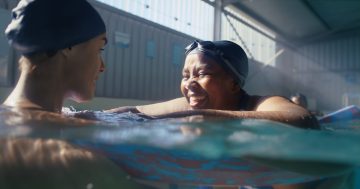
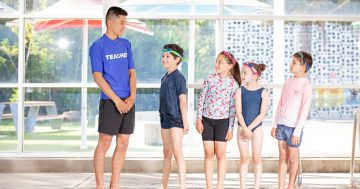
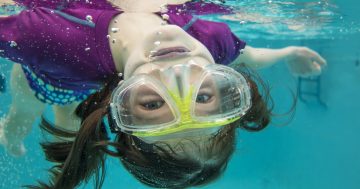
Swim competency is crucial for ensuring the safety of young people in our waterways, but everyone needs to play a part. Photo: Royal Life Saving Australia.
A swim school provider that recently took over one of the Illawarra’s most iconic businesses is calling for a collaborative approach to improving young people’s competency in the water, saying the vital skill should be the responsibility of the whole community rather than relying on the mandatory education system.
It’s a lifesaving skill that is even more crucial in a coastal community, but for children to achieve an acceptable level of swim competency, relying on the school system may not be enough.
“We will have to work together on this,” Aquabliss managing director Nitin Singhi said.
“Schools are under a lot of pressure – they’ve got cost pressures, they’ve got a lack of staff, and as well as limited curriculum times.
“That’s where schools like Aquabliss and McKeon’s can step in to complement a lifelong skill for children that they need.
“We definitely do not want to blame schools, we think they’re doing a great job, we just think they could be better supported at times. That’s what we’re seeking to do, and we urge the government to support them even more whenever they can.”
Aquabliss, which runs McKeon’s Swim School, hopes to serve more than 3000 Illawarra students in school programs over the next five years, having already catered for 750 school students in the past 12 months alone.
“At McKeon’s, we’re very lucky that we have a dedicated Schools Coordinator, and we’ve worked with eight schools over the past 12 months and many more in the last five years,” Nitin said.
“They come in and they have a dedicated program that we devise for them.
“We want to continue to support schools from public schools, private schools, independent schools – wherever we have the opportunity to do that, we’d like to do that.”
The impact of being able to access the vital training through the school’s program has been seen firsthand at McKeon’s.
“I was speaking to our Schools Coordinator and she mentioned one student who was seven years old when they started and had had a near-drowning experience before coming to the school’s program,” McKeon’s swimming program coordinator Samantha Waterhouse said.
“He was super anxious to get in the water, and now he’s done two terms of school swimming and can now swim a small distance, probably 12 metres unassisted, so that’s amazing.”
A report released in 2025 by Royal Life Saving Australia found that schools allocated fewer than 8 hours per year to learn-to-swim programs, with 31 per cent of schools not offering a learn-to-swim program at all.
Almost half of Australian Year 6 students are estimated to leave primary school without meeting the National Swimming Benchmark.
“The Department’s School Swimming and Water Safety program has been available to all NSW public school students since 1954,” a Department of Education spokesperson said.
“A comprehensive range of swimming programs is also available to students through external providers.”
More than 50 public primary schools across Wollongong, Shellharbour and Kiama have participated in the department’s program, with explicit water safety skills also set to be part of the PDHPE syllabus for Kindergarten to Year 6 students, to be implemented next year.
And while there are still barriers to children accessing enough practical swim education and experience, Aquabliss believes that it needs to be higher on everyone’s agenda for real progress to occur.
They are encouraging parents to support school swimming programs by continuing swimming education beyond school-based programs where possible; encouraging children to swim regularly throughout the year; reinforcing water safety conversations at home; helping children build confidence and technique through ongoing practice; and seeking community-based swimming opportunities that complement school learning.
“There are so many different circumstances, cost obviously, but I just think making swimming a priority for everybody and collaborating with each other needs to be at the forefront now,” Samantha said.
“Just working together, through whatever the reasons are, to make sure this doesn’t continue to be a problem.
“I think they’ve got to realise that swimming is not an option; it’s a necessity,” Nitin said.
“It’s a lifesaving skill, and it’s a lifelong skill that requires regular practice, and it needs to be up the priority list of busy family lives and busy school curriculum.”