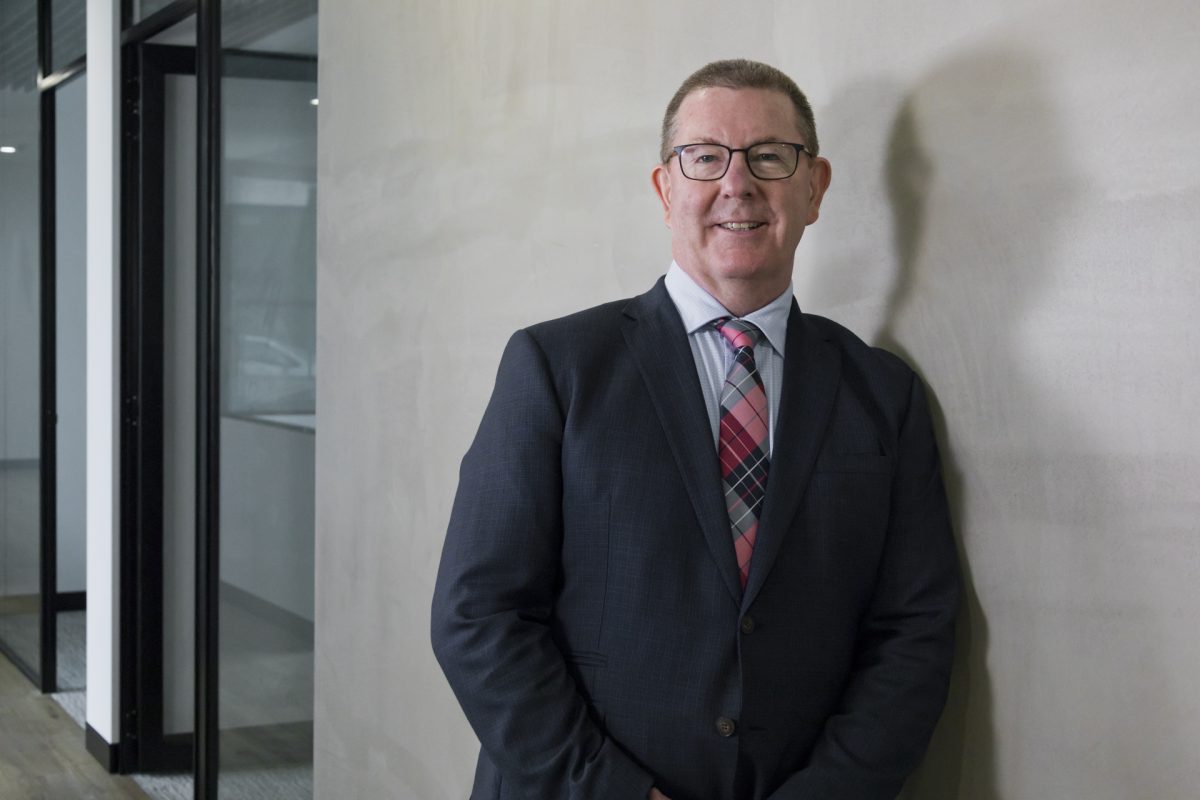
Graham Lancaster of Lancaster Law and Mediation welcomed a reform that will designate motor neurone disease as a mandatory notifiable condition. Photo: NEG Photography.
Illawarra residents living with motor neurone disease (MND) will help lead the nation in tracking and tackling “the beast”, with NSW now the first Australian state to classify MND as a mandatory notifiable condition.
Under the Public Health Amendment (Motor Neurone Disease) Order 2026, medical practitioners and hospitals across the state will now be legally required to report all cases to NSW Health.
The data collected, ranging from patient demographics to date of diagnosis, aims to establish a vital evidence base to track cluster locations, plan regional healthcare services, and hunt for potential environmental causes.
Prominent local businessman Graham Lancaster, who has been open about his own journey with MND, strongly welcomed the announcement.
“For too long, we have not had a complete picture of how many people are living with MND, where cases are occurring, or whether there are patterns that might help researchers understand why the disease develops,” he said.
“People with MND want more than sympathy — we want to be counted, studied and given every possible chance of contributing to the search for effective treatments and, ultimately, a cure.
“Better data may help identify geographic or environmental patterns, improve the planning and delivery of health and support services, and give researchers a stronger foundation for investigating this devastating disease. Knowledge is power and knowledge shared is very powerful.”
MND is a progressive neurological disorder causing rapid muscle degeneration that impairs walking, talking, breathing and general movement. There is currently no cure.
The disease affects about eight in every 100,000 Australians, with 90 per cent of cases occurring sporadically without any family link or known trigger. In NSW alone, roughly 750 people are living with MND. This year, at least 300 residents will be diagnosed, and at least 300 will lose their lives to it.
While notifiable disease declarations are typically used to track contagious outbreaks, applying the mechanism to MND focuses purely on research and resource allocation.
Confidential data logged by NSW Health will include the patient’s full name, address, age, gender, Aboriginality, language spoken, country of birth, occupation, onset date, and referring doctor details.
Health Minister and Member for Keira Ryan Park described the Australian-first reform as a practical step advocates have been crying out for.
“There is a reason people call motor neurone disease the beast – it is unrelenting and unforgiving, and it slowly takes away a lot of what people hold dear,” he said.
“We hope that by building this knowledge base, our incredible medical researchers and clinicians can do what they do best and develop preventive measures, better treatments, and maybe even a cure.”
MND NSW CEO Liam O’Meara described the policy shift as a landmark victory for the community.
“Minister Park deserves real credit for mandating this change and ensuring it didn’t get bogged down in lengthy parliamentary process,” he said.
The progress means a lot to Mr Lancaster, who met his 2024 diagnosis with the trademark grit that made him a formidable force in the courtroom and will again this year take on the Illawarra Walk to Defeat MND.
“Five kilometres doesn’t sound like a huge distance. Previously, I wouldn’t have given it a second thought. But at the moment, after walking only 300 to 500 metres, I’m developing significant pain through my lower back and hip,” he said. “So over the next two weeks I’ll be doing what people living with MND become rather good at — adapting. I’ll train carefully. I’ll experiment with walking poles. I’ll rest when I need to. I may be slower than I once was. But I intend to be there.”
While Mr Lancaster acknowledged the reform would not deliver an immediate cure, he noted its profound value for those facing the diagnosis today.
“With MND, knowledge is not merely power — it is hope,” he said.