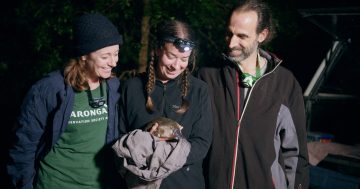
The increase in bogong moths might be bothering some people but experts are urging residents to appreciate the rare experience. Photo: Ajay Narendra, Macquarie University.
They’re flying in through air-conditioning vents, hitting car windscreens, infiltrating the washing and swarming outdoor lights at night, but Illawarra residents are being told to appreciate the bogong moth invasion, with the endangered bugs about to move on.
Just days ago it was the spike in dragonflies, now it’s a moth migration being swept off course – a bug boom across the region is in full swing and the flies haven’t even settled in for the summer yet.
An unusual surge in sightings of the endangered moth has been the talking point of the town with residents reacting in awe, disgust or fear as swarms of the creatures stop by after barely being seen for a decade.
“The bogong moths actually experienced a population crash in 2017, their numbers fell by 99 per cent and they were listed as endangered on the IUCN red list, so seeing these high numbers again is very exciting,” University of Wollongong researcher and insect migration expert Dr Megan Reich said.
“They’re currently moving from their breeding grounds to the Australian Alps where they estivate in caves and in boulder fields over the summer and then they return back to their breeding grounds.
“We figure they’re swept a little bit off course this year, they’re a little bit more coastal than they’ve been in many years, so it’s a little unusual but part of their regular migration.”
Locals have had divided reactions, with the increase of insect sightings seeing pest control companies being inundated with calls and some residents online claiming the swarms are causing fresh phobias of the winged creatures.
But even the most fearful are being urged to stop before they swat or spray, with the bogong moth actually playing an important environmental role.
“It’s a catch and release situation for sure,” Dr Reich said.
“I would encourage people to appreciate this phenomenon, it’s something we haven’t seen in a while and it’s actually incredible.
“They’re really neat animals – they can navigate using the stars and they have a magnetic compass and they’re going to go to these caves in the Australian Alps and they use the same caves year after year.
“They’re really important to ecosystems. They’re pollinators and there are many birds and other animals that are feeding on them and they bring an important source of nutrients into these delicate Alpine ecosystems, in particular the endangered pigmy possum relies on them as a summer food source.”
And as quickly as they came, the moths are expected to leave.
“I think the numbers are already decreasing and they’re starting to move on – we’ll see over the next couple of days, but they won’t be long,” Dr Reich said
Until that time comes, avoiding keeping outdoor lights on and making sure doors are closed are the best ways to make your house less attractive to an invasion.
If you’re a bit more brave, snapping a picture and logging any sightings can go a long way for conservation, with no guarantee we’ll see them in these numbers or here again.
“A couple of things you can do to help with their conservation, document your sightings on them either on iNaturalist if that’s a platform you use or Moth tracker,” Dr Reich said.
“Insect population numbers are known to be very bouncy and so the high numbers this year do demonstrate that the bogong moth population can make a resurgence really quickly when the conditions are good, but it’s not necessarily an indication that numbers will remain high next year or the year after that.
“So it’s still very important to focus on the conservation of the bogong moth, this one year of high numbers doesn’t mean they’re out of the woods.”
And as we say goodbye to these controversial critters, a new wave of insect activity could soon be heading our way, whether it’s driven by the wet or the warmth.