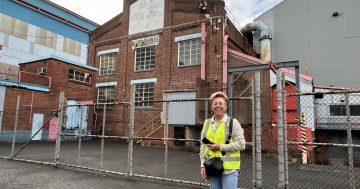
Jennifer Macey recording on a pilot boat in Port Kembla Harbour for Postcards from Port Kembla. Photo: Supplied.
What do a pilot boat skipper who swam to work, Australia’s first female surf lifesavers and a former steelworker surviving on one meal a day have in common?
They’re all part of the rich tapestry of stories Jennifer Macey has uncovered while exploring Port Kembla’s past and present.
After more than 80 interviews, the former ABC and DW Radio journalist and University of Wollongong PhD student is launching Postcards from Port Kembla on 1 November, a six-part documentary podcast that takes listeners deep into the Wollongong suburb.
Jennifer spent a week at The Bank in Wentworth Street in 2024, where a bank vault was transformed into a makeshift recording studio and people were invited to share their Port Kembla stories.
“We squished in there, and I set up the microphones, and people would come and talk,” she said.
“It was then the snowball effect. I would speak to one person and then they say, ‘Oh, have you talked to this person?’”
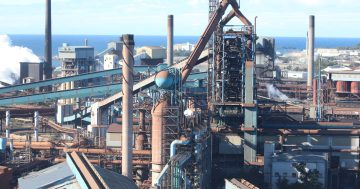
She also boarded a pilot boat, hunted for an abandoned coal mine in the rainforest, climbed grain silos and gained behind-the-scenes access to record inside the steelworks.
Combining interviews, soundscapes recordings, archival audio and music, the podcast takes listeners on what Jennifer describes as a “geography field trip for your ears”.
Each episode explores Port Kembla through its major commodities – water, steel, coal, grains and cars – tracing the region’s history from the Wadi Wadi dreaming stories and early settlement, to post war migration, industrial downturns and the present day.
However, Jennifer discovered the most compelling stories weren’t necessarily about industry itself.
“With the grain episode, I thought, look, grain is a food. I’m just going to do stories about food and growing food,” she said.
That changed when she interviewed a former steelworks boilermaker who lost his job during the 1980s downturn.
“He said, ‘We’d always make sure we paid the bills first, but that meant sometimes you just wouldn’t have enough left over to buy groceries,'” she said.
“I stopped and said, ‘What, so you didn’t eat?’ and he said, “We’d only have one piece of bread a day or we’d only have one meal a day’.
“Then all of a sudden, in that one anecdote, I had my food episode, because food is also about workers and supporting your family and putting food on the table.
“We talk about the downsizing and all these big economic concepts and in that one moment, it became about a real person.”
Other stories were much lighter.
Former pilot boat skipper Mark Peterlin, a born-and-bred local, recalled swimming to work.

Jennifer with Martin Feld from BlueScope during recording at the slabcasters at BlueScope Steelworks. Photo: Supplied.
“He put his tags in his boardshorts, and he would jump in the water at Fisherman’s Beach, and then swim around the headland, and then come in at the boat ramp where the port authority is, and then have a shower at work,” Jennifer said.
She also interviewed some of Australia’s first female surf lifesavers, a group of eight women who trained for a year before travelling to Coffs Harbour to earn their bronze medallions in 1980.
One recalled being sponsored by her boss at a local travel agency.
In an extraordinary coincidence, Jennifer was later interviewing a man about his father, who played a key role in bringing the grain terminal to Port Kembla.
“I said, ‘What did your father do?’ and he said ‘Oh, he had a travel agency – Morton’s Travel Centre,’” she said.
“The Illawarra is a small world, but Port Kembla is even smaller.”
She said the project helped her better understand the environment and social and economic changes within Port Kembla, but admitted she felt like she was “scratching the surface”.
“I think a lot of people don’t know there’s a grain terminal at Port Kembla or that it’s New South Wales’ main grain terminal,” she said.
Discovering the port was named after Mount Kembla Mine also sent her off to investigate the mine, the mining disaster and timber jetties that once dotted the coastline but were washed out to sea.
Supported by sound composer Russell Webster from local band Shining Bird and designer Luke Player, she encouraged people to take a listen when it went live regardless of whether they lived in Port Kembla.
“It’s like going on a walking tour of Port Kembla, but in your ears,” she said.
“You can do it from the comfort of your own home.”
The podcast forms part of Jennifer’s PhD research in human geography at UOW and an Australian Research Council-funded project exploring change in Australia’s industrial landscape.
Postcards From Port Kembla launches 1 November on Spotify and other podcast platforms.