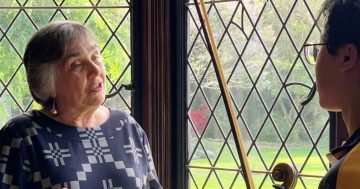
Wollongong Lord Mayor Tania Brown and newly elected Deputy Lord Mayor David Brown. Photo: Wollongong City Council.
David Brown is ready to step up as the Wollongong Lord Mayor’s right-hand man for the next 12 months as he returns for a third stint in the deputy role, bringing a wealth of experience and confusingly familiar surname to council’s leadership team.
Lord Mayor Tania Brown and now Deputy Lord Mayor David Brown have been clarifying their connection for many years.
“We do put on our election campaign materials in brackets ‘not related’,” David said.
“A number of people think she’s my sister or wife but neither of those are true.”
Now the pair are teaming up to take on Wollongong City Council’s top jobs after David was elected in the deputy position for the third time.
“I just wanted to play an extra role,” he said.
“I found I had a bit of extra spare time and it’s always good to be a backup to the Lord Mayor and help out where I can.”
In an official capacity, the deputy steps in at events or occasions when the Lord Mayor is unavailable – a responsibility which David said helps better connect with and understand the community they serve.
“It’s a great way to find out what’s going in the city which you may not otherwise find out,” he said.
“You hear what people think and ultimately people come up to you and perhaps they’ve got a problem with bureaucracy and you can help them solve problems.”
He will also take on some work behind the scenes like signing off on some documents and chairing council meetings when the Lord Mayor is absent.
But on an informal level, the position allows David to be a go-to for staff for advice or expertise if they need it, utilising his nearly two decades with the council where he has seen a number of challenges, controversies and changes.
He became a councillor at the end of 2002 during a byelection, after having watched the ins-and-outs of operations as a journalist and federal political staffer.
“It’s one of those things where you take an interest in your local community – it’s your hometown, you want to try and do your bit to try and improve the place,” David said.
“A million years ago I was a journalist covering it … I was part of a political party and had helped out with campaigns and been a watcher of council for a number of years before I got elected – so there was an opening there and I just thought I’d go at it.”
But it wasn’t all smooth sailing, with David forced to take a step back after the whole council was replaced with administrators after a corruption scandal involving other councillors derailed local government operations in the city.
Despite seeing controversies and challenges such as COVID, David said a constant task to overcome was managing the growing demand and expectations of the community with extremely limited resources.
“People assume because we have three levels of government, state, local and federal, they assume that we’ve roughly got equal powers and capacity, where the numbers are quite skewed,” he said.
“So sometimes people come up and say ‘fix xyz’ and it’s actually a state government or a federal government issue – sometimes they think you’re just trying to flick the pass but that’s the reality.
“Financial capacity is another one; local government really does struggle with sustainability.
“It’s always about how we manage the community expectations – the wants are infinite, the needs are limited – so we try to do what we can with the money we’ve got, try and invest the community’s money wisely and deliver those infrastructure projects and services that we sensibly can.”
He said over the years the fabric of the city had also changed, with more people coming to Wollongong rather than commuting to Sydney.
“I think that changes the culture of the city as well, because if people are spending lots of hours commuting, they can’t be out there coaching their kid’s footy team or frying the sausages at Bunnings and you do lose the chance to be part of the community,” he said.
And as expectations have changed, so has the way the community connects with their local representatives.
“This is going to sound like caveman stuff, but when I first got on council most people still wrote hard copy letters and maybe 10 per cent via emails,” David said.
“Now it’s 99 per cent by emails.
“What happens now is it’s very easy for a community group to decide to do an email campaign and you can get swamped with it.
“But that’s part of the process, you wade your way through it.”
However it’s that close connection and the ability to make change in his community that keeps David coming back to local government.
“In one sense you’re not a cog in a larger machine; you can materially fix somebody’s life,” he said.
“It might just be that they have a broken drain or want something in a park, and so you can see those little projects through to fruition which can be very rewarding when you’ve helped somebody solve a problem or you’ve delivered something that you can see there is a need in the community.”
David will hold the position of deputy for the next year and be on the council until at least 2028.
But with his vision of a community centre in the Wollongong CBD, and a potential museum, to delivering on footpath commitments and sports ground lighting, David could be around for a long time yet.
“I try to make a decision at the end of each term, but I’m still happy in the job, there’s still a lot of projects out there that I’d like to see through, so I’m not going anywhere any time soon.”