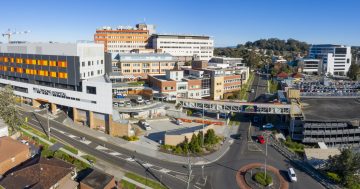
One in 10 attendees to Wollongong ED are spending more than 20 hours in the department. Photo: Keeli Dyson.
Many patients waiting to be admitted or transferred to another hospital from Wollongong’s ED have been stuck in the department for more than a day, with a new report revealing the areas of the system still struggling with ongoing demand.
Thousands of patients are spending more than 12 hours in Illawarra’s emergency departments according to new data by the Bureau of Health Information (BHI).
Attendances numbered 18,281 in Wollongong ED between October and December last year, and although 75 per cent started their treatment on time, around one in 10 ended up spending more than 20 hours in the department.
The people who spent the longest were those who needed to be treated and then admitted to hospital or transferred to another hospital, with only 14.3 per cent leaving the ED within six hours and a median time spent of 15 hours and 3 minutes.
The 90th percentile, which is about one in 10 of those attendances, was 30 hours and 32 minutes.
NSW Health Minister Ryan Park said flow-on effects from aged care patients were impacting progress across many areas.
“Our hospitals continue to show signs of progress and improvement in terms of ED and surgery wait times, which has coincided with our investments in more hospitals, more staff, and more pathways to care outside of the hospital,” Mr Park said.
“These improvements however are being offset by Commonwealth bed block – patients ready to be discharged but unable to leave because they are waiting for Commonwealth aged care or NDIS placements. They deserve better.”
Of Shellharbour Hospital’s 9633 ED attendances, the median time spent from arrival to leaving was 3 hours and 34 minutes, with 93.8 per cent of all attendances leaving within 12 hours.
The pressure on hospitals and staff can be seen across the local health district (LHD) by looking at data related to complex and urgent cases.
“The latest Bureau of Health Information (BHI) Healthcare Quarterly (October to December 2025) highlights the significant and sustained demand Illawarra Shoalhaven Local Health District (ISLHD) hospitals experienced during the last quarter of 2025,” ISLHD Executive Director Clinical Operations Margaret Martin said.
“The Healthcare Quarterly report shows that our EDs treated a greater number of patients presenting with more urgent and life-threatening conditions, with increases in resuscitation (triage category 1), emergency (triage category 2) and urgent (triage category 3) presentations compared to the same quarter the year before.
“Despite these pressures, our staff continued to work incredibly hard to provide safe, high-quality care to the community. We thank all our clinicians and support teams for their professionalism and commitment during what was a particularly busy quarter.”
The data also revealed positive progress on elective surgery, with 1676 procedures performed at Wollongong and 903 at Shellharbour.
At Wollongong, 89.5 per cent of elective procedures were performed on time, but at Shellharbour that number was just 70.5 per cent, which is the lowest in the LHD and 18 percentage points lower than the hospital’s peer group average.
However, in Shellharbour, 100 per cent of urgent procedures were performed on time, with 99.5 per cent of urgent procedures performed on time at Wollongong.
“The number of patients waiting longer than clinically recommended for planned surgery at the end of December 2025 was 219 people, a decrease of 384 patients compared to the end of December 2024,” Ms Martin said.
“ISLHD remains strongly focused on reducing wait times for planned surgery.”
Ms Martin said strategies included “innovative models of care supporting same-day discharge for clinically suitable procedures and patients; maximising theatre capacity, including resourcing an additional operating theatre at Shoalhaven Hospital; and where possible, scheduling additional ophthalmology sessions at Shellharbour Hospital; and ongoing partnerships with local private facilities to undertake targeted public planned surgery, focusing on those areas with the highest number of overdue patients.”
And while our local MPs recognise there’s more work to be done, they are dedicated to continuing to improve results and investing in the region.
“We have recruited more health professionals, including 30 FTE nurses in the Wollongong Hospital emergency department as the Minns Labor Government continues to deliver on its promise to deliver staffing reform,” Wollongong MP and Planning Minister Paul Scully said.
“We have also invested in Wollongong Hospital with initiatives like six new beds in the Emergency Short Stay Area which is helping improve service to patients and lower wait times.
“The government will continue to roll out further investments which will assist, like the completion of the Warrawong Community Health Centre build and the $220 million investment in the next upgrade of Wollongong Hospital.”