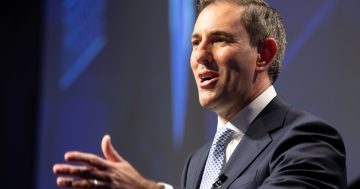
Reserve Bank of Australia Governor Michele Bullock says all RBA board meetings are ‘live’ and an interest rate hike this month can’t be ruled out. Pic: RBA.
A further interest rate hike remains a live prospect for mortgage holders this month when the Reserve Bank of Australia meets to decide the direction of the cash rate.
RBA Governor Michele Bullock has said is too early to tell how the fresh war in the Middle East will impact Australia’s economy.
Global oil prices have already spiked following missile strikes in and from Iran, hampering the movement of oil tankers in the region.
“The past few days have seen a significant escalation in conflict and instability in the Middle East, which is deeply concerning,” Ms Bullock told a business summit on Tuesday (3 March).
“The human cost is particularly regrettable, and we sincerely hope that conditions improve quickly for all civilians affected.
“These events are a timely reminder that in this world of geopolitical uncertainty, things can change quickly.
“It’s too early to say what the economic impact will be; events are moving rapidly, and there are different ways this can play out.”
The governor said the RBA board will take some time to make sense of what the conflict could mean for inflation in Australia.
Some economists have raised the alarm that petrol prices in Australia could rise by as much as 40 cents a litre as a result of the Middle East conflict.
Before the war in the Middle East began on the weekend, most had speculated that another interest rate rise was not likely until May. That would follow RBA deliberations on the March quarter data.
But if oil prices spike dramatically, all bets are off.
“A supply shock could, for example, add to inflation pressures. And the potential implications for inflation expectations are something we are very alert to,” Ms Bullock said.
“But at the same time, a prolonged impact on energy markets could have adverse effects on global economic activity and result in downward pressure on inflation.
“It is not obvious how this might play out.
“So as much as I know the public would like more certainty about the direction of interest rates, it would be wrong for us to pretend to have greater certainty than we do.”
But she said that did not mean the RBA board will collectively throw up its hands and say it’s all too hard.
Instead, views on the most likely central-case outcome for the major economic variables will be set out, and a range of scenarios explored, to understand how the economic outlook might change and how policy may need to respond in the circumstances.
If it becomes clear that the economy has evolved differently from the RBA’s earlier expectations and that the difference is likely to endure, then the central bank will adjust its policy stance.
That was the case in February when the RBA board decided to increase the cash rate target by 25 basis points to 3.85 per cent, the first interest rate rise in more than two years.
The board meets again on 16 and 17 March, and is not ruling out another interest rise, as “every meeting is live”.
“I’m often asked to give more guidance on the direction of monetary policy, and as you know, I’m reluctant to do that,” Ms Bullock said.
“This is because we set policy in an inherently uncertain environment, from unexpected developments here and overseas, as well as uncertainty around our own assessments, forecasts and models.
“That means judging a range of risks and how they might play out. Sometimes the answer is more obvious – when inflation climbed quickly after the pandemic and the cash rate was very low, interest rates clearly had to rise.
“But there are other times when the answer is much less clear.”
Original Article published by Chris Johnson on Region Canberra.