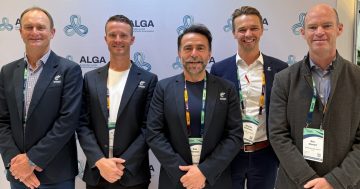
Yass Valley Council Mayor Jasmin Jones, Deputy Mayor Myra Murrihy of Moyne Shire Council with fellow councillors at the Australian Local Government Association National General Assembly in Canberra. Photo: Yass Valley Council.
Before another scorching summer arrives, local councils across Australia are urging the federal government to dive into what they describe as a looming infrastructure crisis — the ageing of the nation’s public swimming pools.
Regional councils are calling for a dedicated National Pool Fund, arguing they cannot afford the billions of dollars needed to repair or replace community pools, many of which were built in the 1950s and 1960s and are now reaching the end of their lifespan.
The push gained national backing after a motion led by Yass Valley Council Mayor Jasmin Jones was carried at the Australian Local Government Association’s (ALGA) National General Assembly in Canberra.
The proposal will now form part of the ALGA’s advocacy agenda, making it one of the key issues the peak body will take to the Federal Government.
Supported by Newcastle City Council in NSW and Bass Coast, Campaspe and Moyne Shire councils in Victoria, the motion calls on the Commonwealth to establish a long-term funding program to modernise ageing public swimming facilities.
Councils are looking at around $8 billion to upgrade existing pools.
“About 64 per cent of that annual investment would fall on the local government, but we simply can’t do it alone,” Cr Jones told Region.
She argues that replacing a standard Olympic-sized public pool now costs at least $10 million, putting many projects well beyond the financial reach of regional councils.
The concerns extend beyond Yass.
Wollongong Lord Mayor Tania Brown said her council was equally concerned.
“We know our community is passionate about our city’s eight pools and nine rock pools,” she said.
“Right now, we’ve winter works scheduled at a number of our facilities to ensure they’re in top-top shape for summer.“We are always appreciative of any grant funding support provided by the Australian Government which assists council to deliver and maintain the facilities our community value.’’
A Kiama Municipal Council spokesperson said it was also supporting the Australian Local Government Association’s call for the Federal Government to create a National Pool Fund.
“Public pools are an important community asset and we would welcome a nationwide approach to provide sustainable funding.
“Accessible swimming facilities are essential so that people, particularly children, can learn to swim. Anything that can be done to reduce drowning fatalities is a worthwhile investment.
‘At Kiama Council, we operate pools at the Kiama Leisure Centre and Jamberoo which both need significant investment. We have developed a masterplan for the Kiama Sporting Complex, which includes replacing the Leisure Centre with new aquatic facilities, and if Kiama Council was able to access funding from a National Pool Fund, it could help make that vision a reality.”
Cr Jones said the issue went well beyond ageing infrastructure.
“In a country where one in two children can’t swim the length of a pool by the time they finish primary school, we can’t afford to have public pools ageing out and shutting down,” she said.
She also pointed to Australia’s changing demographics, saying migration had increased the need for accessible swimming facilities.
“We’ve got a lot of migration, with children arriving in Australia who haven’t had the opportunity to learn to swim, and often parents who haven’t learnt either. At the same time, our drowning rates are going up while investment in public pools is going down.”
The National Drowning Report 2025 recorded 357 drowning deaths over the past year — 27 per cent above the 10-year average. The report also found people living in regional and remote Australia experience drowning rates almost three times higher than those living in major cities.
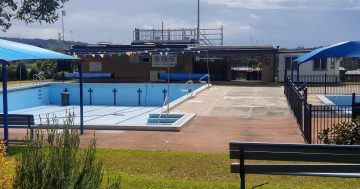
Yass Memorial Pool tells the broader story.
Built in 1965 for £62,000, including a government grant of £10,000, the pool opened before a crowd of about 4000 people and was celebrated as a community asset that would serve generations.
Sixty years later, keeping it operational has become a multi-million-dollar challenge.
Rather than replacing the facility entirely, Yass Council hopes to restore the Olympic pool while gradually transforming the site into a heated aquatic centre that can operate well beyond the current three-month swimming season.
The Yass Swimming Club has already secured grants for a heat pump system and solar panels, while the council has funded repairs to stop persistent leaks.
But completing the long-term vision will require significantly more investment.
“Heated pools mean children can learn to swim year-round, not just during a short summer season,” Ms Jones said.
“They’re also important for rehabilitation after surgery, low-impact exercise, disability access and community health.”
The role of community pools has also expanded as heatwaves become more frequent.
During this year’s extreme heat, Yass Council opened the pool free of charge for eight consecutive days.
Ms Jones said the decision was about more than helping residents cool down.
“It kept kids out of dams, rivers and unsafe swimming environments, and made the pool accessible to everyone, regardless of their circumstances,” she said.
Original Article published by Naziya Alvi Rahman on Region Canberra.