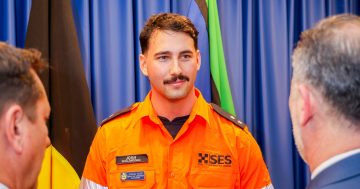
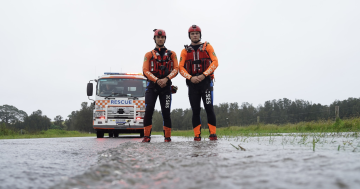
NSW SES volunteers taking part in a night-time flood rescue exercise on the Shoalhaven River. Photo: NSW SES.
Flood rescues can be challenging at any time, but when it’s dark and people are missing it’s even more fraught.
To test their night-time flood rescue skills, NSW State Emergency Service (SES) volunteers from Kiama, Shellharbour and Nowra came together in a large-scale exercise near the Shoalhaven River on Saturday (8 August).
Southern Illawarra local commander John Wall said training at night helped recreate the challenging conditions volunteers could face during a real emergency.
“With many flood rescues occurring at night, the exercise focused on operating in low-light conditions and gave crews the chance to practise navigating, communicating and carrying out rescues after dark,” he said.
“This exercise gave our crews a realistic scenario where they had to work together, search from vessels, locate people in the water and safely bring them on board.
“They also practised providing first aid, assessing the needs of casualties and safely transporting them for handover to a simulated ambulance crew.”
The volunteers were split into two teams during Operation MoPoke, with multiple flood rescue vessels launched from opposite ends of Broughton Creek to undertake an on-water search as daylight faded.
Crews responded to a simulated scenario where six people had been swept into the creek following intense rainfall, giving volunteers the opportunity to practise the skills they would use during a real flood rescue.
The NSW SES has responded to 138 flood rescues across the state so far this year.
SES South Eastern deputy zone commander Sharon Fox said exercises such as MoPoke were an important part of keeping volunteers prepared for emergencies.
“Our volunteers respond in all conditions and at all hours, and many flood rescues happen at night when visibility is limited and the environment can be more difficult to navigate,” she said.
“Training after dark gives our crews the opportunity to practise working with limited visibility, coordinating multiple vessels and making decisions under pressure in a controlled environment.
“Bringing volunteers from Nowra, Kiama and Shellharbour together also strengthens the teamwork and coordination we rely on when responding to larger flood operations.”