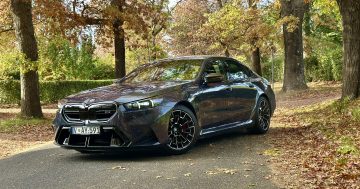
Mazda has NVES liabilities of $25 million. Photo: James Coleman.
Six months into Australia’s new vehicle emissions laws and the scorecard is in.
Some of the country’s biggest brands are staring at multi-million-dollar penalties, while others have banked hundreds of millions of dollars’ worth of credits they can sell to rivals.
Mazda leads the list of brands in the red, with more than $25 million in liabilities. On the other side of the ledger, Chinese EV giant BYD has racked up more than $314 million in credits.
Industry experts say the early results from the Australian Government’s New Vehicle Efficiency Standard (NVES) show the industry has, overall, met its first-year targets.
But the scheme tightens sharply from here – and the fight over what it means for car prices is only just beginning.
Remind me: What is the NVES and how does it work?
The New Vehicle Efficiency Standard began on 1 January 2025, with compliance measured from 1 July.
It sets an average CO2 limit across each car maker’s fleet. If a brand’s vehicles exceed that limit, it incurs a $50 penalty for every gram per kilometre over the target, per vehicle. Companies can either pay the penalty or buy credits from cleaner rivals.
The first six months have been described as the “easiest” year of the scheme, but CO2 targets will continue to drop each year until 2029.
The peak body for car importers, the Federal Chamber of Automotive Industries (FCAI), says the combined industry has met the 2025 target – but “significant challenges lie ahead”.
“An increase in the range of zero and low emission vehicles available in the Australian market have supported the achievement of the first-year targets,” chief executive Tony Weber said.
More than 100 EV models are now on sale, but demand remains modest.
“However, despite this increase in supply, EVs represented just 8.3 per cent of new vehicle sales in 2025, which was only a 1.1 percentage point increase on 2023. Sustaining compliance as targets tighten will require materially stronger uptake of EVs than current market trends indicate.”
In 2025, passenger cars and SUVs had to beat an emission limit of 141 g/km of CO2, while utes, vans, and large off-road SUVs had to come under 210 g/km.
These targets fall another 17 per cent in 2026 and, by 2029, will be 59 per cent lower than in 2025.
The fines and the credits
About a third of brands are already in negative territory.
Mazda has accrued $25,425,850 in liabilities in the first six months – an average of $661 per vehicle. Nissan sits at $10.8 million, Subaru at $7 million and Hyundai at $4.2 million.
General Motors’ local arm (GMSV), Porsche, Mahindra, Honda, KGM (SsangYong) and LDV are also in the red by over $1 million.

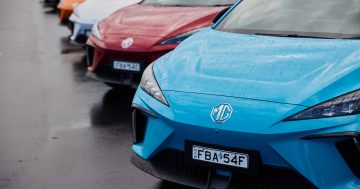
BYD is raking in the credits under the NVES scheme. Photo: James Coleman.
If penalties are not settled within two years – either by the brands selling more efficient vehicles or buying credits from other brands – the rate doubles to $100 per gram per kilometre. By 2029, for instance, Mazda could rack up a bill of nearly $51 million.
On the other side of the ledger, EV-heavy brands are flush.
BYD (including its Denza brand) has generated credits worth $314,141,200 at the base rate – enough to cover the total liabilities of all manufacturers in the red several times over.
Toyota has banked $144,531,250, and Tesla $110,604,650. Kia, Geely, Volkswagen, Chery, Ford, Great Wall Motor and Isuzu have also generated significant credits.
The government does not pay companies for beating the target, but the dollar figures do reflect the value of penalties those credits can offset or be traded for.
Transport Minister Catherine King said the results “make it clear the NVES supports both lower emissions and consumer affordability”.
“These first NVES results show that cleaner vehicles and a competitive market can go hand in hand,” she said.
What happens next – and will prices rise?
So far, there has been no widespread “price shock”.
Industry analyst Matt Hobbs told the ABC the first six months have been a “soft start”.
“But because of the way it was designed, we still haven’t seen a price shock,” he said.
“But by the time you get to 2028 and 2029, those targets are hard to hit.”
Federal opposition leaders have dubbed NVES a “tax on families” and “ute tax”, and suggested it could increase the cost of popular utes and SUVs in coming years. To some extent, it looks like they’ll be right. Many brands have already begun to lift prices or trim high-emission variants.

The Ford Mustang is Australia’s best-selling sports car – but for how much longer? Photo: James Coleman.
The 2025/26 Ford Mustang line-up, for example, has risen by about $5000. Ford and Isuzu have dropped the cheapest versions of their Everest and MU-X SUVs. Kia has axed its Sorento and Carnival V6 petrol models. And Hyundai’s chief operating officer Gavin Donaldson has said, “the NVES will see some of our prices of cars going up”. By 2029, even today’s Toyota RAV4 Hybrid will be in the red.
FCAI chief Tony Weber also warned: “The rate of improvement required to avoid NVES penalties presents a substantial challenge, and any additional costs generated by the NVES will likely be passed on to new car buyers.”
The key question lies in EV demand. And the figures are not looking good at the moment.
“The key to long-term success of the NVES relies on increased demand for EVs and low-emission vehicles,” Mr Weber added.
“At the moment, demand for EVs remains subdued, and this is a major concern and disappointment for car makers.”
Original Article published by James Coleman on Region Canberra.