Lawrence Hargrave (left) and his father Judge John Fletcher Hargrave. Photo: Wikipedia.
John Fletcher Hargrave was born in 1815. His father, Joshua Hargrave, was in trade as an ironmonger in England.
Nonetheless, young John was schooled privately and finished his studies at Trinity College Cambridge gaining an MA by 1840.
In 1843 he married his cousin Ann Hargrave and the couple produced seven children in 10 years, with some dying tragically young.
Called to the Bar in 1841, John’s distress was already evident during his editing from 1841-1844 of a multi-volume edition of Blackstone’s Commentaries on the Laws of England. He continued to practice law for 10 years, but seems to have become increasingly unstable.
Although apparently deeply depressed by 1851, a timely inheritance from his father meant he could retire from the bar and try his hand at investing.
Unfortunately, he appears to have been less than spectacularly good with his money.
By 1854 his wife Ann had him committed to the sprawling Colney Hatch Lunatic Asylum thus leaving herself with four children to provide for. Perhaps she was unable to afford a private asylum – but for the rest of his life the future Judge Hargrave never forgave her.
When finally released, John left for Australia and arrived in February 1857 with his brother and eldest son but without his wife and other children.
With his father apparently having little interest in seeing his wife ever again, young Lawrence Hargrave and other siblings were left with their mother in a small cottage at Keston in Kent, an area steeped in Roman archaeological history.
Shipped off to boarding school, Lawrence proved less than academic but took much more interest in the archaeology and natural world of the surrounding area.
In Australia the unstable John Hargrave rocketed to the top and within three weeks of arrival was admitted to the NSW Bar. He resigned in February 1859 to become NSW Solicitor-General and soon represented, in turn, East Camden and the Illawarra in the Legislative Assembly.

Judge Hargrave’s lovely shack in Paterson Road Coalcliff (before the white ants ate it and before Paterson Road). Photo from a Kerry & Co glass negative. Photo: Supplied.
But during the Lambing Flat anti-Chinese riots he recklessly suggested the use of martial law – leading to accusations of both ignorance and incompetence. Nonetheless he still gained a place on the Supreme Court bench in 1865.
Judge Hargrave was not much liked by his legal colleagues, some of whom remarked on his “surprising instances of official imbecility”. His colleagues even boycotted his swearing in.
Yet, given his estranged marital arrangements, it was probably fitting that in 1873 he was appointed the first divorce judge in NSW but even in this he caused controversy and was considered by many to be misogynistic.
Having also offended some of his colleagues’ wives, it has been suggested he hated all women. Yet he does seem to have liked (or at least tolerated) his daughter Alice when she eventually came to Australia and also Margaret, the woman his son Lawrence married.
After the 15-year-old Lawrence Hargrave was brought to Sydney in 1865, he too proved somewhat erratic and failed to matriculate to Sydney University.
Lawrence then began an apprenticeship as an engineer. Oddly his father consented to allowing him to go on a ship to the Gulf of Carpentaria.
An as an engineer or researcher he eventually went on six expeditions to New Guinea – one of which in 1872 was aboard a leaky boat that sank, drowning 35.
In 1875 Lawrence joined William Macleay’s Chevert expedition, leaving after six months to explore with Octavius Stone in the area around Port Moresby.
In 1876 he sailed with Luigi D’Albertis to chart the Fly River but criticised D’Albertis’ navigation skills and also condemned D’Albertis’ looting of sacred native objects.
Funded by Dad, Lawrence had the leisure to come up with various inventions. Some proved pretty nutty – such as boat-shaped shoes to enable him to walk on water.
Dad had also purchased some 161 ha (400 acres) of very isolated land near Stanwell Park and built a lovely shack at Coalcliff.
Gaining appointment to the Sydney Observatory in 1878 for £200 per annum, in 1882 Lawrence later travelled to Mount Dromedary (near Narooma) to observe the transit of Venus but later decamped to the property his father gifted him at Stanwell Park.

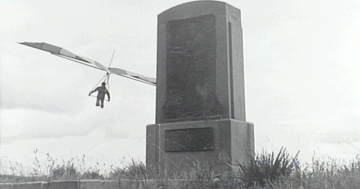
Lawrence Hargrave (seated) and James Swain with their box kites behind Stanwell Park Beach in November 1894. A staged photo by Charles Bayliss held by the NSW State Library. Photo: Supplied.
There, with James Swaine, Lawrence’s box kites lifted him into the air.
Failing to patent his design, these were snapped up in America. Although then more acknowledged abroad than in Australia, even the famous Alexander Graham Bell, in a lecture in 1910, praised Lawrence’s pioneering aeronautical work.
But the eccentric side of Lawrence Hargrave again surfaced when his interest in archaeology was reignited by the rock carvings he saw at Bondi. These he argued were the work of Spanish sailors from Lope de Vega’s 1595 expedition.
Archaeologists dismissed Hargrave’s theory and he was considered in his final years pretty much as a crank.
His only son, Geoffrey, died at Gallipoli in May 1915 and Lawrence himself died two months later.
Prior to the war with Germany, Hargrave had been criticised for allowing the Deutsche Museum in Munich to buy his kite models rather than keeping them in Australia.
Perhaps that’s one of the reasons the new Sydney Airport at Badgery’s Creek carries the name of Nancy Bird Walton rather than that of Lawrence Hargrave.
Ironically, the vast majority of Hargrave’s kite models were destroyed in aerial bombings during World War II.
Some say, however, that if Lawrence Hargrave had ever met the Wright Brothers they would have said, “Thanks for the lift, mate!”