A 1925 caricature of NSW Premier Sir George Fuller by Len Reynolds. Image: Supplied.
Even though my father left school at 13 he apparently endured sufficient rote-learning to be able to regularly come up with the quote from Shakespeare’s Julius Caesar, in which Antony famously says, “The evil that men do lives after them; The good is oft interred with their bones”.
Consequentially, he insisted I not organise a funeral for him – presumably because he thought people might say bad things.
Yet over the years I’ve found nearly all the obituaries of the good and the great in the Illawarra appear to have been written by people who in contrast, followed the Latin “de mortuis nil nisi bonum” meaning “of the dead, [say] nothing but good”.
So the more fulsome the praise, my tendency has often been to dig deeper and try to more accurately assess just how good some people may reputedly have been.
As an example I’ve long been puzzled by how the Fuller family of Dunmore could have done so well financially and politically after such a disastrous start on their voyage to Australia.
After being born in Dunmore in County Galway, seven-year-old George Laurence Fuller left Ireland on board the ship North Britain in November 1839 with his parents, William and Ann and six siblings.
By December George’s father was dead and so was his new baby brother born later during the voyage.
Things didn’t get better, for on arrival the ship and its passengers were quarantined for 41 days as a “raging typhus” was aboard.
While marooned in quarantine George’s two-year-old sister, Charlotte, also died.
Without a husband and any obvious means of support, George’s mother, after release from quarantine had the older boys sent to the Male Orphan School at Liverpool, while the girls, Sarah and Annie, went to the Female Orphan School at Parramatta. The eldest daughter, Elizabeth, aged 15, was assigned as a nursemaid in Windsor.
The standard story is that by “March 1840, Anne relocated alone to Wollongong, establishing a bakery and shop on the corner of Corrimal and Market streets”.
But how could this have been possible? And how could later her son – George Laurence Fuller – become fabulously rich and one of her grandsons, George Warburton Fuller, rise to become Premier of NSW?

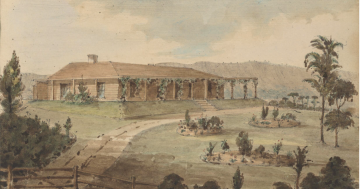
Dunmore House in the 1920s. Photo: Supplied.
Well, young George left the orphanage and helped his mother set up a shop in Wollongong. And, aged 22, George took a cargo of goods to the Victorian goldfields for sale, made a big profit and was soon on his way to success.
But the puzzle remained as to how Mrs Fuller and son could so quickly rise from desperation to, after a stint at Gerringong, purchase Kiama’s Victoria Stores in 1859 and expand it into the district’s largest general store. Then in 1868 they became property developers, purchasing 2560 acres (1035 ha) along the Minnamurra River naming it Dunmore after their Irish home town.
Moreover, by 1880 their land holdings had expanded to approximately 9000 acres (3642 ha) stretching from Lake Illawarra to the Minnamurra River.
So the obvious question was, who was the fairy godmother or godfather who first enabled a desperate Ann Fuller to get a start as a businesswoman in Wollongong?
And then to also make it possible for her son to become a land magnate and her grandson who, after a career as a barrister, became a successful politician during the reign of the egregious Holman Government and was in charge of putting down the Great Strike of 1917 with a vengeance.
It remained a puzzle until, finally, I learned Sir Maurice Charles Philip O’Connell – born in Ireland and who became Lieutenant-Governor of NSW – just so happened to be a cousin of Mrs Ann Fuller.
So it wasn’t just enterprise and hard work but also assistance from someone in high places that helped Ann get a shop in Wollongong that initially bankrolled the Fullers’ extraordinary rise.
Unfortunately, this wonderful bit of luck does not appear to have made the Fullers generous to others.
Ann’s son funded a rival Kiama newspaper and tried to bankrupt the Weston family in a defamation case the NSW Chief Justice declared should never have been brought to court.
In 1917 her grandson deprived strikers of seniority and rewarded scabs with promotions, thus causing lasting bitterness among those who claimed he acted vindictively, hypocritically and illegally against workers defending defend their rights.
Incredibly, the Fuller family’s influence was apparently so locally powerful that the 1891 Minnamurra Railway Station was originally located pretty much for the convenience of the Fuller family.
And it took until the 1940s for the station to be moved in order to service the considerably larger population living on the southern side of the Minnamurra river.
Even the name Dunmore annoys me a bit. For, as a trained grammar Nazi (but one who now insists on breaking all the ridiculous rules once one has thoroughly learned them) I’ve always felt the tiny locality near Minnamurra that was once home to the Fuller family’s Dunmore should have been called “Did More” instead.