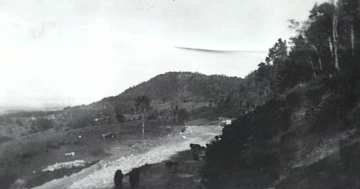
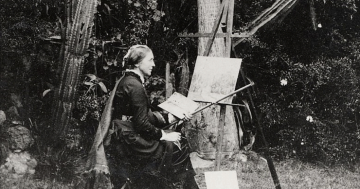
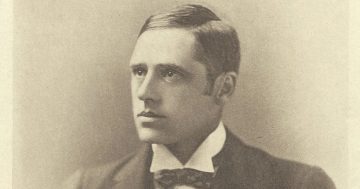
If Wollongong had been more progressive back in the 1850s, it could be the home of the tail-less kangaroo statue commissioned by Henry Gilbert Smith in Manly, after he gave up on promoting Wollongong’s charms. Photo: Supplied.
Common surnames have long intrigued me, as have those that once indicated an occupation.
Building wagons once needed both a Wheelwright and a Wainwright. So please don’t get me started rabbiting-on about Cartwrights or Playwrights or the today much lesser known Arkwrights.
In Australia the surname Smith, of course, wins hands down and survives in heaps of occupations – blacksmiths, goldsmiths, silversmiths, coppersmiths, tinsmiths, gunsmiths, locksmiths – and even in songwriters hoping to become tunesmiths. And any journo worth their salt could hardly ever complain about being tagged a wordsmith.
But there are traps for young historians when it comes to Smiths in Wollongong – especially when asking, “mirror, mirror on the wall, who is the most important early Smith of all?”
Those who’ve read their history books 10 times through would probably say it was Charley – more formally known as Charles Throsby Smith (supposedly dubbed “The Father of Wollongong”).
However, Charley is often mistaken these days for his uncle Dr Charles Throsby of Glenfield, who was pipped at the post by David Batty and the future famous explorer William Hovell (still then a
nobody) who both became the first documented Europeans to walk into the Illawarra from Sydney guided by Aboriginal people in February 1815.
But that’s only because few people have ever heard of Henry Gilbert Smith and his Illawarra land holdings, which eventually doubled that of Charley Smith’s original 300 acre (121 ha) Wollongong grant.
Better still, Henry Gilbert Smith got hold of the best bit of central Wollongong – an area of nearly 4 acres (1.6 ha) complete with a residence on land which today comprises most of Lang Park at South beach and later included most of today’s Robertson, Hinton and Hector Streets.

Henry Gilbert Smith bought up prime Wollongong land including the area now known as Lang Park. Photo: Region Illawarra.
And without a doubt, it’s Henry Gilbert Smith rather than old mate Charley who deserves to be canonised as the Patron Saint of Destination Wollongong.
For, unlike Charley, Henry Gilbert Smith understood the area’s tourist potential. And he did so even long before he much more successfully did the same for Manly NSW – a place that primarily
because of Henry will always be “seven miles from Sydney and seven miles from care”.
As early as 17 February 1835, Henry Gilbert Smith wrote the following to his mum in England: “Have just returned from a little pleasure trip which I have been enjoying at Illawarra with my friends the Reverend Wilkinson and his good lady … Their house is placed close to the seashore … on a beautiful sandy beach … along it I used to ride every day … I went there for the benefit of my health.”
So impressed was Smith by his brief Wollongong sojourn that on 23 March 1836, he wrote again to his mum that he had “bought such a nice house in a little town or village called Wollongong with 4 acres situated on the seaside”.
What Smith had done was bought the Reverend Frederick Wilkinson’s former house located opposite the beach-end of today’s Smith Street Wollongong which, ironically, is named after Charley Smith rather than Henry Gilbert.
But soon after buying the beachfront Wollongong house, Smith went back to England, only returning in 1844.
However this was lucky as, because of the massive economic depression of the 1840s, on his return he was able to buy up heaps of extra land at bargain prices.

Detail from a map showing just some of the many Wollongong real estate holdings of Henry Gilbert Smith. Image: National Library of Australia.
By the mid-1850s Smith owned nearly 600 (242 ha) Illawarra acres. And at the time of his death in 1886 he still owned 75 town allotments in Wollongong.
Smith came to live in Wollongong in 1852 after investing in a paddle steamer named Keera as part of a scheme to make Wollongong the Brighton of NSW and its finest seaside destination.
Disillusioned at Wollongong’s then still halting growth, Henry instead turned his attention (highly successfully) to doing the same for Manly in Sydney where he remains celebrated to this day.
Moreover, H G Smith’s commissioned much-loved kangaroo statue still stands.
Yet in Wollongong our first tourism promoter is mostly forgotten – that is if anyone remembers him at all. But perhaps he wouldn’t be if back then had the foresight to stick a cabbage tree up a pole.
Early Wollongong got it wrong and Manly got it right in the 19th century and so Henry has lucked-out in the memory stakes.
Yet, being cursed with a fairly boring surname meaning “Son of David” myself when I’m actually not, I also feel some sympathy for those with the surname “Wright” who wrongly end up falling in
love with Mr or Miss Wrong.
Similarly, like Australian cricket captain Steve Smith who famously “got it wrong” during his 2018 ball-tampering scandal, in my view Henry Gilbert Smith got it wrong in running with Manly rather than Wollongong.
But ’tis an ill wind that blows no good. And, actually, The Gong may have missed a bullet in Henry doing so.