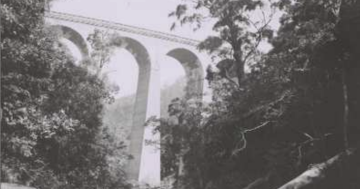
Lilyvale station before its demise. Photo: Supplied.
One of the things that has played the biggest part in making the Illawarra such a lovely place to live is that in 1879, a giant green wall of nearly 15,000 ha created a wondrous breathing space between southern Sydney and the most northern reaches of Wollongong.
As a consequence, one of my favourite things used to be the train ride to Sydney – and it still almost is. That is, as long as you get the chance to take it on an uncrowded day and you are not one of those who need to do a relentless five-day a week commute to the big smoke in order to earn a living.
That giant National Park and train ride was my first experience of what wilderness might have once looked like.
As a teenager, I remember one all-stops late night train trip home from Sydney when the train strangely pulled up in the middle of what looked like nowhere.
A single dim light revealed an almost non-existent platform and a dilapidated sign that read Lilyvale. And there a lone figure got off and walked straight up into what looked like endless scary leafy darkness. I was puzzled as to where on earth he could be going.
Even though trains today no longer stop at Lilyvale, in my view the best thing that ever happened to the Illawarra was the creation of the first reserve in the world explicitly dedicated with the actual phrasing “for the purpose of a national park”.
Supinely, in 1955 it was renamed from The National Park to the Royal National Park following Queen Elizabeth II’s 1954 visit by train to Slacky Flat at Bulli.
But best of all for me, particularly now that I’m no longer up to the challenging coastal walk from Bundeena to Bulli, I am still grateful that just 10 years after our National Park was first gazetted, the government, despite the difficulties involved, completed a rail line through the forest so people in the Illawarra could get the last train home after a big night in Sydney.
Yet, of course, it was cheaper for governments to do such things back then.

A map showing the Illawarra rail line and the National Park, as it was then known. Photo: Supplied.
Apart from the geotechnical difficulties and cost of forging a rail line to the Illawarra, another problem was purchasing land from those who held leaseholds over some of the 15,000 ha.
Hilariously, one of the few people who held a current licence to cut timbers declared he was only willing to stop doing so at double the fee he had paid.
Fortunately, the government still employed some savvy public servants (rather than private contractors) and one discovered the lessee had forgotten to renew his licence. So problem instantly solved.
The other advantage for the government was that in 1879, Sydney had not begun its vast urban sprawl and the land regarded as desirable for acquisition was not considered of much value except for its timber – and even not much for that.
Yet today when the Australian Conservation Foundation estimates that our continent has lost nearly 66 per cent of its original forest cover, those 15,000 ha of untouched or reconstituted rainforest, eucalypt, rugged coastline and swamps are surely a billion times more valuable than they were in 1879.
The Royal National Park hopefully now forever saves Wollongong from becoming some horrendous giant conurbation stretching uninterrupted between Sydney and Windang.

The loopy route of the rail line to Wollongong. Image: Supplied.
What’s more, the National Park also proved educative. In 1921 an ornithologist made a series of visits to the park observing nests of the satin bower bird and learned that it favoured blossoms of dianella and dampiera flowers, in each case “presenting shades of blue”.
He also found that “next to blue, green seems the most appreciated colour” and that “the puff-balls used as part of the adornment of the bower are olive green and the flowers of the billardiera yellowish green”.
For students of indigenous history, the middens and relics of the park could tell of the long history of Aboriginal habitation.
In 1898, however, the one permanent settlement remaining within the proposed boundaries of the National was offered to the Park Trust. Yet, at the end of the severe economic depression of the 1890s, the Trust claimed it couldn’t afford the price, so the enclave of Bundeena has remained residential land.
Nonetheless, two very famous writers have also been excited by bits of the train ride to Sydney through northern Illawarra and on into the park.
D H Lawrence waxed lyrical about the flowering of the Gymea lilies he saw from the train windows in the early spring of 1922.
In the 1892 novel The Wrecker by Robert Louis Stevenson and his stepson Lloyd Osbourne, there is description of the rail line falling into the sea at Clifton that the stepson actually witnessed: “For weeks the rain scarce relented. The whole front of the mountain slipped seaward from above, avalanches of clay, rock and uprooted forest spewed over the cliffs and fell upon the beach or in the breakers.”
Sometimes the truth is stranger than than the fiction.